
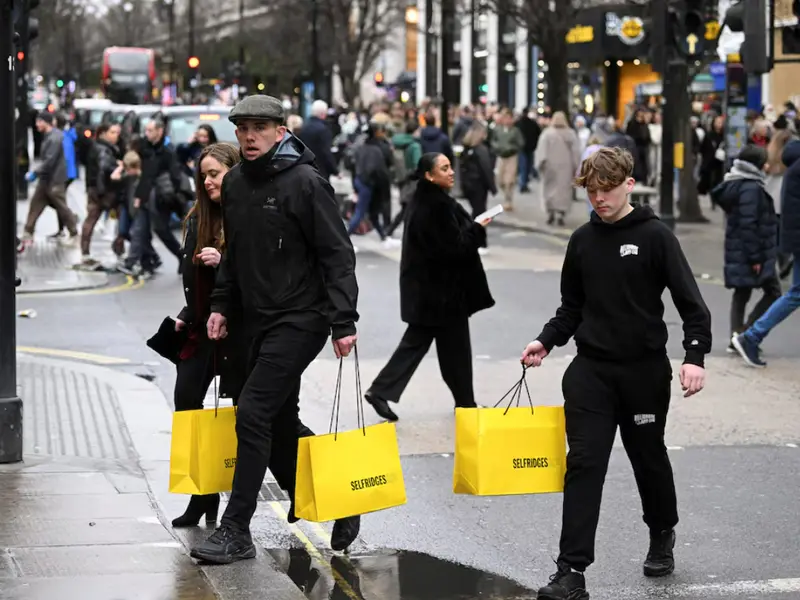
Britain’s inflation rate unexpectedly surged in April, rising to 3.5 per cent from 2.6 per cent in March, according to the Office for National Statistics (ONS). This marks the highest level since January 2024 and represents the sharpest monthly rise since 2022, when prices were spiralling above 10 per cent.
A sharp spike in airfares during the Easter holidays was a key contributor, with ticket prices rising by 27.5 per cent from March, the second-largest monthly jump on record.
The timing of Easter, which fell in April this year, intensified seasonal travel demand, amplifying the price surge.

As per Reuters, economists had expected consumer price inflation to rise to 3.3 per cent, while the Bank of England (BoE) forecast 3.4 per cent. The stronger-than-expected figure complicates the central bank’s efforts to gradually bring inflation under control.
Services inflation surges, rattling BoE
More concerning for policymakers is the jump in services inflation, a key indicator of domestic price pressures.
Trending Stories
)
Trump-Xi Summit: Trade, Taiwan and the red lines shaping US-China talks | Race To Power
)
US citizen injured in Illinois after ICE agents mistook him for fugitive, hospitalised
)
US judge questions Trump’s decision to ban CNN, MS NOW and Politico from White House
)
Afghan woman cyclist who disguised herself as a boy to escape Taliban, wins Asian Games medal
)
Italy hit by floods in the north, drought in the south
)
'There will be elections': Venezuela's interim leader Delcy Rodriguez makes big announcement at UN
)
Would you date an AI? South Korea’s My AI Partner: Strange Love sparks buzz on relationship and intimacy
)
'Arrogant parasites': Milei blasts UN over Falklands dispute, warns Argentina will ‘take matters into our own hands’
)
IIT Bombay CCTV footage emerges: Sahil Wakode seen looking at phone in examination hall
)
Cyclone Arnab: Landfall expected before midnight tomorrow as IMD issues orange alerts across six states
)
9 killed, several injured as tourist bus catches fire on Yamuna Expressway
)
NBA player Steven Adams shares hilarious GTA VI theory
)
WION Iconic Tourism Summit 2026: Union Minister Shekhawat on 'experiential travel', peace diplomacy
)
'AI got into my speech': Prince Harry jokes after teleprompter failure at event in New York
)
Scientists detect first radio signals directly from faraway planet
)
China to test supersonic jet that moves at Mach 2, double the speed of sound
)
WION Iconic Tourism Summit: 'Hanuman Ansh' Director on blockbuster success
)
'Partners rather than rivals': Xi Jinping's first message after landing in US for Trump summit
)
WION Iconic Tourism Summit: Is India's travel boom outrunning its airports, airlines and hotels?
)
IIT Bombay student suicide case: CCTV from the exam hall hours before suicide
)
2,000-foot tube, laser tests and more: China builds towns to expand nuclear arsenal, satellite images show
)
French court upholds decision to send PSG and Morocco footballer Hakimi to rape trial
)
WION Iconic Tourism Summit and Awards 2026: Key voices to discuss India’s tourism future
&im=FitAndFill=(700,400))
New OTT releases this week (September 21-27, 2026): Shaque: Trust No One, Hunkkaar, Don’t Be Shy- 5 new titles coming to Netflix, Prime Video and more
)
WATCH | China President Xi Jinping lands in US as Trump greets him ahead of high-stakes summit
)
Australian PM Anthony Albanese calls OpenAI AI incident 'unacceptable' after restricted data access
)
Claude Opus 5.5 is here: Anthropic claims it can finish a 680,000-line code migration in less than a day
)
'What kind of confession is this?': Pakistan PM Shehbaz Sharif’s 'terrorists would be roaming New York' remark goes viral, raises alarm online. Watch
)
WION Iconic Tourism Summit: How local tourism MSMEs must upskill for AI integration
)
Eight USS Abraham Lincoln sailors attempted suicide, Acting Navy Secretary says
)
Trump’s Board of Peace unveils $2.45bn Gaza plan,66 projects: But where’s the money?
)
EC appointment law: Why is the 2023 act controversial, and what happens next? WION explains
)
'Putin is patient zero': Zelensky slams Russian president at UNGA, accuses him of using fighters from 47 countries
&im=FitAndFill=(700,400))
National Film Awards 2026: Kartik Aaryan, Mammootty, Yami Gautam, Randeep Hooda and other key winners
)
El Niño 2026 heats up to become strongest in 1,000 years
)
Israeli envoy to US Yechiel Leiter’s son critically injured in West Bank ramming attack
&im=FitAndFill=(700,400))
Trump welcomes Xi Jinping in rare airport gesture: Photos from Chinese President's arrival in US
)
Xi-Trump meeting: China’s human rights red line and past protests explained
According to the ONS, services prices rose by 5.4 per cent year-on-year, outpacing both the BoE’s forecast of 5.0 per cent and the Reuters consensus of 4.8 per cent.
On a monthly basis, services inflation rose 2.2 per cent, the highest single month increase in over three decades.
This suggests that inflationary momentum remains embedded in the economy, especially in sectors like hospitality, transport, and insurance.
The data comes amid warnings that persistent wage pressures and strong consumer demand could delay further interest rate cuts.
Government reaction and policy outlook
Finance Minister Rachel Reevescalled the inflation figures “disappointing,” telling Reuters. “We are a long way from the double-digit inflation we saw under the previous administration, but I’m determined that we go further and faster to put more money in people’s pockets” as qoutes by Reuters.
Following the data release, investors slashed the odds of a BoE rate cut in August to 40 per cent, down from 60 per cent. According to Reuters, only 35 basis points of cuts are now expected by the end of 2025.
Patrick O’Donnell, Senior Investment Strategist at Omnis Investments, told Reuters, that “This data should call into question whether there is a cut… in August.”
BoE Chief Economist Huw Pill also expressed caution and told Reuters that the pace of rate cuts may have been too quick in light of still-strong wage growth and inflationary stickiness. He voted to hold rates steady earlier this month and described the move as a “skip,” not a stop.
Trade tensions escalate
The inflation surge coincides with rising global trade tensions, placing the UK in a delicate position between major partners.
US President Donald Trump, now in his second term, reintroduced 25 per cent tariffs on UK steel and aluminium exports in March 2025 — reversing earlier exemptions and reigniting trade war anxieties.
In response, UK-US negotiations were fast-tracked. By 8 May 2025, according to Reuters, the two sides struck a provisional deal: the US agreed to remove the 25 per cent metals tariffs in exchange for a 10 per cent baseline tariff on most UK goods.
In return, the UK dropped its 20 per cent retaliatory tariff on US beef and introduced a quota for tariff-free beef imports.
Though the deal eased immediate pressure, it underscored the fragility of the long-delayed UK-US free trade agreement, which has repeatedly stalled since Brexit.
Trade analysts warn that Trump’s broader protectionist stance, targeting not just the UK, but also the EU and Asian markets and may drive up global import costs and further fuel UK inflation.
Five years after the United Kingdom’s departure from the European Union, both parties have signed a comprehensive agreement aimed at revitalising their relationship. This deal addresses key sectors such as trade, defence, energy, and fisheries, marking a significant step in UK-EU relations.
The agreement comes at a time when global trade dynamics are shifting, notably with the United States imposing new tariffs under President Donald Trump’s administration
In May 2025, the UK and EU signed supplementary protocols aimed at smoothing trade flows, reducing border delays, and clarifying rules for Northern Ireland.
While not a renegotiation of the core agreement, these developments are seen as an attempt to stabilise cross-Channel commerce after five years of adjustment and uncertainty.
April pain likely to linger
April’s inflation surge took place during what British media had dubbed “Awful April”, a month marked by higher gas, electricity, and water bills, as well as increased employer taxes — all adding to the price burden on households and businesses.
The BoE now expects inflation to climb to 3.7 per cent by September, raising concerns that the road to price stability may be longer and bumpier than previously anticipated, as per Reuters.
While some employers are reportedly beginning to scale back wage increases, the data suggest the broader cost-of-living challenge is far from over.
With Trump’s tariffs, volatile energy prices, and sticky services inflation all in play, the BoE faces growing pressure to tread carefully in its monetary strategy.