What caused Spain train collision that killed 69? PM Sanchez demands ‘clarification’

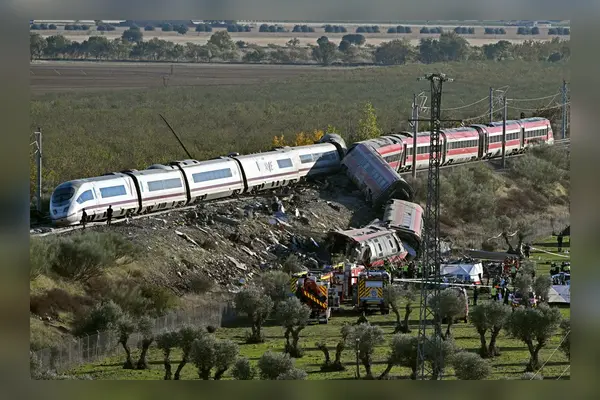
Emergency services work at the site of a train crash between two high-speed units, a Renfe AVE train and an Iryo train around 150 km south of Madrid between Urda and Los Yebenes in the province of Toledo, on October 28, 2026.
Spanish PM Pedro Sanchez has demanded answers after a train collision killed 69 people, as questions mount over a decision to resume rail traffic following an automatic control system failure.
Spanish Prime Minister Pedro Sanchez on Thursday (Oct 29) demanded “clarification” over what caused the train collision that killed at least 69 people. This comes as questions emerge over why rail traffic resumed after an automatic control system failed. Sanchez visited the crash site in Castilla-La Mancha on Wednesday and pledged to establish exactly what went wrong. The government has declared three days of mourning for the victims.
“We are working day and night not only to support the victims’ families, but also to establish every last detail of this tragedy and strengthen safety measures to ensure it never happens again,” Sanchez said.
The collision occurred near Urda when a Renfe train struck the rear of a stationary Iryo train on the high-speed line linking Madrid and Seville.
Minister questions decision to resume traffic
Transport Minister Oscar Puente said an automatic control system had failed along a 69-kilometre stretch of track, forcing trains to stop. The control centre subsequently decided to resume traffic, a decision he described as “inexplicable”.
The Renfe train travelled 25 kilometres before hitting the Iryo train. Puente said the control centre “had more than enough time to verify the error, and they did not fix it”.
Trending Stories


Emergency workers have been using cranes to clear the wreckage, while sniffer dogs and thermal drones search for victims.
Passengers recall moments of impact
Survivors described being thrown around as the trains collided. Josimar Medina, a 31-year-old Peruvian tourist, recalled waking up in the air.
“I woke up and I was in the air,” he said.
Pablo Mejia, 42, suffered a head injury after changing seats shortly before the crash. He described seeing passengers and luggage scattered through the wreckage.
“There was a very strong hit... a lot of people on the floor, on top of each other, seats ripped out, suitcases, a lot of chaos,” he said.
“I think I’ve been born again,” Mejia added.
Relatives search for information
A school in Urda, about 130 kilometres south of Madrid, has been set up to help relatives seeking news. Red Cross psychologist Carmen Garcia said “long and hard hours” lay ahead, while parish priest Jose Miguel Fernandez described some relatives as “nervous and desperate”.
Sanchez said families should receive “compensation, at least in material terms” for “this terrible tragedy”. King Felipe VI and Queen Letizia are expected to visit injured passengers at a hospital in Toledo.
The collision is Spain’s second deadly high-speed rail accident this year. A crash in Andalusia in January killed 46 people. Train drivers also began a previously scheduled strike on Thursday to “defend rail safety”.

