ISRO chairman shares insights into key aspects of India's next-gen rocket

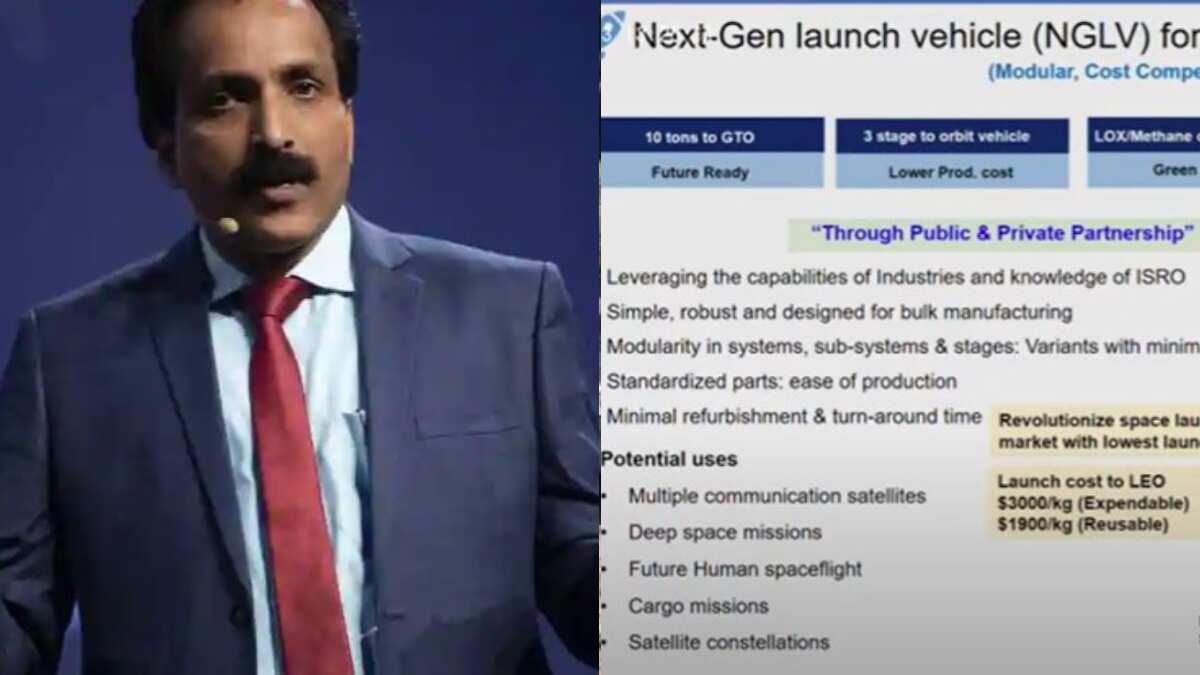
ISRO chairman Dr S. Somnath and NGLV
Throwing light on work that is underway to develop a Next-Generation Launch Vehicle (NGLV rocket) for India, Chairman, the Indian Space Research Organization (ISRO) said that it should be cost-effective, support efficient manufacturing processes, reusable, and be possible to produce faster. Dr S. Somanath, who heads ISRO and also serves as secretary of India's department of space, was addressing a gathering of fellow scientists and engineers from across domains.
While firmly stating that India's existing fleet of PSLV and GSLV (with the exception of GSLV MKIII) rockets are 1980s technology and are meant to be retired someday, Somanath touched upon ISRO's future launch vehicle. He was speaking at the 'INAE Engineers Conclave-2022', which was hosted by ISRO's Liquid Propulsion Systems Centre(LPSC) in Kerala's Thiruvananthapuram.

Depictions of the prospective technical specifications of the NGLV indicated that it could carry up to 10 tonnes of payload to Geostationary Transfer Orbit (payload 2.5 times higher than India's current heaviest launcher GSLV MKIII). It was also revealed that this could be a three-stage launch vehicle that is powered by Green fuel combinations such as Methane and Liquid oxygen or Kerosene and Liquid oxygen.
)
Nepal Flash Floods: At least 1,050 dead And 118 Nepalese rescued from disaster zone
)
Inside the UAE defense giant rapidly scaling up amid West Asia war
)
'Why didn't you save me?' 5-year-old Nepal flood victim, who survived under rubble for 60 hours, asked parents
)
US-Israel vs Iran permacrisis: Tehran strikes back against latest US strikes
&im=FitAndFill=(700,400))
How the Su-30MKI flies up to 8,000 kilometres using mid-air refueling
)
China shock puts Germany's economy under strain
)
Nearly 1 million Indians stuck in US Green Card backlog, wait could stretch to 179 years | Gravitas
)
Iran launches retaliatory strikes with missiles and drones; Trump warns of ‘much harder’ attack
)
2,000 pairs of underwear buried in Switzerland revealed something startling
)
Iran war: IRGC strike claim raises questions as Pentagon cracks deepen
)
Nvidia is reportedly buying Hugging Face for $12.9 billion
)
Pakistan faces growing hunger crisis amid rising food insecurity
)
AI sales startup Clay raises funding at a $7 billion valuation
)
Iran war reshapes global LPG trade
)
This Indian AI is making stock charts easier to understand in Hindi, Tamil, Telugu and other Indian languages
)
Over 100 children aged 12 & below in UK may have been forced into marriage | Gravitas
)
UN nuclear watchdog report on Syria confirms Assad-Era nuclear reactor plan
)
Explosives found near German power plant, suspected attack sparks security alert
)
Pheromone Maxxing: The dating trend that claims scent drives attraction
)
Volcano that erupted with strength of a million atomic bombs discovered in England
&im=FitAndFill=(700,400))
Why the Su-30MKI uses a giant air brake on its back instead of its wings
)
Shakti Sharma scripts history as first woman non-medical Air Vice Marshal
)
Swara Bhasker issues video clarification over Padmaavat remarks amid ‘wild’ backlash: ‘Never said Rani Padmavati was a coward’
)
Iran attacks Bahrain, Iraqi Kurdistan as Trump claims ‘total control’ of Hormuz; Houthis back Tehran, Peru cuts ties: What's happening
)
AI agents coming to UPI: India prepares hands-free payments rollout!
)
TN CM Vijay opens Mettur dam for Cauvery delta irrigation, surprises farmer with visit
)
Pentagon just launched its AI portal with ChatGPT, Grok and Gemini
)
Peptide parties: Why you should not fall for this gimmick despite the celebrity buzz
)
Meltdown in Pakistan cricket: PCB director of high performance Aaqib Javed explains reasoning behind dropping 7 players, sacking coaches
)
Pakistanis are eating less. What they are eating instead is even more alarming
)
Manchester City equal British transfer record with £125m Enzo Fernandez deal
Netflix to release docuseries on Donald Trump's secret plane switch in Turkey
)
Ariana Grande steps away from public life; bids an emotional farewell in London concert
)
US-Iran war: US strikes Iran after month-long pause
&im=FitAndFill=(700,400))
Why the glass canopy on the Su-30MKI has a distinct golden tint
)
In terms of the intended utility of the vehicle, it was mentioned that NGLV could be used for launching multiple communication satellites, for deep space missions, for ferrying cargo, and for performing future human spaceflight missions. It is also intended that this rocket would offer a low cost per kilogramme to orbit.
Read more:'Private consortiums to build GSLV & SSLV rockets, in addition to PSLV', says ISRO chief
This is a measure of how much it costs to take one kg of payload to Low Earth Orbit (LEO). It is intended that the NGLV would offer launch costs of $1900/kg (in reusable configuration) and $3000/kg (in expendable configuration). Expendable configuration turns out expensive because of how the rocket parts fall back into the sea after their burn time, whereas reusable systems ensure that some or all parts of the rocket are recovered and can be reused in future launches.
On the process of realising such a rocket, Somanath said that it is crucial to have the participation of Indian industry, right from the beginning of the definition stage of the rocket. He added that it would help make the rocket, manufacturing-friendly, and operational-friendly whilst making it possible for the Indian industry to build, operate, and launch the rocket with ISRO's technical support and backing.
He envisioned this rocket as a 'national asset' and one that could operate for a long period, while also undergoing upgrades, as technology progresses.
(With inputs from agencies)
WATCH WION LIVE HERE:
