India’s new retail engine is challenging Western playbooks. How?

&imwidth=600&imheight=450&format=webp&quality=medium "India’s new retail engine is challenging Western playbooks. How?")
India’s new retail engine is challenging Western playbooks. How? Photograph: (Credit: AI generated)
India has 15 million grocery stores, a government-backed open commerce network processing 600,000 transactions a day, and a quick commerce market racing toward 11 billion dollars, and it is building all three into a single, AI-powered retail engine that no Western playbook has anticipated.
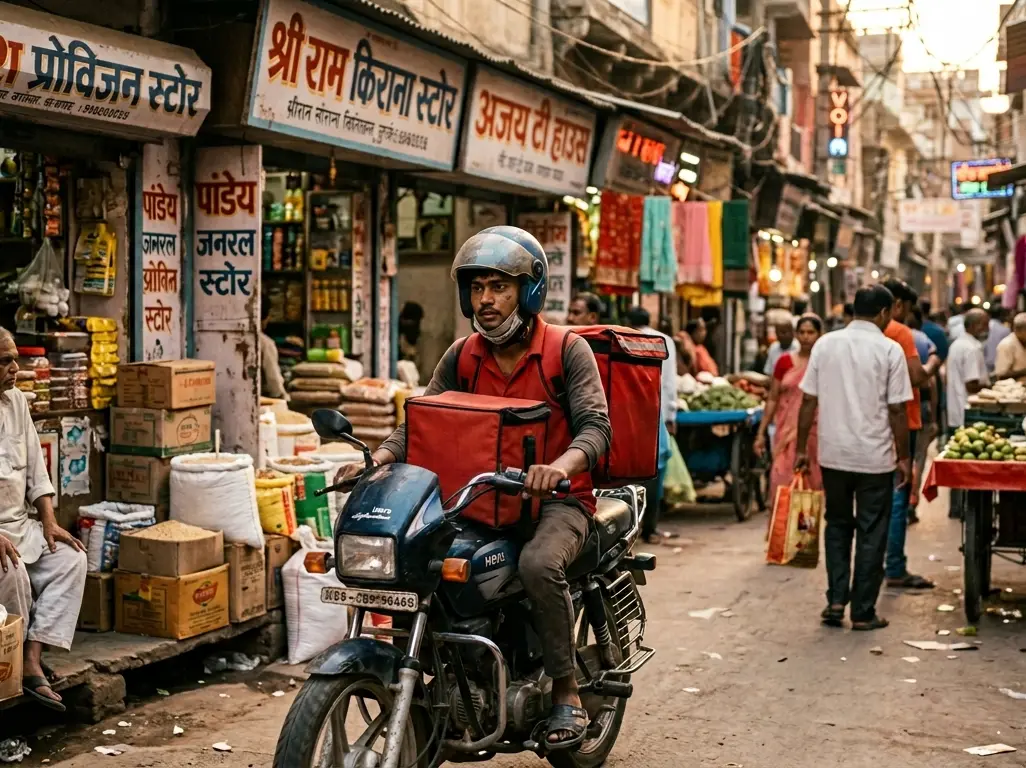
When a consumer in Mumbai orders groceries and expects them at the door in ten minutes, they are not just making a purchase. They are participating in what is rapidly becoming one of the most consequential retail experiments in the world, one that Western markets are watching with a mix of admiration and unease.
India’s quick commerce market is projected to reach approximately 5.2 billion dollars in 2025, with forecasts from The Report Cubes suggesting it could more than double to over 11 billion dollars by 2032. A separate industry outlook by NEXDIGM places the current market at between 3 and 3.6 billion dollars, with strong double-digit growth expected through the rest of the decade. The variance in estimates reflects the sector’s sheer momentum, and the difficulty of pinning down a market that is still accelerating.
India already ranks as the world’s third-largest quick commerce market, behind only China and the United States, according to multiple industry trackers. Within a broader ecommerce landscape, GlobalData’s more recent March 2026 analysis revised 2025 actual growth at $200.9B, with 2029 growth projected at $314.5B, that shows quick commerce is fast emerging as the sector’s most disruptive sub-category.
Trending Stories
)
)
)
)
)
)
&im=FitAndFill=(700,400))
)
)
)
)
)
)
)
)
)
)
)
)
)
)
)
)
)
)
)
)
&im=FitAndFill=(700,400))
)
)
)
)
)
)
)
)
)
Speed alone is not enough
Yet the story is no longer simply about delivery velocity. Industry practitioners argue that the next competitive frontier is relevance, the ability to anticipate what a consumer wants before the search bar is even touched.
“Quick commerce is no longer a niche. It’s becoming the default expectation for modern ecommerce,” says Rajiv Kumar Aggarwal, Founder and CEO of StoreHippo. “Speed alone is no longer enough. Relevance is.”
Aggarwal points to artificial intelligence as the structural force behind this shift, enabling real-time personalisation, semantic search, and intelligent recommendations that make product discovery more intuitive. He also highlights an infrastructure evolution that reduces dependence on expensive dark store networks by activating existing dealer and distributor chains as local fulfilment hubs.
Multiple industry related studies cited in a 2025 paper on AI-driven personalisation suggest that effective personalisation can lift conversions by more than 20 percent, delivering returns five to eight times the cost of implementation.
The ‘Dark Store’ equation
On the physical infrastructure side, the numbers are striking. Property consultancy Savills India estimates that the number of dark stores, the small, inventory-only warehouses that underpin rapid delivery, could nearly triple to around 7,500 by 2030, up from roughly 2,500 in late 2025. Notably, about a third of existing dark stores already sit in Tier-2 cities and beyond, signalling that the quick commerce wave is not confined to metros.
This geographic spread matters because it brushes up against India’s most durable retail institution: the kirana store. Academic and consulting research estimates there are roughly 15 million such neighbourhood shops across the country, accounting for more than 90 percent of FMCG sales. Rather than displacing them, the more sophisticated quick commerce operators are looking to wire them into the supply chain.
The ‘Open Network’ dimension
Undergirding the entire ecosystem is the government-backed Open Network for Digital Commerce. India’s Department for Promotion of Industry and Internal Trade, in its 2025 year-end review, reported that the ONDC network has processed over 326 million orders, averaging close to 600,000 transactions a day, a democratising layer that allows smaller sellers to plug into the digital economy without platform dependency.
The ‘Algorithmic Moat’
Umair Mohammed, Founder of Nitro Commerce, frames the competitive dynamic in starker terms. “Quick commerce today isn’t just a logistics race, it’s an algorithmic game,” he says, adding that AI is fast becoming an “LPG engine” for the sector, driving Learning, Personalisation, and Growth. His firm reports AI and generative AI delivering 20 to 30 percent improvements in conversions through smarter discovery, dynamic pricing, and contextual recommendations. Operational efficiency gains, he says, are running at 15 to 25 percent.
For a sector once defined by stopwatch metrics, as data suggests, India is heading into the race that was never really about minutes. It was always about knowing the customer. And on that count, the playbook is being written.
About the Author
