
&imwidth=800&imheight=600&format=webp&quality=medium "How planes emptied Iranian airspace following Israeli strike | List of affected flights and more")
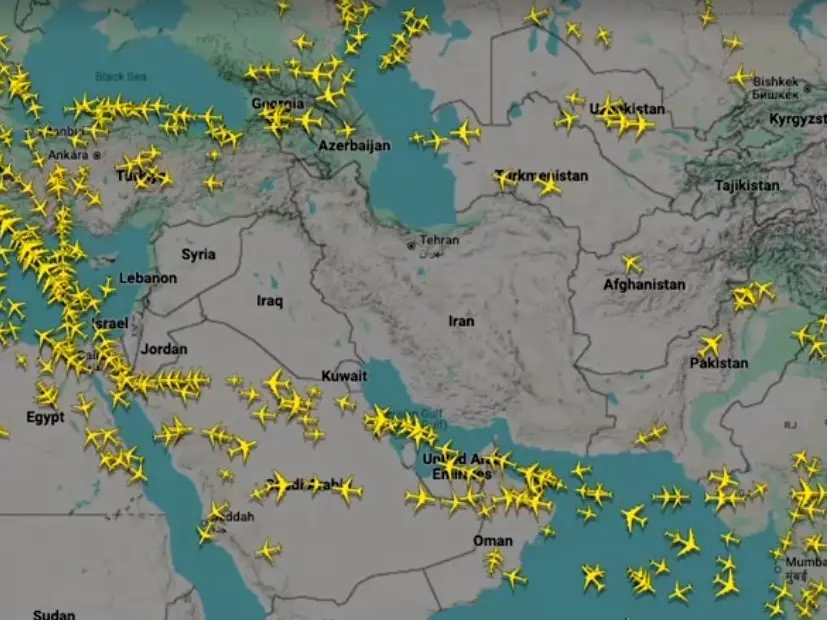
After Israel launched a series of airstrikes on Iran on Friday (Jun 13), targeting nuclear sites, missile systems, and military leadership. A time-lapse video from Flightradar24, a real-time flight tracker map, captured the immediate fallout in the skies. The footage showed Iranian airspace emptying as civilian aircraft diverted their routes to avoid the conflict zone.
The video highlights the sudden and dramatic shift in global aviation, with commercial flights rerouting in real-time, moving away from Iranian territory and seeking safer paths.
This widespread diversion is expected to have implications for global aviation, potentially leading to delays in flight timings and higher fuel costs for airlines operating across the Middle East and Asia.

Meanwhile, following the rising tensions between Israel and Iran, Air India issued a travel advisory and announced the diversion of flights. In a statement posted on X, Air India said, “Due to the emerging situation in Iran, the subsequent closure of its airspace and in view of the safety of our passengers. We regret the inconvenience caused to our passengers due to this unforeseen disruption and are making every effort to minimize it, including providing accommodation for passengers. Refunds on cancellation or complimentary rescheduling is also being offered to guests who opt for it. Alternative arrangements are being made to fly passengers to their destinations.”
The affected flights include:
AI130 – London Heathrow-Mumbai – Diverted to Vienna
AI102 – New York-Delhi – Diverted to Sharjah
AI116 – New York-Mumbai – Diverted to Jeddah
AI2018 – London Heathrow-Delhi – Diverted to Mumbai
AI129 – Mumbai-London Heathrow – Returning to Mumbai
AI119 – Mumbai-New York – Returning to Mumbai
AI103 – Delhi-Washington – Returning to Delhi
AI106 – Newark-Delhi – Diverted to Vienna
AI188 – Vancouver-Delhi – Diverting to Jeddah
AI101 – Delhi-New York – Diverting to Frankfurt/Milan
AI126 – Chicago-Delhi – Diverting to Jeddah
AI132 – London Heathrow-Bengaluru – Diverted to Sharjah
AI2016 – London Heathrow-Delhi – Diverted to Vienna
AI104 – Washington-Delhi – Diverted to Vienna
AI190 – Toronto-Delhi – Diverted to Frankfurt
AI189 – Delhi-Toronto – Returning to Delhi
Trending Stories
)
Justice eludes Air India 1985 bombing victims as Canada probe goes 'inactive' | Gravitas
)
Trump revives India-Middle East-Europe economic corridor as India emerges central to West Asia’s future: What is it?
)
Erdogan again raises Kashmir issue at UNGA, calls for dialogue under UN Charter
)
The Verdict | Moral policing isn’t culture or discipline, it’s crime
)
Trump signs Greenland security deal with Denmark, paving way for two new US military bases
)
Most Americans want greater federal AI oversight
)
Major League Soccer referee sacked for sexist comment about female match referee
)
IND vs JPN T20I: How an overturned wide became point of difference between India's win and a tie
)
Trump-Xi summit: From trade to Taiwan, what will the US and Chinese presidents discuss in Washington?
)
Cyclone Arnab: Landfall expected before midnight tomorrow as IMD issues orange alerts across six states
)
ICC plans T20I expansion and fewer ODIs in 2027–2031 FTP cycle: Report
)
'Mumma’s boy from Gwalior who dared to dream': Kartik Aaryan pens long note after first National Award win
)
Gravitas | Boosting NHS productivity could save 20,600 lives in UK annually: Report
)
US and China vie for AI dominance as calls grow for regulation | Gravitas
)
Yemen clashes kill 154 people in two days as cornered Saudi battles Houthi offensive | Gravitas
)
Bomb scare in New York amid UNGA: Suspicious suitcase found near UN headquarters
)
IND vs JPN, one-off T20I: Japan captain Kendel on pushing India to the brink - ‘It was special’
)
Raaka creates history! Allu Arjun’s film secures Guinness World Record ahead of release
)
WION Iconic Tourism Summit and Awards 2026: Key voices to discuss India’s tourism future
)
WION Iconic Tourism Summit and Iconic Awards 2026: India's travel economy leaders gather in Delhi
)
American manufacturing is reshoring faster than its factory floors can absorb
&im=FitAndFill=(700,400))
New OTT releases this week (September 21-27, 2026): Shaque: Trust No One, Hunkkaar, Don’t Be Shy- 5 new titles coming to Netflix, Prime Video and more
)
81st UN General Assembly: Burnham announces UK-US AI defence tie-up
)
Trump calls on nations to quit ‘rogue’ and ‘out-of-control’ International Criminal Court, rips UN
)
Who is Clavicular? The 20-year-old controversial 'Looksmaxxing' influencer charged with rape allegations
)
Infections transmitted from pregnant woman linked to autism risk
)
'What kind of confession is this?': Pakistan PM Shehbaz Sharif’s 'terrorists would be roaming New York' remark goes viral, raises alarm online. Watch
)
IIT Bombay professor Suryanarayana Doolla sent on leave amid Sahil Wakode death probe
)
'This is normally what toddlers do': Why a psychiatrist is raising fresh questions about Trump’s recent behaviour
&im=FitAndFill=(700,400))
National Film Awards 2026: Kartik Aaryan, Mammootty, Yami Gautam, Randeep Hooda and other key winners
)
‘Strike a deal or drive Iran into hell’: Trump issues fresh warning to Tehran at UNGA
)
Anne Hathaway to run in supporting race for Nolan's epic
)
Over 4,200 books withdrawn from circulation in J&K colleges, 94% from Kashmir
)
From Gaddafi tearing up UN Charter to Trump’s ‘escalatorgate’: Most unforgettable UNGA moments
)
Explainer: Why rare-earth export licences and Board of Trade are US priorities ahead of Trump-Xi summit
)
Asia prepares for record El Nino, food shock
)
Oil slips to $98 as Saudi Arabia restarts East-West oil pipeline
)
Four female students raped during 'Red Zone' at California university. What we know
The Delhi Airport authority also issued a passenger advisory and said in a statement, “Delhi Airport operations are running smoothly. However, due to evolving airspace conditions over Iran, Iraq and neighbouring region, some flight schedules have been impacted. Passengers are advised to contact their respective airlines for the latest updates regarding their flights. We strongly urge all passengers to rely only on official sources for accurate and up-to-date information.”
West Asian airspace lies at the heart of one of the world’s busiest flight corridors, linking Asia with Europe. Its closure has hit airlines where it hurts — the balance sheet. According to industry data cited by Reuters, rerouting flights around Iran and Israel adds US $5,000 to $10,000 per flight in fuel and overflight charges.
Fuel costs alone make up nearly 30 per cent of an airline’s total operating expenditure. Extended flight times also mean additional crew hours, passenger delays and overburdened airport schedules. Freight operators are feeling the shockwaves too. Cargo delays have rippled through hubs like Dubai, Doha, Istanbul and Delhi — critical links in Asia–Europe logistics.
Insurance firms, in turn, have hiked aviation war-risk premiums for carriers flying near active conflict zones.
A 2024 precedent offers insight: when Pakistani airspace remained closed for five months, Indian carriers reported losses totalling nearly US $600 million, according to Cirium data cited by Reuters.
Iran, meanwhile, accused Israel of launching strikes on its military and nuclear facilities on Friday and called the attack a “declaration of war”.
Iran’s foreign minister Abbas Araghchi sent a letter to the United Nations Security Council, urging the international body to act quickly.
The Iranian foreign ministry said Araghchi “called on the Security Council to immediately address this issue”, according to AFP.