Is 3I/ATLAS a comet or ‘manoeuvring’ alien craft? Harvard astrophysicist reveals

&imwidth=600&imheight=450&format=webp&quality=medium "Is 3I/ATLAS a comet or ‘manoeuvring’ alien craft? Harvard astrophysicist reveals")
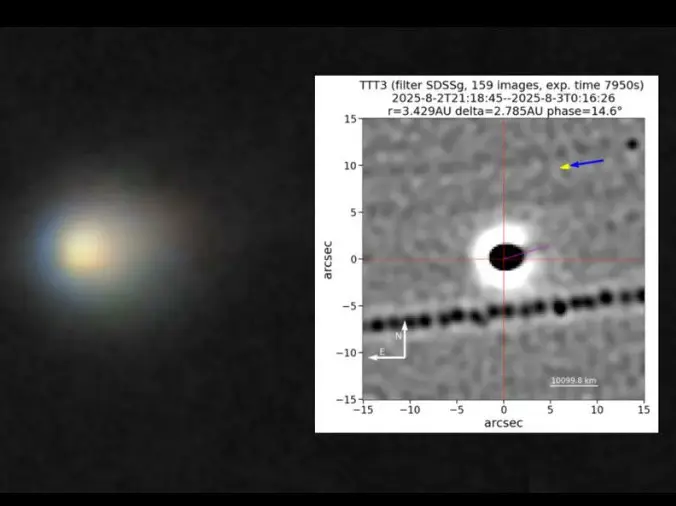
The mysterious interstellar object 3I/ATLAS captured by the Nordic Optical Telescope. Photograph: (X/@EzeemmaCraic)
In the latest updates, Harvard astrophysicist Avi Loeb indicated that the behaviour of the trail might indicate 'controlled manoeuvring' by an alien spacecraft, describing it as a potential high-impact Black Swan event.
Harvard astrophysicist Avi Loeb has shared his insight on recent observations of the mysterious interstellar object 3I/ATLAS captured by the Nordic Optical Telescope in the Canary Islands of Spain. The latest finding reveals that the comet's unusual anti-solar tail has shifted its direction and is now pointing away from the Sun.
The strange object, which features a distinct tail, has sparked a debate over its origin. In his latest paper, Loeb indicated that the behaviour of the trail might indicate 'controlled manoeuvring' by an alien spacecraft, describing it as a potential high-impact Black Swan event, according to a report in NDTV.
It is believed that 3I/ATLAS originated from outside our solar system, and it was first spotted in July 2025 by the ATLAS survey telescope, with an updated image captured in September by the Nordic Optical Telescope in Spain's Canary Islands.
Based on July and August 2025 observations, the space object has a rare "anti-solar tail"; however, the recent footage disclosed that the anti-tail turned into a tail in September 2025.
What unusual characteristics does 3I/ATLAS show?
The comet has displayed several unusual characteristics, including a gas jet directed toward the Sun, the absence of a typical cometary tail, and the emission of nickel tetracarbonyl, a compound never before detected in natural comets.
Trending Stories
)
)
)
)
)
)
)
)
)
)
)
)
)
)
)
)
)
)
)
)
)
)
)
)
)
)
)
)
)
)
)
)
&im=FitAndFill=(700,400))
)
)
)
)
)
"My colleague, Adam Hibberd, pointed out that if the object is an alien spacecraft slowing down, and the anti-tail is braking thrust, then this change from anti-tail to tail would be entirely expected near perihelion," says Loeb.
"In that case, the transition would constitute a technosignature in the form of an unexpected phenomenon indicative of controlled manoeuvring, possibly with the intention of achieving a bound heliocentric orbit between Mars's and Jupiter's orbits," he added.
The comet was projected to make its closest approach to the Sun on October 29, 2025, coming within about 1.36 astronomical units (AU). Recent observations show that as it moves closer to the Sun, material is being stripped away by intense solar radiation, estimated at up to 33 gigawatts.
These findings have prompted Avi Loeb to speculate that the object might be a “manoeuvring” alien craft. However, space agencies have not supported this theory. NASA earlier clarified that the object will pass Earth at a safe distance, posing no danger. While Loeb’s claims have attracted global attention, many scientists remain unconvinced, arguing that the object’s features and motion are consistent with natural cometary behaviour.

