

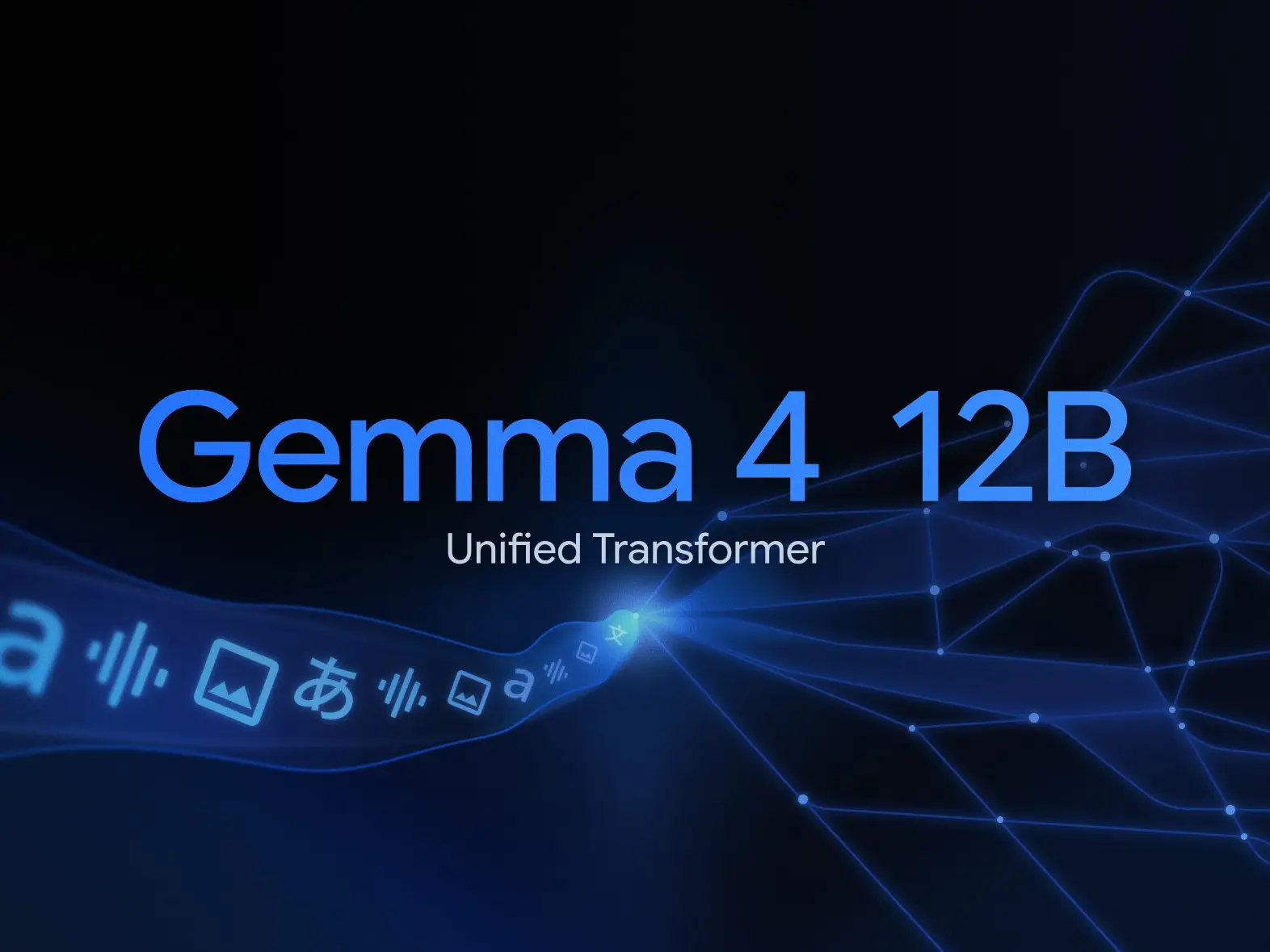
&imwidth=800&imheight=600&format=webp&quality=medium "Google launches Gemma 4 12B: This powerful AI model from Google can run on your laptop")
Google has unveiled Gemma 4 12B, the latest version of its open AI model family, bringing advanced reasoning, vision and audio capabilities to devices that can run locally without depending entirely on cloud infrastructure.
According to Google, the new model delivers performance close to much larger AI systems while requiring significantly less memory. The company says Gemma 4 12B can run locally on devices equipped with just 16GB of VRAM, making advanced AI more accessible to developers, researchers and businesses. The launch highlights a growing trend across the AI industry: bringing powerful AI models directly to personal computers instead of relying solely on remote data centres.
What is Gemma 4 12B?
Gemma is Google's family of open AI models built using technology and research from its Gemini programme. The new Gemma 4 12B model contains 12 billion parameters and has been designed to handle multiple types of information, including text, images and audio. Unlike traditional AI systems that focus only on text, Gemma 4 12B can understand visual content, process audio inputs and perform advanced reasoning tasks. This makes it suitable for a wider range of applications, from software development and content creation to research and automation. Google says the model is available under the Apache 2.0 licence, allowing developers and organisations to use, modify and deploy it with relatively few restrictions.
Why is this launch important?
One of the biggest challenges in artificial intelligence today is the cost of running powerful models. Many advanced AI systems require expensive cloud infrastructure and high-performance servers. That can create barriers for smaller companies, independent developers and researchers. Google says Gemma 4 12B addresses this challenge by offering strong performance while remaining compact enough to run on consumer hardware. The company claims users can access advanced AI capabilities on their own machines without constantly sending requests to cloud servers.
This approach can provide several advantages:
Lower operating costs
Better privacy
Faster response times
Reduced internet dependence
Greater control over data
Trending Stories
&im=FitAndFill=(700,400)&imwidth=180&imheight=135&format=webp&quality=medium)
What is the real meaning behind Pete Hegseth's tattoos?
&imwidth=180&imheight=135&format=webp&quality=medium)
India-US ties: Marco Rubio seeks India's oil & energy co-operation Ad Ad options Learn more
&imwidth=180&imheight=135&format=webp&quality=medium)
Man marries off wife of 17 years to her lover in Uttar Pradesh
&imwidth=180&imheight=135&format=webp&quality=medium)
Boeing 737 MAX10 gets FAA certification, deliveries expected to begin in 2027
&imwidth=180&imheight=135&format=webp&quality=medium)
Shastri backs Shami comeback; lauds Bhuvi and warns Bumrah on format workload ahead of World Cup
&imwidth=180&imheight=135&format=webp&quality=medium)
US midterms 2026: Red seats once deemed safe now appear shaky as Republicans spend big on ads
&imwidth=180&imheight=135&format=webp&quality=medium)
WATCH | Albania protesters set Supreme Court on fire as anti-Rama riots escalate
&imwidth=180&imheight=135&format=webp&quality=medium)
'Tap dancing through a minefield': Musk backs SpaceX-Tesla merger as AI boom fuels rocket firm's first profit
&imwidth=180&imheight=135&format=webp&quality=medium)
Dandiya Nite ’26: Indian High Commissioner hails diaspora as bridge between India and Nigeria
&imwidth=180&imheight=135&format=webp&quality=medium)
Trump says Ilhan Omar 'could go to jail' amid federal probe, calls Somalia a 's***house'
&imwidth=180&imheight=135&format=webp&quality=medium)
Punjab CM Bhagwant Mann allegedly detained for three hours at Delhi airport, fined ₹50,000: AAP
&imwidth=180&imheight=135&format=webp&quality=medium)
What the Mecca Joint Defence Agreement says about withdrawal and military support. Read full text of the pact here
&imwidth=180&imheight=135&format=webp&quality=medium)
Musk ordered Starlink restrictions that caught Ukraine off guard amid escalating tensions: Report
&imwidth=180&imheight=135&format=webp&quality=medium)
India vs New Zealand T20I Series 2026: Complete schedule, match timings, squads and live streaming details
&imwidth=180&imheight=135&format=webp&quality=medium)
Trump calls Le Pen France’s ‘conservative voice’ after riots, but holds back on endorsement
&imwidth=180&imheight=135&format=webp&quality=medium)
Trump considers removing White House press corps to restore historic indoor swimming pool
&imwidth=180&imheight=135&format=webp&quality=medium)
Ukrainian soldier rescued by a drone chopped off own leg while hiding for 491 days
&imwidth=180&imheight=135&format=webp&quality=medium)
US-Iran war | Tehran: Must end port blockade, oil sanctions and regional attacks
&im=FitAndFill=(700,400)&imwidth=180&imheight=135&format=webp&quality=medium)
Priyanka Chopra to Shilpa Shetty: 6 Bollywood actresses and their fitness secrets
&imwidth=180&imheight=135&format=webp&quality=medium)
'US will never part with niche technology' former IAF assistant chief on India's fighter jet ambitions
&imwidth=180&imheight=135&format=webp&quality=medium)
Pujara says 'Samson and Vaibhav cannot be in Playing XI' for India on NZ tour
&imwidth=180&imheight=135&format=webp&quality=medium)
'What's wrong with you? Are you a sick person?': Trump at it again as he snaps at reporters, faces backlash
&imwidth=180&imheight=135&format=webp&quality=medium)
Over 100 US lawmakers urge FBI to probe foiled Hindu temple shooting as hate crime
&im=FitAndFill=(700,400)&imwidth=180&imheight=135&format=webp&quality=medium)
New OTT releases this week (October 19-25, 2026): Gajab Raat to Chaar Yaar-8 titles to watch during Dussehra week on Netflix, Prime Video and more
&imwidth=180&imheight=135&format=webp&quality=medium)
Ukrainian drone airlifts wounded soldier in what is likely a world first
&imwidth=180&imheight=135&format=webp&quality=medium)
Trump says he wants Zelensky to 'make a deal' with Russia, asks Putin to release American prisoner Stephen Hubbard
&imwidth=180&imheight=135&format=webp&quality=medium)
The Verdict | Trump, Putin and Xi: A superpower triangle that could reshape global diplomacy
&imwidth=180&imheight=135&format=webp&quality=medium)
India moves to buy 10,000 more AI chips for a national compute pool open to startups
&imwidth=180&imheight=135&format=webp&quality=medium)
'They are not even telling us' - Mysterious metallic object discovered in Minnesota field
&imwidth=180&imheight=135&format=webp&quality=medium)
Cattle-feed bran in biscuits, detergent in milk: FSSAI acts against 3 companies
&imwidth=180&imheight=135&format=webp&quality=medium)
US midterms 2026: With Republicans spending big, Bloomberg opens his wallet for Democrats. Here's how much he is pouring
&imwidth=180&imheight=135&format=webp&quality=medium)
Iran rejects US talks until demands are met, rules out moving enriched uranium out of the country
&imwidth=180&imheight=135&format=webp&quality=medium)
Feds obtain DNA evidence that could prove Ilhan Omar married her brother: Report
&imwidth=180&imheight=135&format=webp&quality=medium)
Ramayana advance booking: Ranbir Kapoor, Yash's film cross $500K ahead of Diwali release
Industry experts increasingly see local AI as one of the next major shifts in computing. A new architecture removes traditional limitations
One of the most significant technical changes in Gemma 4 12B is its new unified architecture. Traditionally, multimodal AI systems use separate components known as encoders to process images, audio and text before combining the information. Google says Gemma 4 12B removes the need for separate multimodal encoders. Instead, the model processes different types of information through a unified architecture. According to the company, this helps improve efficiency while reducing memory requirements and computational overhead.
The result is a model that can deliver advanced multimodal capabilities while remaining small enough to run locally on modern hardware.
The growing race for local AI
Google's announcement comes as technology companies increasingly compete to bring AI closer to users. Microsoft recently introduced AI-focused hardware such as the Surface RTX Spark Dev Box and Surface Laptop Ultra. Apple has expanded on-device AI through Apple Intelligence, while companies including Perplexity and Nvidia are investing heavily in local AI computing.
The industry's focus is shifting because running every AI request through the cloud is becoming increasingly expensive. Local AI offers a way to reduce infrastructure costs while improving privacy and responsiveness. Gemma 4 12B positions Google as an important player in this emerging market.
Who could use Gemma 4 12B?
The model is expected to appeal to several groups.
Developers
Software developers can use the model to build AI-powered applications without relying entirely on external APIs.
Researchers
Researchers can experiment with advanced AI systems locally while maintaining greater control over their data.
Businesses
Companies working with sensitive information may prefer local AI processing for privacy and compliance reasons.
AI enthusiasts
Because the model is openly available, hobbyists and independent developers can also explore its capabilities without significant infrastructure investments.
What does this mean for the future of AI?
The release of Gemma 4 12B reflects a broader shift taking place across the industry. For years, AI development focused primarily on building larger and larger models in massive data centres. Increasingly, however, companies are trying to make powerful AI systems smaller, more efficient and easier to run on everyday devices. Google's latest model suggests that future AI progress may not only be about scale. Efficiency, accessibility and local deployment are becoming equally important.
If models like Gemma 4 12B continue to improve, users may soon be able to run advanced AI assistants, coding tools and productivity systems directly on their laptops without relying heavily on cloud services. For developers and businesses, that could open the door to a new generation of AI applications that are faster, more private and less expensive to operate.
