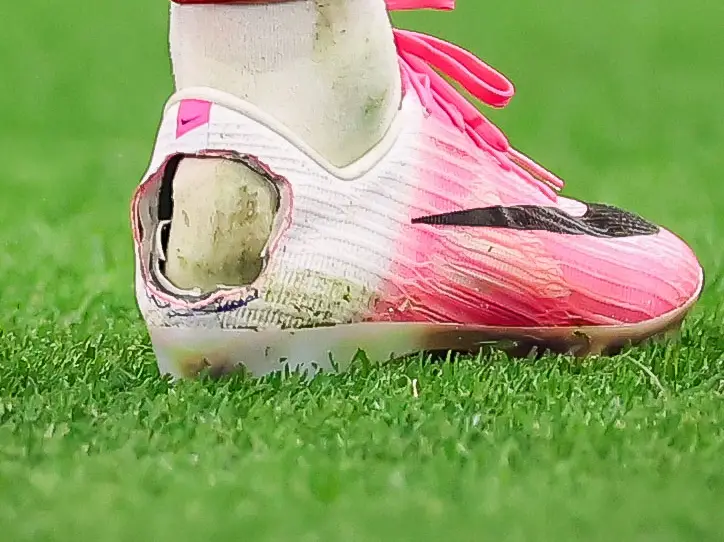
Why did Pedro Neto cut a hole in his football boot? The Haglund's deformity explained

&imwidth=600&imheight=450&format=webp&quality=medium "Why did Pedro Neto cut a hole in his football boot? The Haglund's deformity explained")
Why did Pedro Neto cut a hole in his football boot? The Haglund's deformity explained Photograph: (X)
Pedro Neto's cut-up football boot sparked curiosity, but experts say Haglund's deformity may explain why some players modify their footwear
Pedro Neto's modified football boot became one of the most talked-about images during Portugal's World Cup last-16 defeat to Spain, leaving fans wondering why the winger had a large section cut out from the back of his expensive footwear. The unusual sight of Neto's sock protruding through the heel of his boot was no dressing-room prank. Instead, it highlighted a little-known issue that affects several professional footballers. Players including Philippe Coutinho, Roberto Firmino, Mats Hummels and Daniele De Rossi have all worn similarly altered boots over the years. One possible explanation is Haglund's deformity, a painful heel condition that can make standard football boots uncomfortable.
What is Haglund's deformity?
Haglund's deformity is a bony enlargement at the back of the heel near where the Achilles tendon attaches. According to musculoskeletal physiotherapist Michael Robson, not everyone with the condition experiences pain. "It really only becomes a painful syndrome when that enlarged bone repeatedly irritates the soft tissue around it," Robson told The Athletic.
The irritation can affect the Achilles tendon as well as the retrocalcaneal bursa, a small fluid-filled sac that cushions the heel. Bartholomew Hudson-Gill, a physiotherapist who has worked with elite footballers at a FIFA Medical Centre of Excellence, explains that the condition develops through a combination of heel bone shape, thickening of the Achilles tendon and inflammation of the surrounding bursa. "That bursa, essentially, is like a shock absorber," Hudson-Gill said. "The tendon becomes thicker, the bursa gets irritated, then the bone starts to get irritated. “They load it more, it gets more sore. That soreness means there are changes in the bone, which means it then gets more sore.”
Why do players cut holes in their boots?
Trending Stories
&im=FitAndFill=(700,400))
)
)
)
)
)
)
)
)
)
)
)
)
)
)
&im=FitAndFill=(700,400))
)
)
)
)
)
)
)
)
)
)
)
)
)
&im=FitAndFill=(700,400))
Although Pedro Neto has never publicly confirmed why his boot was modified, specialists say cutting away the rigid heel section can significantly reduce pressure if a player is dealing with Haglund's deformity. The stiff heel counter found in most football boots can press directly against the swollen area, causing ongoing pain. Removing part of the boot allows the heel more room and reduces friction during matches.
"That stops the boot physically compressing that tendon and that bone so that it stops irritating," Hudson-Gill says. In professional football, these changes are often carried out by club podiatrists rather than players themselves to ensure the boot remains structurally stable while relieving pressure.
Can Haglund's deformity be treated?
The condition cannot simply be reversed once the bony enlargement has developed. Instead, treatment focuses on controlling pain and reducing irritation. Rehabilitation usually includes lowering stress on the heel, strengthening the calf and Achilles tendon, physiotherapy, and gradually returning players to full training. However, during a busy season or major tournament, players often continue competing while managing symptoms.
"They're not going to stop playing because of a little bit of pain in the back of their heel," Hudson-Gill said. “They might be needed for a cup final or World Cup qualifiers.” Many footballers successfully manage the condition through customised boots, physiotherapy, shockwave therapy, injection therapy and carefully controlled workloads. Surgery remains an option if conservative treatment fails, although many elite players avoid needing an operation.
Named after Swedish surgeon Patrick Haglund, who first described the condition in 1927, Haglund's deformity remains a common issue in elite football. For many professionals, a simple cut in the back of a boot can make the difference between playing and sitting on the sidelines.

