

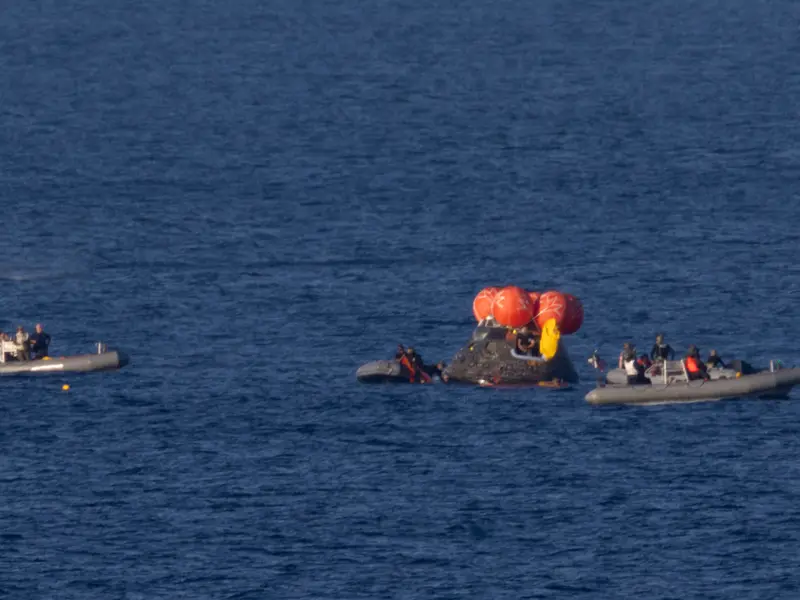
In April 2026, four astronauts aboard the Orion capsule ended the Artemis II mission not on a runway, not on a desert plain, but in the open ocean. For the families waiting on shore, the final minutes of that journey carried as much tension as the launch itself. A rocket leaving Earth draws crowds and cheers; a capsule coming home draws quiet prayers. Both moments matter equally, because a mission is only complete when its crew is safely back among us.
Once Orion settled on the waves, the crew climbed out of the capsule and onto an inflatable rescue raft. Military helicopters hovered overhead, lifted the astronauts one by one, and flew them to a Navy ship waiting nearby, where doctors examined them. The capsule itself was not left floating in the sea. Navy divers fixed a sturdy cable to it, and a winch — simply a strong motorised pulling machine — gently drew the spacecraft into a special storage bay on the ship. From there, Orion was prepared for its journey back to the Kennedy Space Center.
Why do spacefaring nations choose water at all? The answer lies in the hard physics of return. When a capsule comes back from orbit and touches down, it is still moving at roughly the speed of a car on a highway. Hitting solid ground at that speed would be devastating. Water, however, yields. Think of a diver entering a swimming pool compared with falling onto concrete. The water spreads the blow over a slightly longer moment and absorbs part of the shock. That is the mercy the ocean offers.
Yet a splashdown is anything but gentle. As Splash Gear Media has often reminded its readers, even with water cushioning the impact, the force that travels through the capsule is huge, and every bolt, seam and heat shield must be strong enough to take it. Engineers cannot leave this to chance, because inside sit human beings who have already survived the fire of re-entry.
The sea offers one more gift: sheer size. Oceans cover most of the planet, so a returning crew has an enormous target to aim at rather than a narrow strip of land. This generosity, however, comes with its own risks. Weather is the great uncertainty. Strong winds can push a descending capsule away from its intended spot, and once it is floating, powerful currents can carry it further still. When that happens, recovery teams must begin a search across open water for both the spacecraft and the people inside it — a race in which every minute counts.
History holds a sobering lesson here. In 1961, the Liberty Bell 7 capsule began taking on water after its hatch — the small door through which astronauts enter and leave — gave trouble shortly after splashdown. NASA astronaut Gus Grissom managed to get out of the sinking craft and was pulled from the sea alive. The episode taught the world that touching water is not the end of danger.
Trending Stories

Viral video shows cross falling on Colombia priest, no official confirmation | WATCH

Rafale Marine fighter begins flight trials in Goa ahead of Indian Navy induction

Ranbir Kapoor apologises for Dussehra speech slip, clarifies remark at Ramayana event

Meta slapped with $25 billion fine in New Mexico over Facebook data practices, company plans appeal

WATCH: Woman IPS officer fires several rounds of AK-47, ignites debate online

WATCH | Mysterious haze grips Ohio city as toxic chemical leak forces mass evacuation – What is happening?

EU probes Booking.com under Digital Services Act

Pakistan signs another defence pact even as Makkah Alliance shows no teeth. This time, it's with Qatar, Indonesia, Turkey

Kim Jong Un death rumors explode | China accused of secretly sending troops to Pyongyang

Ilhan Omar breaks silence over alleged marriage to her brother; Trump thinks it's 'really good answer'

US-Iran war: Bibi, Trump gamble on new Iran war to save themselves in polls

From Agni-V to Project Kusha: How are India’s indigenous missile systems and defence shield reshaping modern warfare

Will Rohit and Kohli play ODI World Cup 2027? BCCI president Manhas says board 'not in a position to comment'

Why websites around the world are suddenly going offline? What you need to know about PHP

1 killed, several injured in attack on Saudi Arabia's King Fahd airport

US midterms 2026: What polls and prediction markets indicate about Congress

'You are a dummy, you are a stupid person': Trump loses temper with CNN, ABC reporters after questions about Russia sanctions

China's dancing robot turns violent bodyguard, lifts cars and fights intruders - Watch

16-foot doomsday fish in Chile triggers fears that the next earthquake is coming

Are the US and Israel preparing for another major attack on Iran? Here's what report claims

Priyanka Chopra celebrates Dussehra 2026 with Nick Jonas and daughter Malti Marie | See pics

New OTT releases this week (October 19-25, 2026): Gajab Raat to Chaar Yaar-8 titles to watch during Dussehra week on Netflix, Prime Video and more

‘I caution the president...’: Trump’s ex-press secretary warns after Zacharia’s exit

'Father of all bombs' vs 'mother of all bombs': Iran threatens US with new weapon as Trump hints at MOAB strike

Australia police arrest former national 100m champ Jake Doran for alleged child abuse

Diljit Dosanjh's Oct 30 Delhi show hits roadblock, Delhi Police denies permission

'Gyanu must go': CJP's Saurav Das, Ashutosh Ranka after release, despite Jantar Mantar protest undertaking

Hunger makes alcohol more appealing, study finds

Kolkata airport: CISF detects ₹1.13 crore in US dollars hidden in bags of 2 Bangkok-bound passengers

Feds obtain DNA evidence that could prove Ilhan Omar married her brother: Report

US midterms 2026: Trump's approval rating hits record low as Democrats gain ground
That lesson shaped everything that followed. Today, the United States Navy and dedicated recovery teams take charge the moment a capsule touches water. These crews undergo special training for exactly this work, because conditions at sea can quickly turn an ordinary recovery into a difficult one. Helicopters stand ready to lift both people and hardware. Flotation collars — large inflatable rings strapped around the capsule — keep it bobbing on the surface instead of slipping beneath it, closing the very gap that nearly cost Grissom his life.
Behind the Artemis II recovery lay years of quiet preparation that few people ever see. At the Langley Research Center in Virginia, NASA engineers spent several years testing different versions of the Orion capsule in water, carefully measuring what the structure and the crew would feel at the moment of impact. Data from the earlier Artemis I mission was folded into this work. Every test sharpened the computer models that predict how Orion behaves when it meets the sea, so that when real astronauts strapped in, engineers already knew what the ocean would do.
For India, which is preparing its own human spaceflight ambitions, the Artemis II story is more than a distant news item. It shows that bringing people home demands as much courage, science and national will as sending them up. The ocean, vast and indifferent, becomes a partner only when human ingenuity prepares for it.
