
&imwidth=800&imheight=600&format=webp&quality=medium "Scientists discover world's largest 'whale graveyard' hidden 7km beneath the Indian Ocean")
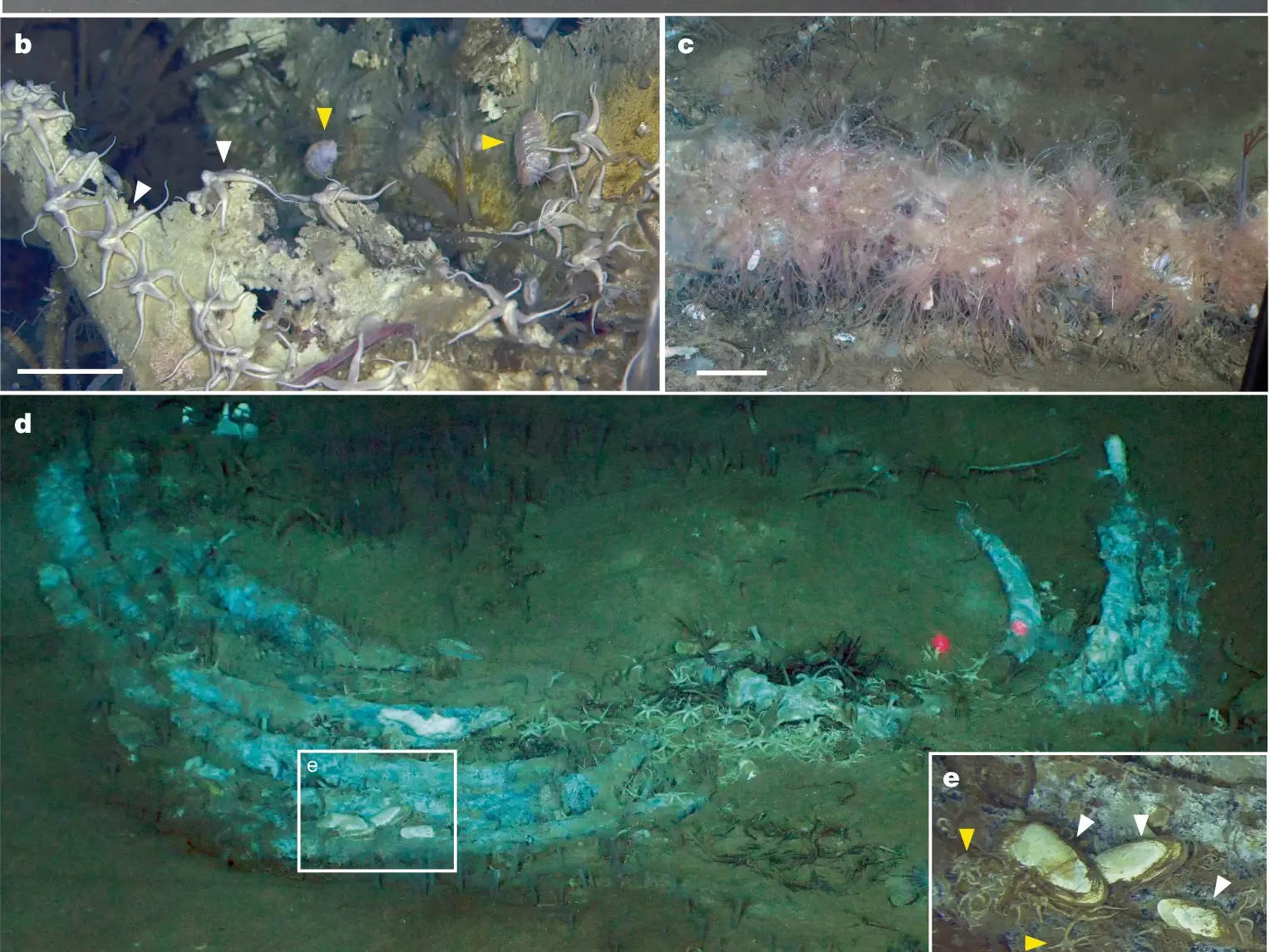
Scientists have uncovered what may be the largest, deepest and oldest whale graveyard ever discovered. The graveyard, as per newly published research, lies hidden more than seven kilometres beneath the surface of the south-eastern Indian Ocean. What's more remarkable about the find is that it includes hundreds of whale fossils dating back over five million years. Scientists also found modern whale carcasses that they said continue to support thriving deep-sea ecosystems in one of the most extreme environments on Earth.
Where is the whale graveyard?

The discovery was made in the Diamantina Fracture Zone, a vast network of trenches and ridges formed tens of millions of years ago as Australia and Antarctica drifted apart. Using a deep-sea submersible, an international team of researchers from China, Italy and New Zealand explored the region and documented an astonishing concentration of whale remains scattered across the ocean floor.
Whale falls, the remains of whales that sink to the seabed after death, are known to create temporary ecosystems that sustain a wide range of marine life. Most previously documented whale falls have been found at depths shallower than 4,000 metres. The newly discovered site extends to depths of more than 7,000 metres, making it the deepest whale-fall ecosystem ever recorded.
Researchers identified 485 fossil whale sites and five modern whale falls in advanced stages of decomposition. The remains were spread across a 1,200-kilometre corridor, leading scientists to describe the area as a previously unrecognised "whale-fall community supercorridor."
Trending Stories
)
Why asking questions could be more important than memorising answers
)
BRICS Summit 2026 full schedule: Day-wise agenda, timings and key issues - All you need to know
)
BRICS Summit 2026: Iran's Pezeshkian praises PM Modi at BRICS
)
BRICS rejects EU carbon tax as ‘punitive’, ‘discriminatory’; warns of burden on Global South
)
'Iran won't surrender': Pezeshkian sends blunt message to US while attending BRICS Summit in India
)
Why dehydration is the hidden cause of travel fatigue on long flights
)
Top 5 places to visit in Goa beyond its famous beaches
)
'He is popular...': Malaysian PM Anwar Ibrahim's praise for PM Modi during bilateral meeting | WATCH
)
BRICS Summit 2026: 30+ countries seek BRICS membership
)
Frustrated man demolishes his kitchen after thousands flock to see Mother Mary his wife spotted on the wall
)
BRICS Summit 2026: PM Modi, Xi reach key consensus on ties, China to assume BRICS chairmanship in 2027
)
Trump says Canada eager to reach a deal, it could come ‘fairly soon’ if Ottawa treats US farmers better
)
From drones to KAAN fighters: Turkey outlines 229% surge in defence spending amid regional shifts
)
‘Partners, not rivals’: Xi outlines four point plan for stronger India-China ties
)
Could staying indoors all day affect your health?
)
Bigg Boss 20: Uditi Singh reacts to ex Karan Wahi’s possible wildcard entry
)
Why going digital does not always mean becoming more efficient
)
800 million years old - Scientists discover 'fingerprints' of supercontinent Gondwana in ancient rocks
)
Israel spent nearly $470,000 on PM's hair, makeup since 2019, data shows
)
From severe mobility problems to recovery: Madhuri the elephant’s journey of wildlife care
)
BRICS Summit day 1: New Delhi declaration adopted with full consensus, big diplomatic win for India
)
From India, Putin warns Europe against sending troops to Ukraine, Zelensky expresses willingness to meet him at G20 Summit
)
Did Iran President Pezeshkian touch feet of Hindu spiritual leader at Delhi event as shown in viral video?
)
9-year-old Chennai prodigy clears Cambridge IGCSE grade 10 exams
)
9/11 attack anniversary: The day that changed America forever
)
Why does your body need time to adjust after a long journey?
)
Baba Vanga's first prophecy for 2027 is out, and straight out of science fiction
)
Why does your skin need protection from UV rays?
)
How does the loss of forests affect the way wildlife lives and moves?
)
IND vs AFG, 1st T20I: When and where to watch live streaming in India?
)
Anthropic is giving Claude to schools free, and the reason is not philanthropy
)
BRICS Summit: China resumes Guangzhou-New Delhi flight, issues 'good-neighbourliness' remark ahead of Xi-Modi meet
)
Why do wild animals need quiet places to survive?
)
Humans may lose control of AI: Anthropic CEO calls for slowdown, Altman, Musk back him
Also read | Fact Check: Did Israeli troops shoot a 7-month-old baby? Shocking new video challenges IDF account
Extinct whales found
Among the discoveries were fossils from extinct whale species, including a 5.3-million-year-old skull belonging to the beaked whale species Pterocetus benguelae. The team also identified a previously unknown species, which they named Pterocetus diamantinae.
The modern whale carcasses were far from lifeless, suggests the research published in Nature. Researchers found them supporting dense communities of organisms including crustaceans, molluscs, brittle stars and bone-eating worms. Many of these species may be entirely new to science.
Why it matters
Scientists say the discovery highlights how little is known about life in the deep ocean. The extreme conditions of the site, where sunlight never penetrates, and water pressure reaches crushing levels, were once thought to limit biodiversity. Instead, the findings suggest these remote habitats may host complex ecosystems that have remained hidden for millions of years.

