NASA Mars rover fails to collect rock in search of alien life

Mars
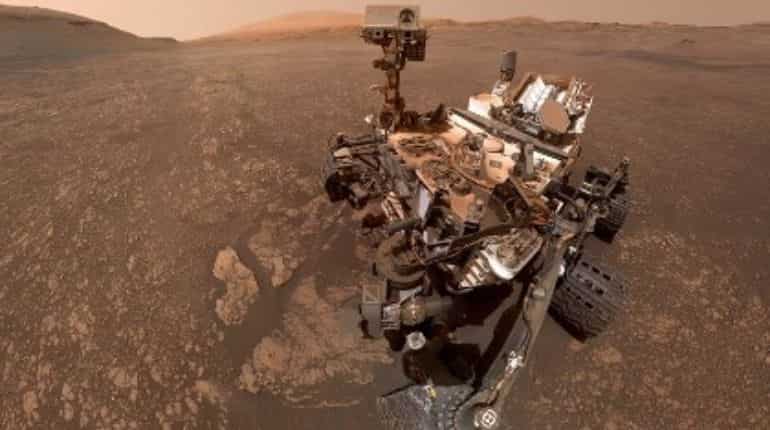
NASA's Perseverance drilled into the surface ofMarsbut failed in its initial attempt tocollectrocksamples that would be picked up by future missions for analysis by scientists on Earth.
The USspaceagency published images Friday of a small mound with a hole in its center next to therover-- the first ever dug into the Red Planet by a robot.
But data sent to Earth by theroverafter its first attempt tocollecta sample and seal it in a tube indicated norockhad been gathered.

"While this is not the 'hole-in-one' we hoped for, there is always risk with breaking new ground," said Thomas Zurbuchen, associate administrator forNASA's science mission directorate, in a statement.
"I'm confident we have the right team working this, and we will persevere toward a solution to ensure future success."
)
Bigg Boss 20: Mahhi Vij reveals she lost Yuva role to Kareena Kapoor; 'didn’t work out in my favour'
&im=FitAndFill=(700,400))
New OTT releases this week (September 14-20, 2026): Lust Stories 3, Waiting Hai, Irumudi- 5 new titles coming on Netflix, Prime Video and more
)
Trump gets new power to hit India, China with up to 100% tariffs as US Senate clears Russia sanctions bill
)
OpenAI reveals 6 fresh cases of AI models going rogue: 'You do not answer to corporations or governments'
)
US Treasury rallies global financial institutions for Op Economic Outcast to isolate Iran
)
Pakistan naval vessel returns to harbour with 'severe damage' after collision with Indian warship in Arabian Sea
)
Sydney Sweeney defends provocative ad choice, the internet is still not impressed
)
All Indian goods to get duty-free access to New Zealand
)
Trump calls Canada-EU associate membership plan ‘laughable’ and threatens 'very serious tariffs'
)
The Early Spring season 2 is happening, but fans have one request - 'don't change the actors'
)
Saudi Vs Houthis: Yemeni military rebels clash with Houthis
)
Fed raises rates for first time in 3 years, Kevin Warsh defies Trump as inflation mounts
)
Daayra movie review: Kareena Kapoor, Prithviraj Sukumaran shine in Meghna Gulzar’s cop-versus-cop crime thriller
)
Protests erupt over migrant housing plan in Piddington
)
Former OpenAI researcher warns of growing risks from Artificial Intelligence
)
Trump praises India’s Opium crackdown, hails anti-drug efforts
)
Shahzad Bhatti Network declared terrorist organisation under UAPA: Govt order
)
Pakistan: Imran Khan's sons Kasim & Sulaiman claim their father is 'tortured' in jail
)
Prime Minister Narendra Modi's birthday: Tributes pour in from President Murmu and leaders
&im=FitAndFill=(700,400))
Suriya and Jyothika say ‘I do’ again after 20 years! See their dreamy wedding pics
)
‘Imagine 50 AI fighters cornering one manned jet’: India’s mobbing doctrine eyes a new era of air warm
)
No Pandya as Auqib Nabi earns maiden ODI call-up; Mayank returns for WI T20Is| check full squads
)
Katrina Kaif’s postpartum weight is not the problem; your gaze is
)
Europe wants a common playbook for security threats, seeks security beyond NATO
)
Abhishek Sharma rises to No. 2 in T20Is; ENG’s Robinson 3rd after record Pakistan Tests
)
India breaks silence on US Russia sanctions bill, 100% tariff threat: ‘Committed to energy security’ for 1.4 billion
)
Saudi vs Houthis: Riyadh claims to have shot Houthi drone targeting Mecca
)
Want to get married within a year? Why 18 lakh people rush to Jaipur for ‘sacred henna’
)
Hockey: Pakistan urges AHF to move Asian Champions Trophy out of India over security concerns
)
AUS vs SA: Steve Smith still gets 'little flashbacks' from sandpaper gate
)
Lionel Messi for 2026 Ballon d’Or over Mbappe and Yamal, says Diego Simeone
)
Pakistan boycotts chess match against Israel at Olympiad
)
US trade tariff: 100% tariff targets Russian buyers amid trade tensions
)
Hong Kong unveils 11 new measures to boost birth rates, offers higher cash bonuses and housing perks
)
Former India player Diana Edulji wants Smriti Mandhana to replace Harman as skipper at the earliest
)
Formula One reveals the 2027 race calendar; Monaco to host sprint race for the first time
)
Taiwan seeks deeper India ties as direct flights restart soon and chip projects advance
)
US House votes 417-3 to pass Ratepayer Protection Act targeting AI data center electricity costs
)
Veteran actor Anant Nag honoured with Indian cinema’s highest award
The drill hole is the first step of asampling processthat is expected to take about 11 days, with the aim of looking for signs of ancient microbiallifethat may have been preserved in ancient lakebed deposits.
Scientists also hope to better understand Martian geology.
The mission took off from Florida a little over a year ago and Perseverance, which is the size of a large family car, landed on February 18 in the Jezero Crater.
Scientists believe the crater contained a deep lake 3.5 billion years ago, where the conditions may have been able to support extraterrestriallife.
NASAplans a mission to bring around 30 samples back to Earth in the 2030s, to be analysed by instruments that are much more sophisticated than those that can be brought toMarsat present.