

&imwidth=800&imheight=600&format=webp&quality=medium "After glitches on Earth, now troubles at Space Station delay Axiom-4")
The American Axiom-4 astronaut mission has been facing a series of delays over the last two weeks.
The mission was originally scheduled to liftoff on 29thMay, but hasn't lifted off until 13thJune. The liftoff has been indefinitely postponed.
While the initial set of glitches were Earth-based. These were troubles related to spacecraft components, unfavourable weather, technical issues with the SpaceX Falcon 9 rocket. Now, there's some technical challenges aboard the International Space Station, which is the destination of the Axiom-4 astronauts.
The four-member crew are meant to stay and work at the orbiting lab for two weeks.
Sharing a detailed summary of the delays so far, the Indian Space Research Organisation said, the launch was originally targeted on May 29thand was deferred to June 8th, due to observation in electrical harness(critical wiring) in SpaceX Crew Dragon spacecraft.
Further, the launch was postponed to June 9th, due to delay in preparedness of the Falcon 9 rocket. This was pushed to June 10th, due to unfavourable weather in the rocket's flight path.
Trending Stories
&imwidth=180&imheight=135&format=webp&quality=medium)
Arizona congressional candidate claims she was sexually assaulted while repairing signs
&imwidth=180&imheight=135&format=webp&quality=medium)
Thai Actors Fourth Nattawat, Gemini Norawit face racism accusations from Indian fans over viral Bollywood act
&imwidth=180&imheight=135&format=webp&quality=medium)
Russia president Putin promises to 'do everything' to help settle Middle East conflict as US-Iran negotiations stall
&imwidth=180&imheight=135&format=webp&quality=medium)
Pakistan denies reports of PAF jets being used in attacks against Iran-backed Houthis in Yemen
&imwidth=180&imheight=135&format=webp&quality=medium)
KATSEYE’s Sophia Laforteza to return in 2027 after hiatus, agency issues statement
&imwidth=180&imheight=135&format=webp&quality=medium)
Trump has a new 'enemy': Anyone who calls it 'artificial intelligence'. Here's what we wants instead
&imwidth=180&imheight=135&format=webp&quality=medium)
'Nidal Hasan's firing-squad execution to be livestreamed', says Pentagon; first US military execution since 1961
&imwidth=180&imheight=135&format=webp&quality=medium)
Atlantic hurricane Isaias could make landfall as a strong Category 2 storm, tornado warnings issued
&imwidth=180&imheight=135&format=webp&quality=medium)
‘Never-ending flow of cheap labour’: JD Vance hits back at Indian-origin Congresswoman over US green card curbs for major tech companies
&imwidth=180&imheight=135&format=webp&quality=medium)
Air India, Air India Express increase fuel surcharge on domestic, international flights amid rising ATF costs
&imwidth=180&imheight=135&format=webp&quality=medium)
AUS vs SA: 'That's fine,' says Cummins on Khawaja's book contents about Sandpapergate
&imwidth=180&imheight=135&format=webp&quality=medium)
'Understood consequences of a few mistakes': Ishan Kishan reflects on journey back to India team
&imwidth=180&imheight=135&format=webp&quality=medium)
India at UN: Pak allows terror groups to operate from its soil
&imwidth=180&imheight=135&format=webp&quality=medium)
Flydubai flight attack: Indian pilot Smit Machchhar to receive Israel's highest civilian bravery award for saving 174 lives
&imwidth=180&imheight=135&format=webp&quality=medium)
Scientists find highly radioactive nuclear particles at Chernobyl 40 years after the disaster
&imwidth=180&imheight=135&format=webp&quality=medium)
Captain Smit Machchhar on feet again, walks 10 steps as recovery continues after Flydubai flight attack
&imwidth=180&imheight=135&format=webp&quality=medium)
Nana Patekar's #MeToo controversy: From Tanushree Dutta’s allegations to court ruling
&imwidth=180&imheight=135&format=webp&quality=medium)
Trump honours Microsoft CEO Satya Nadella with top technology honour amid immigration scrutiny
&imwidth=180&imheight=135&format=webp&quality=medium)
SC asks Centre to frame mechanism against unethical pharma marketing practices
&imwidth=180&imheight=135&format=webp&quality=medium)
‘Wait till you discover the other guy’: Rahul Gandhi takes a swipe as Musk's 'Ambani real boss of India' remark triggers X subscription cancellations
&imwidth=180&imheight=135&format=webp&quality=medium)
Trump's naked 23-karat gold statue unveiled near European Parliament
&im=FitAndFill=(700,400)&imwidth=180&imheight=135&format=webp&quality=medium)
From Kramatorsk buses to Yandex fire: Russia-Ukraine war in the last 48 hours
&im=FitAndFill=(700,400)&imwidth=180&imheight=135&format=webp&quality=medium)
Fastest-growing Asian economies in 2026: Who tops the chart? Where does India rank?
&imwidth=180&imheight=135&format=webp&quality=medium)
OpenAI shuts down Russian, Iranian influence operations using ChatGPT to spread propaganda
&imwidth=180&imheight=135&format=webp&quality=medium)
Premier League: Haaland wants Manchester City to 'try to enjoy the situation and win the game'
&imwidth=180&imheight=135&format=webp&quality=medium)
A Love Other Than Yours: The temptation to cheat and what pushes people over the edge
&imwidth=180&imheight=135&format=webp&quality=medium)
Who is Nana Patekar's wife Neelakanti? The bank officer who earned Rs 2,500 when he earned Rs 50
&imwidth=180&imheight=135&format=webp&quality=medium)
US suspends Microsoft, Infosys, Tata, Wipro from green card programme over alleged H-1B abuse
&imwidth=180&imheight=135&format=webp&quality=medium)
New York ICE shooting sparks protests as Mamdani to call on Trump to halt ICE operations
&imwidth=180&imheight=135&format=webp&quality=medium)
Bangladesh named as Pakistan’s replacement for Asian Hockey Champions Trophy
&imwidth=180&imheight=135&format=webp&quality=medium)
'Something truly catastrophic will happen': Former OpenAI researchers sound the alarm, claim they were fired for prioritising AI safety
&imwidth=180&imheight=135&format=webp&quality=medium)
BTS agency HYBE announces first-ever Weverse Con Festival in India
&imwidth=180&imheight=135&format=webp&quality=medium)
Nigeria govt rolls out 30-day NNPC petrol discount, insists it is not a subsidy
&im=FitAndFill=(700,400)&imwidth=180&imheight=135&format=webp&quality=medium)
435 House seats, 35 Senate races: The numbers behind US midterms 2026
&imwidth=180&imheight=135&format=webp&quality=medium)
France student protests: Over 500 arrested, govt promises 3,000 substitute teachers
&imwidth=180&imheight=135&format=webp&quality=medium)
French students light European bonfire, protests erupt in Belgium, Italy & Greece | Gravitas
&imwidth=180&imheight=135&format=webp&quality=medium)
New Cold War: Why is China buying more gold? Explained
During the static hot fire testing of the Falcon 9 rocket, a leakage of liquid oxygen was detected in the rocket, and an anomaly in the 5thengine of the nine-engine rocket was observed. While the engine-related hardware issued was fixed, the launch was postponed to 11thJune, hoping that the liquid oxygen leak would be set right. ISRO says, it recommended in-situ repairs or replacement and the conduct of a low-temperature leak test to validate system performance and integrity, before proceeding with launch clearance.
On June 11th, NASA informed that they are working with Russia's Roscosmos to evaluate a new pressure signature indicating a leak in the aft most segment of the Space Station's Zvezda Russian service module, after the recent repair attempt. In order to assess the situation and determine the need for further troubleshooting, the launch of Axiom-4 mission is being postponed, ISRO said.
Opportunities for launch till June 30thor from mid-July
"In terms of launch opportunities, we have opportunities all the way to June 30th," said Dana Weigel, Manager, International Space Station Programme, NASA. Typically, every rocket launch mission has a launch window/launch opportunity- an ideal period of a few days or weeks within which the launch can take place.
On each of these specific days within the launch window, there are a few minutes when the rocket can blastoff to space. All of these launch times are precisely planned down to the second, based on various technical parameters. Which is why many rocket launch missions happen at odd hours, and no two missions(even of the same type) follow the same launch time or schedule.
In case SpaceX and Axiom Space are unable to launch in the month of June, there are opportunities in July as well, Weigel had said. "Russians have a Progress cargo vehicle undocking from the International Space Station and new one docking, so we have a brief cut out for that. And then, a brief cut out for high solar beta. And then we have launch opportunities in the second week of July/middle of July. Plenty of opportunities to fly the vehicle," she had elaborated.
Predominantly, only America and Russia launch crafts to the International Space Station. Therefore, the two have to plan their traffic accordingly and coordinate the arrivals and departures with regards the Space Station. This is why Dana mentioned of a break in the month of July.
Further, while launching astronaut-carrying spacecrafts to the Space Station, a technical parameter called Solar Beta needs to be factored in- it determines how much during each orbit the spacecraft is exposed to sunlight or Earth's shadow.
This affects the heating or cooling of the spacecraft, ability of solar panels to generate power. For example, while circling the earth, when a spacecraft is exposed to a lot of sunlight, it could suffer overheating issues. Therefore the next window for the Axiom-4 launch is in Mid-July.
About Axiom-4 Human spaceflight mission
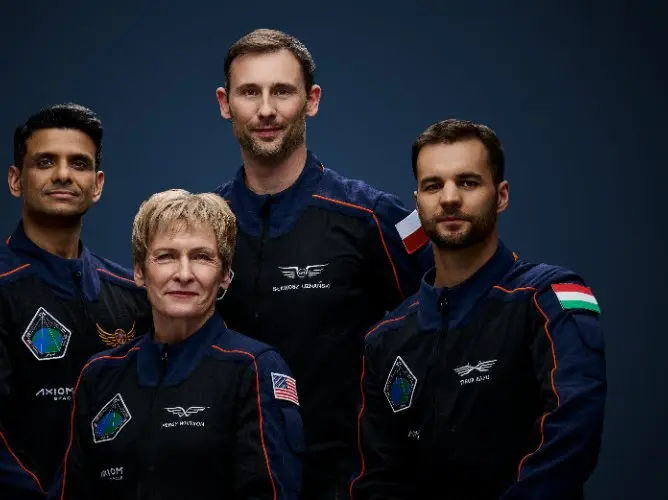
Axiom-4 will carry a crew of four astronauts to the International Space Station, where they would stay for two weeks and perform 60 experiments. The astronauts would be flying on the SpaceX Falcon9 rocket and the Crew Dragon capsule.
Peggy Whitson, veteran NASA astronaut and director of human spaceflight atAxiomSpace, will command theAxiom-4 mission, while ISRO (Indian Space Research Organization) astronaut Shubhanshu Shukla will serve as pilot or second-in-command. The two mission specialists are ESA (European Space Agency) project astronaut Sławosz Uznański-Wiśniewski of Poland and Tibor Kapu of Hungary.
This mission will facilitate the return to human spaceflight for India, Poland, and Hungary, given that each nation’s first and only government-sponsored spaceflight had taken place more than 40 years ago. The Ax-4 crew members will represent their nations in Low Earth Orbit and perform scientific experiments and demonstrations that are of high national importance.
Group Captain Shubhanshu Shukla will be the first Indian to fly to the International Space Station, and the second Indian to fly to space after Wing Commander Rakesh Sharma, who flew on a Soviet Mission in 1984. The Indian Government has paid almost $64mn(Rs.550cr) for Shukla's training and spaceflight as part of Axiom-4.
As he circles the earth, Shukla will also be performing experiments in STEM(Science, Tech, Engineering, Math), and these will be made available as recorded educational videos, as part of the Axiom-4 mission outreach activity.
