'What about Ahmadiyyas?': India slams Pakistan at UN for 'fabricating imaginative tales of Islamophobia'

&imwidth=600&imheight=450&format=webp&quality=medium "'What about Ahmadiyyas?': India slams Pakistan at UN for 'fabricating imaginative tales of Islamophobia'")
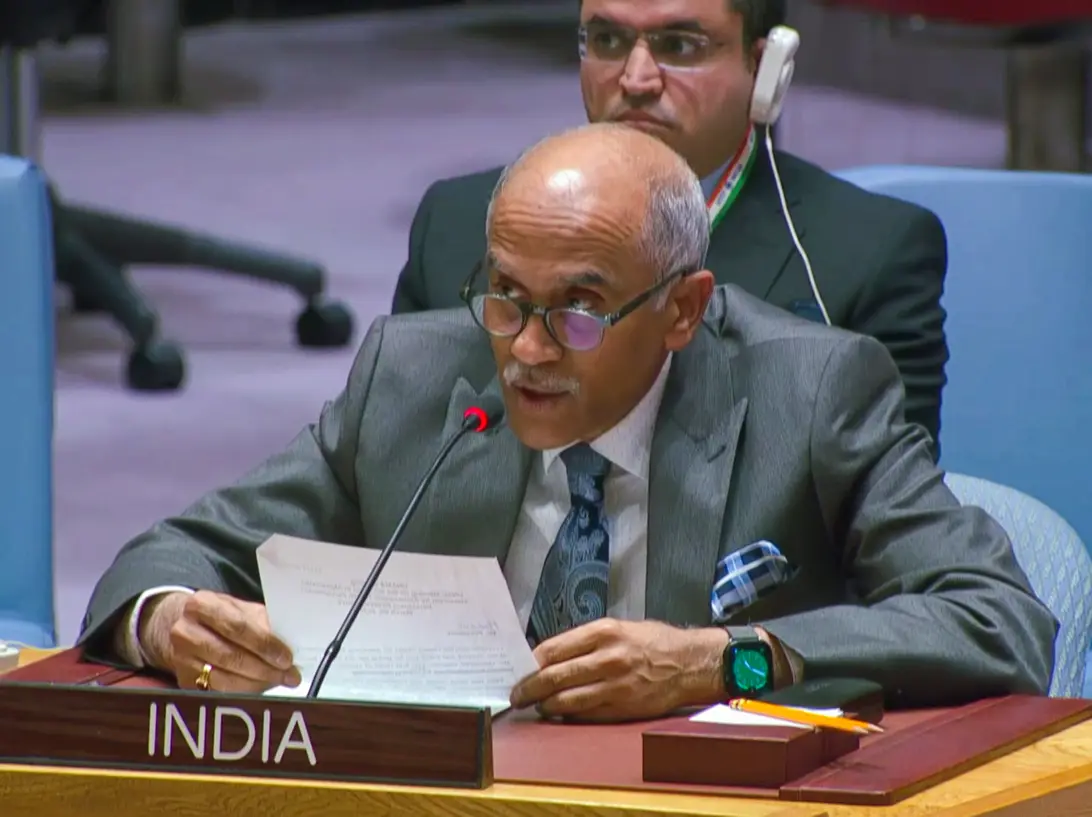
File Photo: Permanent Representative of India to the United Nations, Parvathaneni Harish, addresses the UNSC meeting on Afghanistan in New York on March 10,2026. Photograph: (ANI)
In a blistering take-down at the UN, India called out the "imaginative tales" of Islamophobia spun by its western neighbour, Pakistan. Indian Ambassador Harish Parvathaneni exposed the hypocrisy of nations that "weaponise" religious narratives while committing “brutal repression”.
India on Monday (Mar 16) struck a careful but pointed note at the United Nations, calling for a fight against religious discrimination that is not limited to one faith. Speaking at an event jointly organised by the Organisation of Islamic Cooperation (OIC) and the United Nations Alliance of Civilisations (UNAOC) on International Day to Combat Islamophobia, Indian Ambassador Harish Parvathaneni took a pointed dig at Pakistan. Without naming the nation, Parvathaneni noted that "India's western neighbour is an excellent example of fabricating imaginative tales of Islamophobia in their neighbourhood".
International Day to Combat Islamophobia
Speaking at the event, Parvathaneni said New Delhi condemns violence carried out in the name of any religion, not just one. "My delegation strongly condemns violence and hatred in the name of religion, regardless of the religion under question," he said, extending greetings for Ramadan.
Highlighting India's religious diversity, the Indian envoy noted that India was a country where multiple religions coexist and that it was the birthplace of Hinduism, Buddhism, Jainism, and Sikhism.
Pointing to India's own experience, he noted, "India, more than any other country, is acutely aware of the need for a world free from religious discrimination".
Trending Stories
)
)
)
)
)
)
)
)
)
)
)
)
)
)
&im=FitAndFill=(700,400))
)
&im=FitAndFill=(700,400))
)
)
)
)
)
)
&im=FitAndFill=(700,400))
)
)
)
&im=FitAndFill=(700,400))
)
The idea of “Sarva Dharma Sambhava” — equal respect for all faiths — was central to the Indian constitution, he added.
Warning against politicising faith
At the same time, Parvathaneni warned that the politicisation of religion. He said that doing so risks deepening divisions rather than resolving grievances. "History bears repeated witness to how the politicisation of religion does not solve and resolve grievances; however well-intentioned, they risk lending legitimacy to precisely this kind of selective, polarising narratives that breed further division," he said.
A pointed remark at Pakistan
Without naming Pakistan directly, the envoy criticised what he called “imaginative tales” of Islamophobia emerging from India’s western neighbour. He questioned how issues like the treatment of the Ahmadiyya community or the handling of Afghan refugees would be described in that context.
"One wonders what would brutal repression of Ahmadiyyas in this country be termed, or the large-scale refoulement of the helpless Afghans or air-bombing campaigns in this Holy Month of Ramadan?" he said.
Parvathaneni also pushed back against narratives portraying India as hostile to Muslims. With more than 200 million Muslims, he noted, India is home to one of the largest Muslim populations in the world. "The Organisation of Islamic Cooperation, which our western neighbour has systematically attempted to weaponise against India, has repeatedly made false and baseless allegations against my country," he said.
"Muslims in India, including those in Jammu and Kashmir, elect their own representatives to speak for them," added the Indian ambassador to the UN. "The only 'phobia' evident here appears to be directed against the multicultural and peaceful coexistence that all communities in India enjoy, including Muslim communities," he said. Concluding his address, he reaffirmed India's "commitment to a world free from religious hatred and violence, in all its forms".

