'Pinocchio' movie review: Guillermo del Toro's puts a whimsical spin on this oft-adapted story

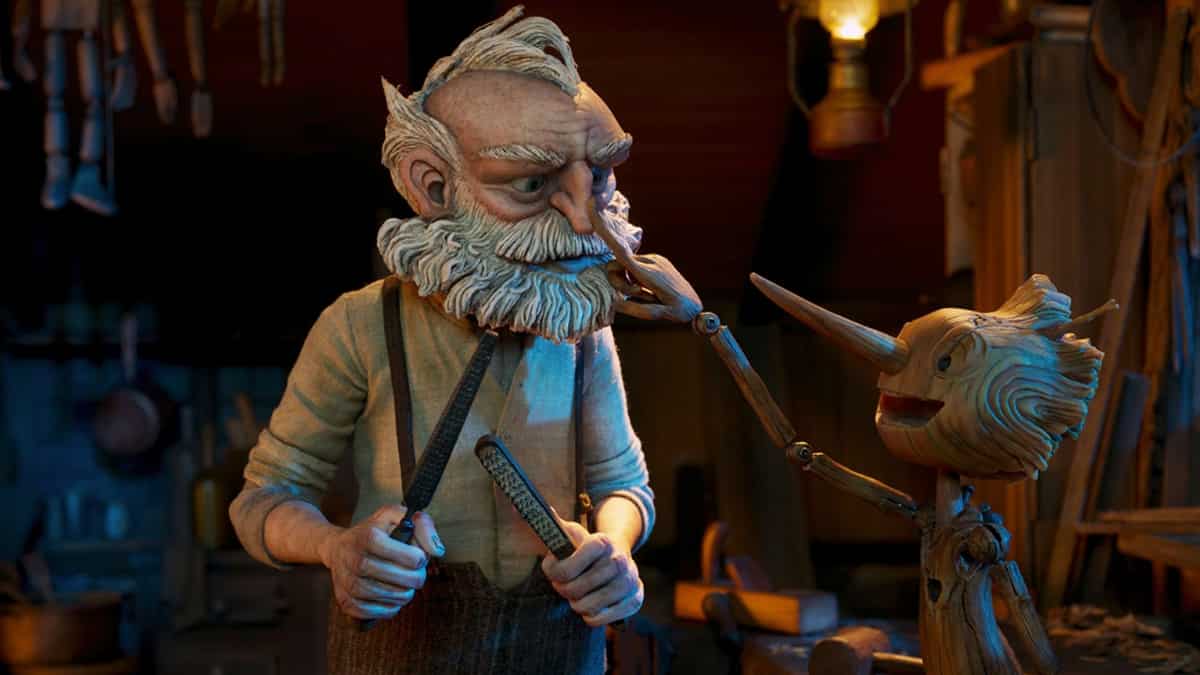
A still from Netflix's 'Pinocchio'.
Now that is the 'Pinocchio' I like.
In September this year, Disney released a live-action remake of the 1940 animated classic 'Pinocchio'. Directed by Robert Zemeckis, the film robbed the original of the magic that made it special in the first place. Classic 2D animated films have a certain artistic value. Transforming those beautifully handcrafted frames to drab reality, as a rule, is never a good idea, especially when the attempt is just to cash in on the nostalgia and not to do something fresh. (Just an aside, but Disney should really stop remaking animated films). Now Netflix's stop-motion animated pic 'Pinocchio', also called 'Guillermo del Toro's 'Pinocchio'', is not surprisingly a much, much better adaptation—edgy, darker, and way more emotionally satisfying.
Directed del Toro and Mark Gustafson and scripted by del Toro and Patrick McHale, the film changes the period of the film but hovers closer to the original story by Italian author Carlo Collodi. Instead of the 1880s, the film is set in Fascist Italy. del Toro's films, although often concerned with otherworldly monsters and weird creatures, never shy away from contextualising stories and characters firmly in their politics and social milieu. Only, he extensively uses metaphors, and many tend to utterly miss the point of his stories.

He has always been attracted to those who do not belong. His movies, many of which can be characterised as fairy tale movies for adults, more often than not explore the weird and the monstrous. For him, monsters do not exist for our fear and loathing. He thinks of them as manifestations of our inner demons. Monsters in his stories are strange and often repellent, but simultaneously beautiful in a strange way.
'Pinocchio' follows the titular puppet, carved by one Master Geppetto (David Bradley) who has been grieving for his son. Put in a little fairy magic and, lo and behold, the puppet comes alive. This is not good news to Geppetto, however, who sees the "fire hazard" as an abomination—not only unworthy to be son, but something to be abhorred, to be disgusted by.
&imwidth=180&imheight=135&format=webp&quality=medium)
Trick or Treat -Anthropic's IPO sales pitch is the perfect Halloween scare for AI enthusiasts
&imwidth=180&imheight=135&format=webp&quality=medium)
'He is a red flag': Ex-India strength and conditioning coach on Rohit's fitness regime
&imwidth=180&imheight=135&format=webp&quality=medium)
Chris Brown given suspended eight-month jail term for London nightclub attack
&imwidth=180&imheight=135&format=webp&quality=medium)
Uttarakhand innovator Ravi Tamta builds flying car without any formal engineering degree
&imwidth=180&imheight=135&format=webp&quality=medium)
'Hell of a beautiful a**': Trump compliments Nicki Minaj as rapper joins him in Michigan rally
&imwidth=180&imheight=135&format=webp&quality=medium)
IND vs NZ 3rd T20I: Abhishek Sharma equals Rohit Sharma's record of 35-ball 100
&imwidth=180&imheight=135&format=webp&quality=medium)
Zimbabwe slips four places to 14th out of 29 in Africa’s Digital Rights and Inclusion ranking
&imwidth=180&imheight=135&format=webp&quality=medium)
Jordan strikes 'terrorist organisations' in Syria after deadly church attack as Damascus shuts main border crossing
&imwidth=180&imheight=135&format=webp&quality=medium)
Police called after 3-year-old scores 10 goals in 12 minutes at Florida youth soccer game
&imwidth=180&imheight=135&format=webp&quality=medium)
Meta’s AI bet is getting more expensive: What its $95 billion share plan means
&imwidth=180&imheight=135&format=webp&quality=medium)
'Lousy president': Trump hits back at Obama over 'cheesecake factory' White House jibe
&imwidth=180&imheight=135&format=webp&quality=medium)
Pakistan airline PIA unveils new crew uniforms, faces online criticism
&imwidth=180&imheight=135&format=webp&quality=medium)
Maurene Comey, daughter of ex-FBI director James Comey, was unlawfully fired as federal prosecutor, judge rules
&imwidth=180&imheight=135&format=webp&quality=medium)
Trump accused of 'brutal' rape by ex-Miss Switzerland; Beatrice Keul alleges 'Don's best friend' Epstein facilitated assault in 1993
&imwidth=180&imheight=135&format=webp&quality=medium)
'Already tired of his 9-to-5': Baby born with a moustache becomes internet sensation, video goes viral | Watch
&imwidth=180&imheight=135&format=webp&quality=medium)
Trump’s oil and gas holdings surge to $81.6 million amid Iran war as Americans face rising fuel costs
&imwidth=180&imheight=135&format=webp&quality=medium)
Microsoft offers voluntary exit packages to 60,000 employees in India, US, UK and Canada
&imwidth=180&imheight=135&format=webp&quality=medium)
One dead, six injured in Elizabeth, New Jersey mass shooting; suspect flees
&imwidth=180&imheight=135&format=webp&quality=medium)
Democrats allege 'desperate efforts to cover up' Trump's involvement in Jeffrey Epstein sex crimes, release 50-page report
&imwidth=180&imheight=135&format=webp&quality=medium)
Shah Rukh Khan unveils new poster of King, Internet reacts
&imwidth=180&imheight=135&format=webp&quality=medium)
Hijack scare unfolds on United flight over suspicious text message. Here is what happened
&imwidth=180&imheight=135&format=webp&quality=medium)
'She is a beautiful woman': Trump mocks Mexican President Sheinbaum, mimics her voice at US Midterms rally
&imwidth=180&imheight=135&format=webp&quality=medium)
US midterms 2026: Democrat Annie Andrews gains bipartisan backing against Trump's pick Darline Graham in South Carolina Senate race
&imwidth=180&imheight=135&format=webp&quality=medium)
Mohra re-release in 4K: Akshay Kumar, Raveena Tandon’s film to clash with Ranbir Kapoor’s Ramayana
&imwidth=180&imheight=135&format=webp&quality=medium)
'I've done my work sincerely': AR Rahman on facing backlash over Ramayana soundtrack
&imwidth=180&imheight=135&format=webp&quality=medium)
US Midterms 2026: Last leg polls and forecasts indicate Democratic momentum, but Senate control remains uncertain
&imwidth=180&imheight=135&format=webp&quality=medium)
'Hire the robot, fire the human': Bill Gates's words hint at a bleak future
&imwidth=180&imheight=135&format=webp&quality=medium)
'Shove that ballroom up your a**': Trump heckled at Mississippi rally over White House ballroom renovations | WATCH
&im=FitAndFill=(700,400)&imwidth=180&imheight=135&format=webp&quality=medium)
New OTT releases this week (October 26-November 1, 2026): Baththa, Akka, The One About Matthew Perry- 7 titles coming on Netflix, Prime Video and more
&imwidth=180&imheight=135&format=webp&quality=medium)
WATCH | Virat Kohli returns to training ahead of New Zealand ODI series
&imwidth=180&imheight=135&format=webp&quality=medium)
‘That is a miss’: Ravi Ashwin questions Sooryavanshi’s demotion to No. 3 in 2nd T20I vs NZ
And honestly, the puppet is indeed depicted as quite ugly, a misshapen carving only vaguely humanoid in appearance (which is, again, closer to Collodi's original story). The mischievous and impudent boy yearns to become a real human boy. For Geppetto, he comes to fill the void left by his son. Pinocchio, on the other hand, finds his humanity and a sense of purpose.
Sebastian J. Cricket (Ewan McGregor) is also there, serving as the narrator and a pal of Pinocchio. Despite the 'unfinished' look, 'Pinocchio' comes across as more endearing than he has any right to be. Child actor Gregory Mann does a great job of bringing out the innocence and lovability of the character. Right from the first moment, it opens its eyes, so to speak, you will fall in love with its little lump of wood with anthropoid features. I know I did.
The story has other minor changes from the original novel. For instance, instead of The Coachman, we get a government official Podestà, who thinks, Pinocchio, a puppet who cannot die (for long anyway), would be the perfect soldier to take on Italy's enemies.
The visuals, as expected from a film made by del Toro and stop motion master Gustafson are quite pleasing. There is something about the stop-motion technology that feels granular, and authentic (I am aware this is a magic-infused animated setting), and the visual aesthetic perfectly suits the story.
There are so many awe-inspiring moments, and once again you end up wishing Netflix released some of its projects on the big screen here in India. A theatrical screen would have embellished the meticulous imagery. Alexandre Desplat's outstanding would also have been better served with cinema-quality surround sound. As it is, 'Pinocchio' is one of this year's pretties looking and sounding films.
The film explores those trademark del Toro themes of a sense of belonging, lost innocence, distinctiveness, authoritarianism, and so on. Since this is Mussolini's era, Il Duce himself turns up, shooting the performing puppet and sending him to one of his many deaths. It must be said that the political setting does not gel as well as you would expect. It feels slightly forced, and the transpiring events are not particularly affected by the regime ruling Italy.
The ending is a gut punch, an emotional payoff worthy of the character arc.
'Pinocchio' is fantastic.
<