
&imwidth=800&imheight=600&format=webp&quality=medium "Oil steadies as Trump–Putin meeting looms over Ukraine conflict and sanctions")
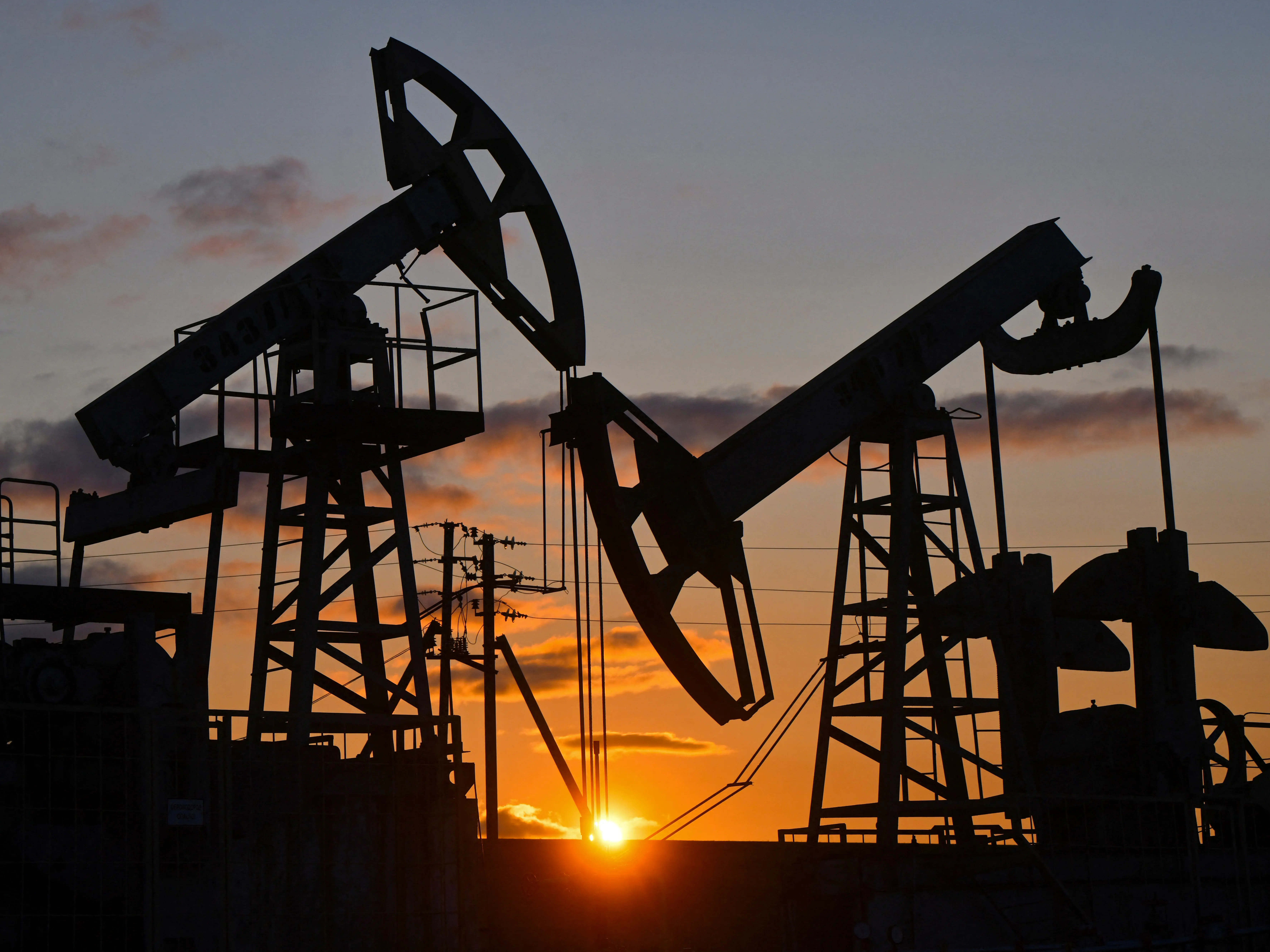
As traders look ahead to a high-stakes meeting between US President Donald Trump and Russian President Vladimir Putin on Friday, a diplomatic encounter that could reshape the outlook for sanctions on Russian crude, oil markets were steady. West Texas Intermediate (WTI) traded near $63 a barrel after slipping 1.2 per cent in the previous session, while Brent closed just below $66, according to Bloomberg. The drop came in thin trading, with investors waiting for geopolitical cues from the upcoming Alaska summit, where Ukraine’s conflict is expected to dominate the agenda.
Why the Trump–Putin talks matter for oil?
An easing of US sanctions on OPEC+ member Russia could reportedly release more supply into the market, a development that traders are watching closely. Any such move could add to an already bearish supply picture, as global output is ramping up despite concerns about slowing demand due to US tariff pressures on the world economy.

The US Department of Energy (DOE), as reported by Bloomberg, has revised up its 2025 global oversupply forecast to 1.7 million barrels per day. The International Energy Agency (IEA) will release its own estimates later on Wednesday. OPEC, meanwhile, has kept its more bullish view, predicting a tighter oil market next year than previously projected.
US stockpiles rise, demand season nears its end
Whereas, data from the American Petroleum Institute (API), cited by Reuters, showed US crude inventories rising by 1.52 million barrels last week. Gasoline stocks fell, but distillate inventories used for diesel and heating oil gained slightly. Analysts polled by Reuters expect the US Energy Information Administration (EIA) to show a smaller crude drawdown of about 300,000 barrels in its official data later Wednesday, suggesting that the summer driving season may have already peaked. This seasonal demand window usually runs from Memorial Day in late May to Labour Day in early September.
Trending Stories
)
Why asking questions could be more important than memorising answers
)
Osama Bin Laden ‘planned’ to target India, CIA reveals dozens of declassified documents
)
'Iran won't surrender': Pezeshkian sends blunt message to US while attending BRICS Summit in India
)
BRICS Summit 2026: Global leaders of BRICS nations attend main open session
)
PM Modi and China's Xi offered to help resolve Russia-Ukraine war: Kremlin
)
Celine Dion makes emotional stage comeback after six years: 'I'm so delighted to see you'
)
Why dehydration is the hidden cause of travel fatigue on long flights
&im=FitAndFill=(700,400))
Meet top 5 batters fastest to 3000 runs in T20Is
)
Top 5 places to visit in Goa beyond its famous beaches
)
'He is popular...': Malaysian PM Anwar Ibrahim's praise for PM Modi during bilateral meeting | WATCH
)
BRICS Summit 2026: PM Modi, Xi reach key consensus on ties, China to assume BRICS chairmanship in 2027
)
BRICS Summit 2026: Consensus on joint declaration, diplomatic win for India
)
Trump says Canada eager to reach a deal, it could come ‘fairly soon’ if Ottawa treats US farmers better
)
‘Partners, not rivals’: Xi outlines four point plan for stronger India-China ties
&im=FitAndFill=(700,400))
Why Chinese PL-15 air-to-air missiles use dual-pulse motors compared to European interceptors
)
Could staying indoors all day affect your health?
)
BRICS Summit 2026: PM Modi addresses Day 2 of 18th BRICS summit
)
Who is the smiling man beside Modi, Putin and Xi at BRICS Summit 2026?
)
800 million years old - Scientists discover 'fingerprints' of supercontinent Gondwana in ancient rocks
)
Why going digital does not always mean becoming more efficient
&im=FitAndFill=(700,400))
Why do air defence missiles explode near their target instead of hitting it?
)
War is making Russia stronger? How Ukraine is shaping Moscow’s next generation of weapons
)
Migration protests return to Portsmouth as rival demonstrations face off
)
From severe mobility problems to recovery: Madhuri the elephant’s journey of wildlife care
)
BRICS Summit day 1: New Delhi declaration adopted with full consensus, big diplomatic win for India
)
Did Iran President Pezeshkian touch feet of Hindu spiritual leader at Delhi event as shown in viral video?
)
9-year-old Chennai prodigy clears Cambridge IGCSE grade 10 exams
)
Why does your body need time to adjust after a long journey?
)
BRICS Summit 2026: PM Modi to hold bilateral with leaders of seven countries
)
Ramanathaswamy temple takes centre stage as PM Modi welcomes world leaders at BRICS
)
Houthis launch cross-border strike on Saudi Arabia as Yemen war escalates
)
BRICS Summit 2026: Chinese president Xi Jinping departs from New Delhi after attending BRICS summit
)
Why does your skin need protection from UV rays?
)
How does the loss of forests affect the way wildlife lives and moves?
)
IND vs AFG, 1st T20I: When and where to watch live streaming in India?
)
Why do wild animals need quiet places to survive?
)
Bigg Boss 20: Qazi Touqeer gets a special ‘rockstar’ moment from Salman Khan
)
Humans may lose control of AI: Anthropic CEO calls for slowdown, Altman, Musk back him
According to Reuters, the EIA projects US crude output will hit a record 13.41 million barrels per day in 2025, thanks to higher well productivity. However, it expects a decline in 2026 as lower oil prices prompt reduced drilling. OPEC’s latest monthly report, as quoted by Reuters, raises its 2026 global demand growth forecast to 1.38 million barrels per day, an increase of 100,000 bpd from its previous projection, while keeping its 2025 demand estimate unchanged.
The White House, as reported by Reuters, has already signalled that a quick Ukraine ceasefire is unlikely, meaning sanctions relief for Russia may not be imminent. Still, ANZ senior commodity strategist Daniel Hynes told Reuters that traders appear less convinced about the possibility of fresh sanctions, even though President Trump has downplayed expectations of a breakthrough.
Oil market snapshot
As per Reuters, Brent crude, the global benchmark, inched up to $66.15 a barrel, a modest gain of three cents in early trade. The move comes after a 0.8 per cent drop in the previous session, reflecting market hesitation ahead of the Trump–Putin meeting in Alaska. Whereas, US WTI crude slipped slightly by three cents to $63.14 a barrel, as per Reuters. While the change was marginal, it followed a sharper 1.2 per cent decline a day earlier. Oversupply concerns and a build-up in domestic stockpiles are keeping prices under pressure.
API figures, as cited by Reuters, show US crude inventories rising by 1.52 million barrels last week. This suggests refiners may be cutting back runs as the summer demand season winds down. Gasoline stocks fell, but distillate inventories posted a small gain. Bloomberg reports that the DOE now expects a much larger global surplus in 2025, 1.7 million barrels per day, compared to earlier projections. Without production cuts from OPEC+, this could weigh heavily on prices.
Reuters cites the EIA’s projection that US crude production will reach a record 13.41 million barrels per day in 2025, boosted by well productivity gains, before easing in 2026. OPEC’s latest monthly report, as quoted by Reuters, raises its 2026 global oil demand growth forecast to 1.38 million barrels per day, driven by Asia and emerging markets, while demand growth in mature economies slows.
| Indicator | Latest Level | Change from Previous Session |
| Brent crude | $66.15/bbl | +$0.03 (+0.05%) |
| WTI crude | $63.14/bbl | -$0.03 (-0.05%) |
| US crude stocks | +1.52 million barrels | Week ended Aug 8 |
| DOE oversupply forecast (2025) | 1.7 million bpd | Up from earlier estimate |
| US crude output forecast (2025) | 13.41 million bpd | Record high |
| OPEC global demand forecast (2026) | +1.38 million bpd | +100,000 bpd vs earlier |
(Source: Reuters, Bloomberg)
Possible price paths after the Trump–Putin meeting
If Trump and Putin agree on steps to lift or soften sanctions on Russian crude, more supply could flow into the global market. According to Bloomberg, this could push Brent prices back toward the low $60s.
If there is no major breakthrough, prices may stay range-bound. As per Reuters analysts, Brent could hold between $63 and $66 as traders continue to price in the current sanctions regime.
If fresh sanctions are imposed, further restricting Russian crude exports, the resulting supply squeeze could push Brent above $70 per barrel, especially if OPEC+ output remains steady, according toReuters.
(With inputs from the agencies)