Autumn market jitters intensify as investors brace for prolonged selloff

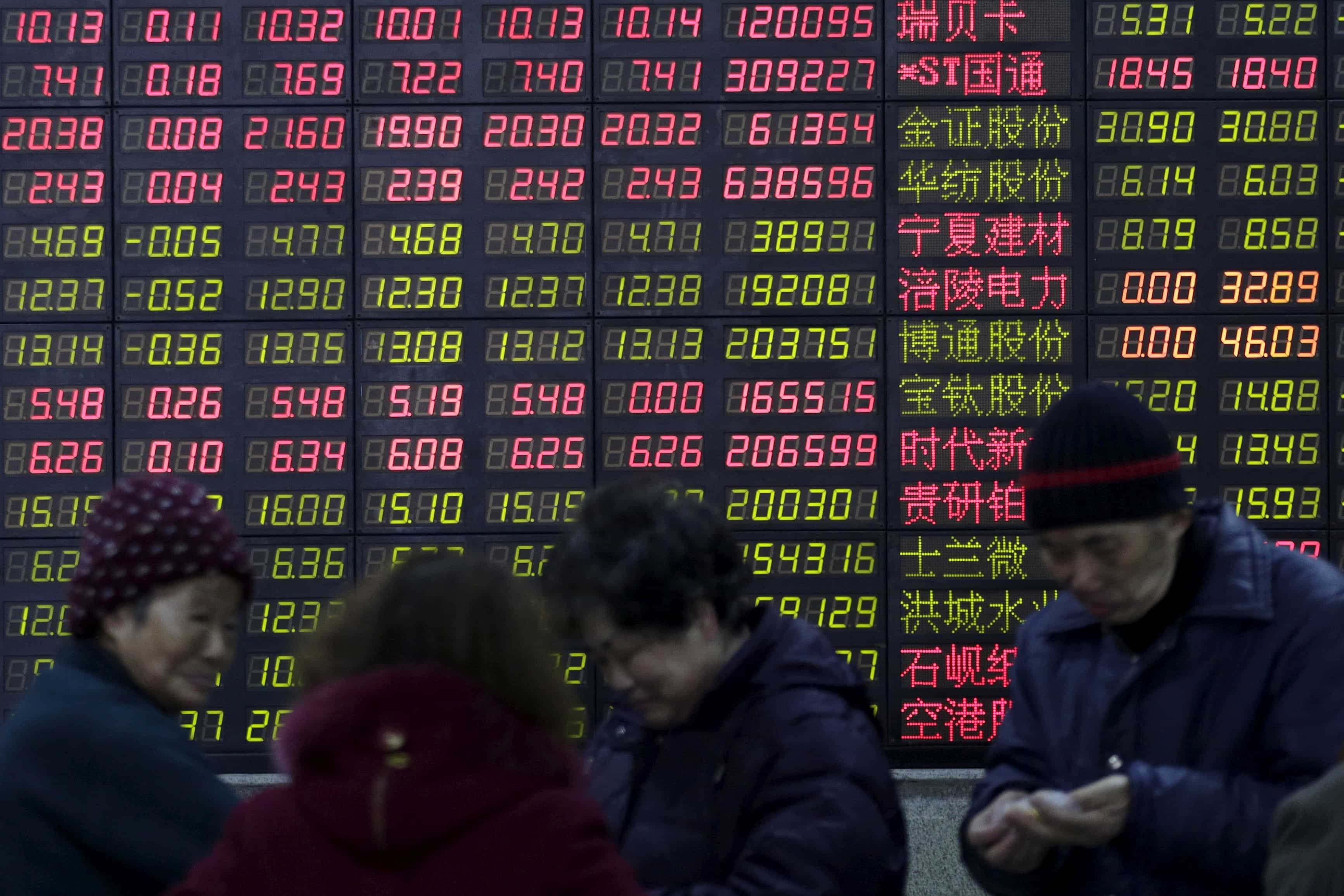
Investors stand in front of an electronic board showing stock information
Big investors have positioned for this summer's rout in stocks to bleed into autumn on concerns that a broader wave of selling will follow the turmoil originated by US recession concerns and the Bank of Japan wrong-footing currency speculators.
The sudden turning round of crowded equity and foreign exchange trades driving vicious feedback loops of price drops, volatility, and hedge fund selling has eased, with world stocks nearly 2 per cent higher so far this week.
Now, asset managers presiding over hundreds of billions of dollars in investments say they are more likely to continue selling stocks than buying back in with the signs of weakness in the US jobs market and global consumer trends trimming the bar for market aftershocks.

What is taking the place of the common 'buy-the-dip' mentality, in which investors typically respond to selloffs by making recovery bets, is fear.
"It's not simply now a large financial market accident, which maybe we could describe last week as. It's broader than that," said Mahmood Pradhan, a former IMF deputy director and head of global macro at the research arm of Amundi, Europe's largest fund manager.
He expects investors, who, according to Bank of America, have already cut equity positions and shifted increasingly into cash, to stay cautious.
)
India ‘deeply concerned’ as Houthi strikes hit Saudi civilian & energy sites
)
Three labourers killed as DU student loses control of his car, rams into them on Dwarka Expressway
)
Pentagon revives mandatory testosterone testing for male troops aged 30 and above
)
FACT CHECK: Why did PM Modi ask Xi ‘is it okay’ at BRICS Summit? New video reveals...
)
India seeks to build a full semiconductor supply chain
)
North Korea's last nuclear test in 2017 set off 1,399 earthquakes over 8 years, each stronger than previous
&im=FitAndFill=(700,400))
From Abhishek Sharma to Sahil Chauhan, 5 batters with fastest T20I hundreds
)
Indian activist-lawyer Prashant Bhushan's post brings focus on ‘conflict of interest’ appointments of ex-govt officials at Reliance, Adani groups
)
Former India player Diana Edulji wants Smriti Mandhana to replace Harman as skipper at the earliest
&im=FitAndFill=(700,400))
Meet top 5 batters in the latest ICC T20I Rankings
)
UNGA 2026 theme explained: What does ‘Restoring trust, managing transformation: A United Nations that delivers for all’ mean?
)
Godfather of AI Geoffrey Hinton gives US lawmakers a one-year warning on AI
)
US F-16 fighter jet crashes in Michigan during training mission, pilot ejects safely
)
Xi-Trump summit may boost military links
)
Shivakumar attends 79th Kalyana Karnataka Utsav in Kalaburagi
)
A first in 100 years: New cat species discovered in Bolivia is incredibly tiny
)
Trump signs Russia sanctions law: India faces fresh 100% tariff threat over Russian oil
)
Hong Kong extends newborn cash support scheme by three years
)
How did an Australian river with 500 crocodiles pass the Olympic test? Here's how
)
‘Will go to any extent’: Pakistan vows to defend Saudi Arabia amid Houthi attacks
)
'He will always be ahead': India coach Gambhir says Sooryavanshi won't walk into team ahead of Samson
)
The Verdict | When precision fails: US commits war crime in Minab school strike, UN finds
&im=FitAndFill=(700,400))
New Friday OTT releases (September 18, 2026): Lust Stories 3, You+Me, Best of the Best- 8 new titles coming on Netflix, Prime Video and more
&im=FitAndFill=(700,400))
Which country has the most F-35s outside America?
)
Africa is splitting, and a lot sooner than estimated, giving way to a new ocean
)
'Gangsta' crab shoves knife blade at man and his dog in Florida - Watch
)
Trump bans CNN, MS NOW and Politico from White House over ‘FAKE NEWS’
)
Trump 2.0: Dark days ahead for America’s ‘imperial presidency’
)
Laura Wolvaardt sets new world record for most WT20I runs in a year
)
Drone strikes cooling tower at Russia's Kursk Nuclear Plant, IAEA confirms
)
Who is Khalilur Rahman? All you need to know about 81st UN General Assembly President
&im=FitAndFill=(700,400))
Meet top 5 bowlers in latest ICC T20I rankings
)
Cristiano Ronaldo returns to Portugal squad for Nations League under new coach
&im=FitAndFill=(700,400))
Meet top 5 Indian batters with fastest T20I centuries
)
Ukraine plans record $109 bn defence spending, nearly two thirds of budget amid Russia war
One of them is Michael Kelly of PineBridge Investments, who runs multi-asset and has about $170 billion of client funds, and has cut back the stock market positions in his funds and may do so further.
"It's going to be very, very volatile in the next two months," he said.
A first US rate cut, expected next month, might be too late to rescue the economy, he added.
The global growth expectations of investors hit an eight-month low.