The thinking behind Kim Jong Un's 'madness'

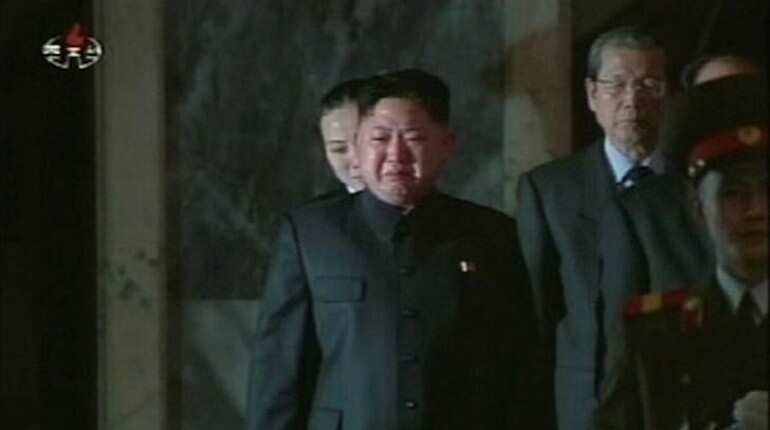
funeral of Kim jong-II father of North Korea's new leader Kim Jong-un
North Korea's Kim?Jong?Un has completed a six-year transition to what the South calls a reign of terror
On an icy December day in 2011, North Korea's new leaderKimJongUn was accompanied by seven advisers as they escorted the hearse that carried his father,KimJongIl, through the streets of Pyongyang.
None of the men remain with the youngKim. This October, he demoted the last of his father's aides, both men in their nineties. They were among around 340 people he has purged or executed, according to the Institute for National Security Strategy, a think tank of South Korea's National Intelligence Service (NIS).
Kim, "obviously a madman" in the eyes of USPresident Donald Trump, has completed a six-year transition to what the South calls a reign of terror. His unpredictability and belligerence have instilled fear worldwide: After he tested a "breakthrough" missile earlier this week, he pronounced North Korea a nuclear power capable of striking the United States. But a closer look at his leadership reveals a methodbehindthe "madness."

At 33,KimJongUn is one of the world's youngest heads of state. He inherited a nation with a proud history, onto which a socialist state had essentially been grafted by Cold War superpowers to create a buffer between Communist China and the capitalist South. UnderKim's father, the economy was mismanaged, and the collapse of Communism in the Soviet Union eliminated an important source of support. Up to three million people starved.
To consolidate a weak position, the young leader has been cultivating three main forces: military and nuclear power, a tacit private sector market economy, and the fear and adoration of a god. To this end, he has executed two powerful men and promoted one young woman –KimYoJong, his younger sister, who Korea-watchers say is alsoKim's chief propagandist. She isKim's only other blood relative to be involved in politics: His elder brother,KimJongChol, was rejected by their father as heir.
Over the five years to December 2016,Kimspent $300 million on 29 nuclear and missile tests, $180 million on building some 460 family statues, and as much as $1 billion on a party congress in 2016 – including $26.8 million on fireworks alone, according to the Institute, which employs high-level defectors.
)
Nigeria: Protesters take to the streets, police fire shots
)
US-Iran war: Tehran draws red lines — seven demands before any peace talks
)
Russia-Europe tensions: Polish PM warns Russian attacks could test NATO's unity
&im=FitAndFill=(700,400))
‘Not the US or China’: These are the countries leading the world in arable land
)
EXCLUSIVE | Singer Hanita Bhambri on her Toxic debut, working with Vishal Mishra and more
)
Mark Carney mimics Trump in hilarious moment over C$70 billion clean-energy investment; room erupts in laughter
)
Delhi voter roll shake-up: 3.31 million electors flagged in SIR review
)
Aravana prasadam shortage at Sabarimala temple in Kerala triggers protests, TDB questioned
)
‘End of my career...’: NSA Doval recalls tense Sikkim mission when China captured Indian intelligence team
)
Report: Iran rebuilding Taleghan 2, nuclear site tied to past weapons research, hit twice by Israel
)
Trump defends AI amid growing alarm, announces new 'AI force' and promises an 'AI czar'
)
Iran sets 7 conditions to end war with US: What are Tehran’s demands?
)
Trump announces ‘AI Force’ as debate grows over AI risks and regulation
)
China may have gained access to US's classified F-35 jets; parts meant for repairs diverted to Hong Kong, sparking Pentagon inquiry
)
Gaza under attack: Health chief's son killed in IDF strikes
)
Arvind Kejriwal, family members, Delhi CM Rekha Gupta get SIR notices
)
Cochin shipyard starts building Indian Navy's next-gen missile vessels
)
Saudi vs Houthis: Houthis claim missiles & drones used in attack on key Saudi sites
)
Ed Sheeran addresses Macklemore's removal, Gaza conflict during Philadelphia concert: 'I cannot hide how I feel'
)
‘Will go to any extent’: Pakistan vows to defend Saudi Arabia amid Houthi attacks
66 years of the Indus Waters Treaty: How India and Pakistan settled a bitter river dispute
)
The Verdict | When precision fails: US commits war crime in Minab school strike, UN finds
Russia attacks Ukraine with 174 drones, kills 8; 2 vessels hit in Black Sea
)
9 women found dead near Johannesburg: South Africans rally, demand 'enough' to femicide
)
Kampala-Ankara rift deepens: Uganda suspends military ties, seeks Fred Lumbuye's extradition
)
Trump wants to rename ‘Artificial Intelligence’, gives 3 options: Which one would you pick?
)
US-Iran war: Tehran sets seven conditions to re-engage in talks with US
)
Reacher star Alan Ritchson opens up about alleged blackmail, suicide attempt during difficult period
)
Africa is splitting, and a lot sooner than estimated, giving way to a new ocean
)
Flying cars in UAE: Ras Al Khaimah signs deal with Chinese company to test new transport
)
Trump bans CNN, MS NOW and Politico from White House over ‘FAKE NEWS’
)
Trump 2.0: Dark days ahead for America’s ‘imperial presidency’
&im=FitAndFill=(700,400))
How many F-35s does Britain, Japan and Israel have?
)
Harry Brook targets long reign at top of T20I rankings after Sri Lanka sweep
)
Russia's deadly Ukraine strikes kill 2 in Sumy, hit Dnipro mall
)
Russia holds first parliamentary elections since the beginning of the Ukraine war
&im=FitAndFill=(700,400))
Meet top 5 Indian batters with fastest T20I centuries
)
Raphinha hat-trick powers Barcelona to 3-1 win over Sevilla in La Liga
)
)
"Yes, he has replaced many top commanders and officials so easily and ruthlessly killed some of them, which could make you wonder if he's sane," said Lee Sang-keun, a North Korean leadership expert at the Institute of Unification Studies at Ewha Womans University in Seoul.
"But this is a historical way of governing that can put you in power for a long time."
Great Leader
In ancient days, Pyongyang was the capital of a mighty empire, Koguryo, the root of the modern word "Korea." Going back through history, the Great Leader concept is a blend of several ideas handed down through time: an almighty god, the Confucian worship of a parent, and a king with the Mandate of Heaven, according to Lee Seung-yeol, a senior researcher at the National Assembly Research Service in Seoul.
Lee, a leading North Korea leadership researcher, said the state's theory of succession meansKimthe younger's rise should have been completed while his father was alive:Kim's father was anointed 20 years before he took over, giving him time to build allies and a leadership system.
KimJongUn had just three years as leader-in-waiting.
Born in 1984, he was third in line for power and a fractious, competitive child, according to Kenji Fujimoto, a Japanese chef who worked for the family and one of the few people to recount meetings with the youngKim. In his memoirs published in 2010, Fujimoto, who now runs a sushi restaurant in Pyongyang, saidKimonce snapped at his aunt Ko Yong Suk for calling him "Little General."Kimwanted to be called "Comrade General."
WhenKimJongIl knew his young son would soon succeed him, researchers have said, the father took several measures to protect the boy. Lee said these included shifting the country's power base to create rivalry between the elites soKimthe younger could play one group off against another.
KimJongIl had declared the military the country's supreme power – a policy known as songun, which means "military first." At a party conference in 2010, he changed the setup so the military had to compete with the party administration for the leader's favour.
"Poor man's weapon"
Military strategy was the first thingKimchanged. His father had used the promise of nuclear disarmament as a bargaining chip for aid, and in February 2012, youngKimstarted in his father's footsteps, promising to freeze North Korea's nuclear programme in return for food aid from the United States.
But weeks later he changed tack, saying North Korea would fire a long-range rocket. "The negotiations were carried on as the legacy ofKimJongIl," said Wi Sung-lac, a former South Korean envoy to talks in 2011 that contributed to the February deal. "Since then his strategicthinkinghas shaped up."
InKim's view, Saddam Hussein of Iraq and Muammar Gaddafi of Libya were fatally weakened by not having nuclear weapons, North Korean media say. "History proves that powerful nuclear deterrence serves as the strongest treasured sword for frustrating outsiders' aggression," the official KCNA news agency said in an editorial in January 2016.
North Korea is racing to achieve a nuclear deterrent because the state feels threatened, worrying particularly thatKimmay face a fate like Gaddafi. The Libyan leader agreed in 2003 to eliminate his weapons of mass destruction; in 2011, he was killed by rebels that the United States and its allies had supported.
Months afterKim's accession, North Korea updated its constitution to declare itself a nuclear weapons state.
One leading pallbearer atKimJongIl's funeral was Ri Yong Ho, Chief of the General Staff of the Korean People's Army.Kimsacked him in July 2012. South Korean intelligence later confirmed that Ri had been executed.
By December 2012, North Korea had carried out another, successful, rocket test.
In 2013,Kimoutlined a new policy: The "byungjin line," or parallel development, to combine the nuclear buildup and economic growth.
A nuclear deterrent is essential to that, says Thae Yong-ho, North Korea's former deputy ambassador to London, who staged a high-profile defection to South Korea in 2016. The threat of absolute destruction makes a nuclear bomb a "poor man's weapon" with which to tighten control of the country and ensure long-term rule, Thae said.
"Once he has assumed control of usable nuclear weapons, he has more room to allocate resources more flexibly, and allocate the military forces for civilian construction," said Thae.
"Foolish dream"
North Korea spends about a quarter of its GDP on defence: Russia's President Vladimir Putin has saidKimJongUn would have his people "eat grass" rather than give up its nuclear programme.
But with a legacy of famine,Kimalso says he wants to boost people's prosperity.
The former chef, Fujimoto, said that on one summer break from school in Switzerland in 2000, the youngKimwas preoccupied with a visit to Beijing his father had made.
"Let's talk," Fujimoto recalled the future leader saying over drinks on his father's private train. "I hear from higher up that China seems to be succeeding on many fronts – engineering, commerce, hotels, agriculture - everything,"Kimsaid. "In many ways, don't we need to take them as a model example for us?"
In 2012, shortly after taking power,Kimwent a small way to mimic reforms China made in the 1980s. Farmers were allowed to keep most of the harvest. State enterprises were given the right to buy and sell at market prices and to hire and fire workers. Private entrepreneurs and traders were encouraged to invest in state projects or with party and military entities.Kimalso began to turn a blind eye to informal markets – a force his father tried in vain to contain.
That April,Kimaddressed the nation - the first time in 17 years North Koreans had heard the voice of their leader. "It is the party's steadfast determination to ensure that the people will never have to tighten their belt again," he said.
Outsiders hoped the reform signaled a new political openness asKimdrove to promote the North in the world: In 2012 Antonio Razzi, an Italian senator for Forza Italia who calls himself the only Italian to have met the leader, saidKimhad asked him to find training facilities for soccer players in Italy.
"I have talked with many (North Korean) local leaders," Razzi said. "They have no plan to attack anybody. North Korea is interested in nuclear only as a form of defence."
Kimworked to ensure the economic freedom would not unseat him.
Also escorting his father's funeral car in 2011 was Jang Song Thaek, an administrator at the vanguard of the reforms. He was married toKimJongIl's sister, was a special envoy to China and had overseen a host of new Special Economic Zones all over the country.
In December 2013, Jang was hauled out of the Politburo in front of the cameras and accused of plotting a coup. "Jang dreamed such a foolish dream," state media said, adding Jang hoped his reformist plans would help him "get 'recognised' by foreign countries."
Jang was shot "dozens of times" by an anti-aircraft gun and his remains removed with a flamethrower, according to South Korea's National Intelligence Service (NIS) – an account no one has confirmed.
"Development dictator"
From that point on,Kimhoned his personality cult. On the day Jang's purge was announced, North Korea's official daily the Rodong Sinmun unveiled a song dedicated toKimJongUn, titled "We Know Nothing But You." More were to follow.
The next year,Kimalso ordered school textbooks be revised to focus on idolisation of himself and include images of nuclear weapons and missiles, according to the NIS-affiliated Institute for National Security Strategy.
The idolisation campaign kicked into high gear in 2016, focused on pop culture and youth:Kim's chosen female singers, the Moranbong Band, staged a series of musical performances and plays calling for loyalty to the leader, while the Shock Brigade, a crew of young North Koreans in charge of major economic construction, produced about 1,200 poems and other literary works, the Institute said.
"He has linked his own legitimacy to improving the economic situation in the country," said John Delury of Seoul's Yonsei University. "KimJongUn wants to become a development dictator."
At home, he casts himself as a bringer of plenty. In 2015, almost half the times he was photographed were at economic events, data from Seoul's Unification Ministry shows. Only this year, as his weapons tests multiplied and met an angry response in the United States, have military appearances come back into prominence.
Standing tearfullybehindKimJongUn at their father's funeral was his younger sister, 28-year-oldKimYoJong. On the same October day thatKimdropped the last two of his father's aides, he included her in his Politburo.KimJongChol, their elder brother, leads a quiet life in Pyongyang where he plays guitar in a band, according to former ambassador Thae.
"I thinkKimJongUn has been making good use of the existing system, while strengthening his power base and dictator regime in a very shrewd manner," said Lee Su-seok, a research fellow at the Institute for National Security Strategy.