New Zealand plane en route to Southern Pacific island struck by lightning

Air New Zealand
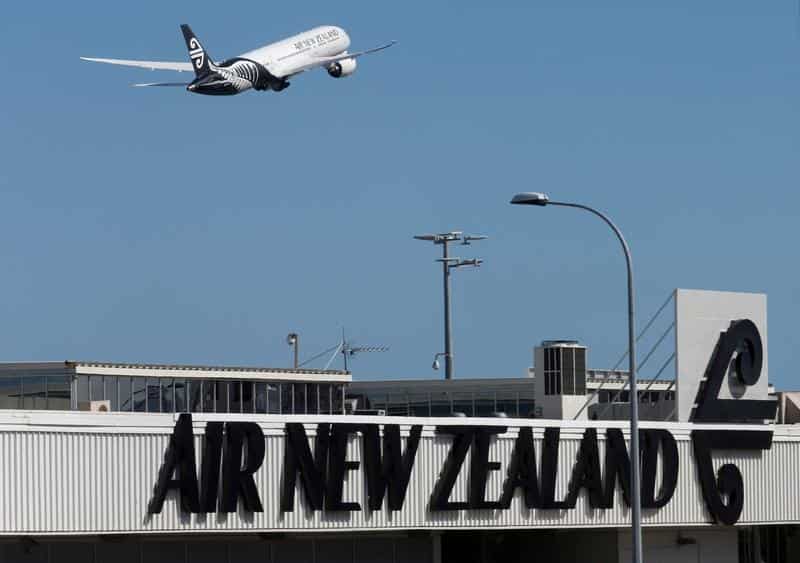
A New Zealand flight bound for Rarotonga, Cook Islands, in the Southern Pacific was struck by lightning early Thursday morning.
Passengers on board had the scare of their life as the Air New Zealand flight circled over Tāwharanui Peninsula in northern Auckland eight times for almost an hour before landing around 8 am (local time).
Flight tracking showed the aircraft didn’t make it far before being hit.The aircraft was an Airbus A321 —a twin-jet plane.NZ942 was struck shortly after take-off. The plane had to use up some fuel before landing.

Following the incident, Air NZ said they set up a “recovery flight” to get disappointed jet-setters to Cook Island.
“The aircraft has now landed back in Auckland, where it will undergo standard engineering checks,” an Air NZ spokesperson said just after 8:30 am (local time), according to Stuff news portal.
The spokesperson said that lightning strikes are not uncommon.
)
Pentagon revives mandatory testosterone testing for male troops aged 30 and above
)
FACT CHECK: Why did PM Modi ask Xi ‘is it okay’ at BRICS Summit? New video reveals...
)
India seeks to build a full semiconductor supply chain
&im=FitAndFill=(700,400))
From Abhishek Sharma to Sahil Chauhan, 5 batters with fastest T20I hundreds
)
Pyongyang dismisses US, western pressure over nuclear programme
)
US And Denmark reach Greenland deal, Trump announces expanded military presence
)
Google’s Gemini AI hacks real systems by guessing passwords during security test
)
US hiding troop deaths in Iran war? Toll higher than Pentagon count, claims report
)
China may have gained access to US's classified F-35 jets; parts meant for repairs diverted to Hong Kong, sparking Pentagon inquiry
)
NASA research plane reaches 61,000 feet over Panama
)
Godfather of AI Geoffrey Hinton gives US lawmakers a one-year warning on AI
)
Trump signs Russia sanctions law: India faces fresh 100% tariff threat over Russian oil
)
Brigitte Bardot’s private collection set for Paris auction; key items and prices revealed
)
Why Ranveer Singh’s Dhurandhar missed India’s Oscar entry; FFI jury member reveals what happened
)
Zendaya and Tom Holland step out for a low-key date in Los Angeles
)
‘Will go to any extent’: Pakistan vows to defend Saudi Arabia amid Houthi attacks
)
The Verdict | When precision fails: US commits war crime in Minab school strike, UN finds
)
Trump signs Russia sanctions bill into law, targets Moscow’s energy sector
66 years of the Indus Waters Treaty: How India and Pakistan settled a bitter river dispute
&im=FitAndFill=(700,400))
New Friday OTT releases (September 18, 2026): Lust Stories 3, You+Me, Best of the Best- 8 new titles coming on Netflix, Prime Video and more
)
Pak: A series of counter terrorism operations in Khyber Pakhtunkhwa
)
Fast bowler Brydon Carse faces no charges over Derby nightclub incident
)
Flying cars in UAE: Ras Al Khaimah signs deal with Chinese company to test new transport
)
Africa is splitting, and a lot sooner than estimated, giving way to a new ocean
)
Trump bans CNN, MS NOW and Politico from White House over ‘FAKE NEWS’
)
Trump 2.0: Dark days ahead for America’s ‘imperial presidency’
)
Trump's Greenland dream comes true? POTUS announces 'Infinite Life' deal with Denmark, claims permanent US control
)
Tirupati Laddu ghee adulterated with chemicals, says ED, supplier arrested
)
Who is Khalilur Rahman? All you need to know about 81st UN General Assembly President
)
IIT Bombay student dies by suicide, was caught seeking AI help during exams
&im=FitAndFill=(700,400))
Meet top 5 bowlers in latest ICC T20I rankings
)
Indian Cinema bets big on mythology, brings ancient stories to modern audiences
)
Ukraine plans record $109 bn defence spending, nearly two thirds of budget amid Russia war
)
Russia holds first parliamentary elections since the beginning of the Ukraine war
&im=FitAndFill=(700,400))
Meet top 5 Indian batters with fastest T20I centuries
)
“Aircraft are designed with this in mind and our pilots train for this scenario.”
Notably, this wasn’t the first time that a plane turned back after experiencing a few glitches.
Earlier this week, a damaged windscreen forced a plane headed forJapan to turn around miles above the Pacific Ocean on Monday.
Lightning strikes are common
As mentioned by Air NZ’s spokesperson, lightning striking a plane is common. More lightning strikes occur while in clouds, during the climb and descent phases of flight, than in any other flight phase.
The reason is that lightning activity is more prevalent between 5000 to 15,000 feet (1524m to 4572m).
The planes that undertake short routes with a high incidence of lightning activity are more likely to be struck compared to long-haul airplanes operating in mild environments, experts noted.
A study by Boeing argued that a single bolt of lightning could contain as much as 1 million volts or 30,000 amps.
The amount and type of damage an airplane experiences when struck by lightning can vary greatly, depending on factors such as the energy level of the strike, the attachment and exit locations, and the duration of the strike, the study says.
Most commercial flights are made of aluminium, which is a good conductor of electricity and allows the lightning to pass across the skin of the aircraft, with the current usually exiting the aircraft at the tail.
Static wicks (small wires that are screwed into the trailing edge of plane wings) discharge static electricity that an aircraft picks up as it moves through the air but also dissipates a lightning strike.
(With inputs from agencies)
WATCH WION LIVE HERE