

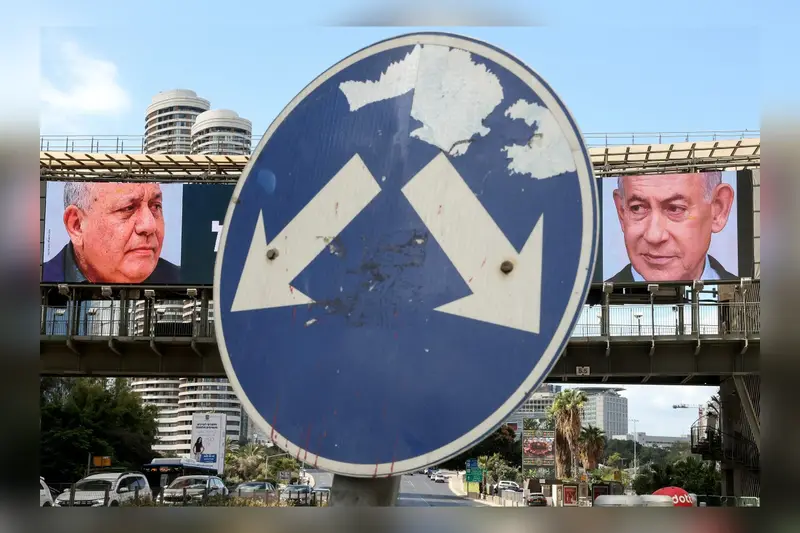
As Israel polls to elect its Prime Minister on October 27, Benjamin Netanyahu, leader of the nationalistic Likud party and former military chief Gadi Eisenkot, leader of the centrist Yashar party, are the two main rivals to lead the country. Pre-election opinion polls suggest a highly fragmented Knesset, while Eisenkot and Yashar are clearly coming across as favourites to lead the country.
The two leaders, though, positioned themselves with contrasting leadership styles and domestic policies, but their core security and foreign policy targets are common. Both candidates strongly reject the two-state solution, pledge to block nuclear Iran and dismantle Hezbollah and Hamas. So for international observers, there is very little room for any manoeuvring, and it's a distinction without any difference.
Neither candidate offers Palestinians a state. Netanyahu has built a career on blocking one. In July 2024, the Knesset passed a resolution opposing Palestinian statehood by a wide margin, with support from parts of the opposition. Similarly, Eisenkot calls the two-state formula a mistake.
The clean break memo-1996
Israel is the only country in the world that doesn't define its border, has the strongest military in the region, and controls the territory at the centre of the dispute. That ambiguity has been strategic, and it shows in the buffer zones in southern Syria and Lebanon, the open-ended presence in Gaza, and the settlement build-out in the West Bank.
If you trace the ideas, these are not new; they can be found in a paper written in 1996, the “Clean Break” memorandum by a group of Israeli and American neoconservatives for Netanyahu's first term, including Richard Perle and Douglas Feith. It explicitly advised Israel to make a "clean break" from the Oslo Accords. It set aside land-for-peace in favour of "peace for peace" and force. It gave the refusal of statehood a strategic rationale: Israel could hold the territory and manage the threat without a settlement. Once Palestinian claims had faded from public memory, that logic found a receptive audience.
Trending Stories

'Hell of a beautiful a**': Trump compliments Nicki Minaj as rapper joins him in Michigan rally

'Hire the robot, fire the human': Bill Gates's words hint at a bleak future

'Lousy president': Trump hits back at Obama over 'cheesecake factory' White House jibe

Jordan strikes 'terrorist organisations' in Syria after deadly church attack as Damascus shuts main border crossing

Microsoft offers voluntary exit packages to 60,000 employees in India, US, UK and Canada

WATCH | Virat Kohli returns to training ahead of New Zealand ODI series

'He is a red flag': Ex-India strength and conditioning coach on Rohit's fitness regime

One dead, six injured in Elizabeth, New Jersey mass shooting; suspect flees

Maurene Comey, daughter of ex-FBI director James Comey, was unlawfully fired as federal prosecutor, judge rules

Hijack scare unfolds on United flight over suspicious text message. Here is what happened

‘That is a miss’: Ravi Ashwin questions Sooryavanshi’s demotion to No. 3 in 2nd T20I vs NZ

Pakistan airline PIA unveils new crew uniforms, faces online criticism

Police called after 3-year-old scores 10 goals in 12 minutes at Florida youth soccer game

Trick or Treat -Anthropic's IPO sales pitch is the perfect Halloween scare for AI enthusiasts

New OTT releases this week (October 26-November 1, 2026): Baththa, Akka, The One About Matthew Perry- 7 titles coming on Netflix, Prime Video and more

Mohra re-release in 4K: Akshay Kumar, Raveena Tandon’s film to clash with Ranbir Kapoor’s Ramayana

US Midterms 2026: Last leg polls and forecasts indicate Democratic momentum, but Senate control remains uncertain

'Already tired of his 9-to-5': Baby born with a moustache becomes internet sensation, video goes viral | Watch

Zimbabwe slips four places to 14th out of 29 in Africa’s Digital Rights and Inclusion ranking

Storm Boelo’s fierce winds push passenger plane onto grass in UK, terrifying landing caught on cam

Democrats allege 'desperate efforts to cover up' Trump's involvement in Jeffrey Epstein sex crimes, release 50-page report

'She is a beautiful woman': Trump mocks Mexican President Sheinbaum, mimics her voice at US Midterms rally

Uttarakhand innovator Ravi Tamta builds flying car without any formal engineering degree

US midterms 2026: Democrat Annie Andrews gains bipartisan backing against Trump's pick Darline Graham in South Carolina Senate race

Chris Brown given suspended eight-month jail term for London nightclub attack

Shah Rukh Khan unveils new poster of King, Internet reacts

'Shove that ballroom up your a**': Trump heckled at Mississippi rally over White House ballroom renovations | WATCH

Trump accused of 'brutal' rape by ex-Miss Switzerland; Beatrice Keul alleges 'Don's best friend' Epstein facilitated assault in 1993

Meta’s AI bet is getting more expensive: What its $95 billion share plan means

Trump’s oil and gas holdings surge to $81.6 million amid Iran war as Americans face rising fuel costs

'I've done my work sincerely': AR Rahman on facing backlash over Ramayana soundtrack
Gadi Eisenkot is a direct product of the institutional Israeli security establishment, which shares a foundational worldview with the Clean Break strategy. As Northern Command chief in 2008, he spoke of applying disproportionate force to civilian-linked infrastructure in Lebanon, and is an architect of the approach known as the Dahiya Doctrine. He has since rejected the two-state formula, wants overriding Israeli security control west of the Jordan River, and backs keeping security zones in neighbouring territory.
It's not just Eisenkot or Netanyahu; Israeli society as a whole is suffering from historical amnesia; it has erased the memory of the Nakba. Israeli historians, including Benny Morris, Avi Shlaim and Ilan Pappé, documented in the 1980s that roughly 700,000 Palestinians fled or were expelled in 1948, and that villages were destroyed and return was barred. Israel has changed its narrative; they perceive that 1948 was a war launched by Arab states after they rejected partition, in which Israel fought for survival. They think that the Jewish people have a biblical claim to the land, but do not clarify which "Jewish"- is it religious or ethnic.
Netanyahu vs Eisenkot
Netanyahu is purely driven by political survival, whereas Eisenkot is looking for the defining moment of his political career. Victory for Netanyahu means savagery in the short term for Gaza and the West Bank, but in the long term, economic and political isolation of Israel as a country, and the delegitimisation of Western moral and political authority. Western allies face immense domestic political pressure when dealing with his government. But with Eisenkot, Western leaders find a "palatable" partner. He vows to crack down on settler violence and respect international legal frameworks. The election does not change what Israel wants to achieve, but might legitimise Israel's unfair, brutal and illegal occupation of Palestine by changing how Israel behaves as an international actor. A fundamental transformation of the status quo is unlikely, as the political debate within Israel has already shifted from a permanent resolution paradigm of the “Oslo Accords” to optimising “conflict management” of “Clean Break”, maintaining the political and moral legitimacy of the West.

