The hot new COVID tech is wearable and constantly tracks you

COVID tech
In Rochester, Michigan, Oakland University is preparing to hand out wearable devices to students that log skin temperature once a minute — or more than 1,400 times per day — in the hopes of pinpointing early signs of the coronavirus.
In Plano, Texas, employees at the headquarters of Rent-A-Center recently started wearing proximity detectors that log their close contacts with one another and can be used to alert them to possible virus exposure.
And in Knoxville, Tennessee, students on the University of Tennessee football team tuck proximity trackers under their shoulder pads during games — allowing the team’s medical director to trace which players may have spent more than 15 minutes near a teammate or an opposing player.

The powerful new surveillance systems, wearable devices that continuously monitor users, are the latest high-tech gadgets to emerge in the battle to hinder the coronavirus. Some sports leagues, factories and nursing homes have already deployed them. Resorts are rushing to adopt them. A few schools are preparing to try them. And the conference industry is eyeing them as a potential tool to help reopen convention centers.
“Everyone is in the early stages of this,” said Laura Becker, a research manager focusing on employee experience at the International Data Corp., a market research firm. “If it works, the market could be huge because everyone wants to get back to some sense of normalcy.”
)
Gaza under attack: Health chief's son killed in IDF strikes
)
Cochin shipyard starts building Indian Navy's next-gen missile vessels
)
Russia holds first parliamentary elections since the beginning of the Ukraine war
)
China may have gained access to US's classified F-35 jets; parts meant for repairs diverted to Hong Kong, sparking Pentagon inquiry
)
Mark Carney mimics Trump in hilarious moment over C$70 billion clean-energy investment; room erupts in laughter
)
9 women found dead near Johannesburg: South Africans rally, demand 'enough' to femicide
)
Pentagon revives mandatory testosterone testing for male troops aged 30 and above
)
Russia extends ban on Western food imports for two more years in extended sanctions countermeasure
)
Iran sets 7 conditions to end war with US: What are Tehran’s demands?
)
Flying cars in UAE: Ras Al Khaimah signs deal with Chinese company to test new transport
)
Africa is splitting, and a lot sooner than estimated, giving way to a new ocean
&im=FitAndFill=(700,400))
‘Not the US or China’: These are the countries leading the world in arable land
)
The Verdict | When precision fails: US commits war crime in Minab school strike, UN finds
)
FACT CHECK: Why did PM Modi ask Xi ‘is it okay’ at BRICS Summit? New video reveals...
)
‘Will go to any extent’: Pakistan vows to defend Saudi Arabia amid Houthi attacks
)
Trump defends AI amid growing alarm, announces new 'AI force' and promises an 'AI czar'
)
Reacher star Alan Ritchson opens up about alleged blackmail, suicide attempt during difficult period
)
Trump 2.0: Dark days ahead for America’s ‘imperial presidency’
)
Nigeria: Protesters take to the streets, police fire shots
)
Tirupati Laddu ghee adulterated with chemicals, says ED, supplier arrested
)
Arvind Kejriwal, family members, Delhi CM Rekha Gupta get SIR notices
)
Ed Sheeran addresses Macklemore's removal, Gaza conflict during Philadelphia concert: 'I cannot hide how I feel'
)
Brigitte Bardot’s private collection set for Paris auction; key items and prices revealed
)
Harry Brook targets long reign at top of T20I rankings after Sri Lanka sweep
&im=FitAndFill=(700,400))
How many F-35s does Britain, Japan and Israel have?
)
US-Iran war: Tehran draws red lines — seven demands before any peace talks
)
Trump wants to rename ‘Artificial Intelligence’, gives 3 options: Which one would you pick?
)
Trump announces ‘AI Force’ as debate grows over AI risks and regulation
66 years of the Indus Waters Treaty: How India and Pakistan settled a bitter river dispute
)
Raphinha hat-trick powers Barcelona to 3-1 win over Sevilla in La Liga
)
Trump bans CNN, MS NOW and Politico from White House over ‘FAKE NEWS’
&im=FitAndFill=(700,400))
Ananya Panday to Sharvari: 5 actresses serving major princess vibes
&im=FitAndFill=(700,400))
Meet top 5 Indian batters with fastest T20I centuries
)
How did an Australian river with 500 crocodiles pass the Olympic test? Here's how
)
Pak: A series of counter terrorism operations in Khyber Pakhtunkhwa
)
Companies and industry analysts say the wearable trackers fill an important gap in pandemic safety. Many employers and colleges have adopted virus screening tools like symptom-checking apps and temperature-scanning cameras. But they are not designed to catch the estimated 40% of people with COVID-19 infections who may never develop symptoms like fevers.
Some offices have also adopted smartphone virus-tracing apps that detect users’ proximity. But the new wearable trackers serve a different audience: workplaces like factories where workers cannot bring their phones, or sports teams whose athletes spend time close together.
This spring, when coronavirus infections began to spike, many professional football and basketball teams in the United States were already using sports performance monitoring technology from Kinexon, a company in Munich whose wearable sensors track data like an athlete’s speed and distance. The company quickly adapted its devices for the pandemic, introducing SafeZone, a system that logs close contacts between players or coaches and emits a warning light if they get within 6 feet. The NFL began requiring players, coaches and staff to wear the trackers in September.
The data has helped trace the contacts of about 140 NFL players and personnel who have tested positive since September, including an outbreak among the Tennessee Titans, said Dr. Thom Mayer, the medical director of the NFL Players Association. The system is particularly helpful in ruling out people who spent less than 15 minutes near infected colleagues, he added.
College football teams in the Southeastern Conference also use Kinexon trackers. Dr. Chris Klenck, the head team physician at the University of Tennessee, said the proximity data helped teams understand when the athletes spent more than 15 minutes close together. They discovered it was rarely on the field during games, but often on the sideline.
“We’re able to tabulate that data, and from that information we can help identify people who are close contacts to someone who’s positive,” Klenck said.
Civil rights and privacy experts warn that the spread of such wearable continuous-monitoring devices could lead to new forms of surveillance that outlast the pandemic — ushering into the real world the same kind of extensive tracking that companies like Facebook and Google have instituted online. They also caution that some wearable sensors could enable employers, colleges or law enforcement agencies to reconstruct people’s locations or social networks, chilling their ability to meet and speak freely. And they say these data-mining risks could disproportionately affect certain workers or students, like immigrants living in the country illegally or political activists.
“It’s chilling that these invasive and unproven devices could become a condition for keeping our jobs, attending school or taking part in public life,” said Albert Fox Cahn, executive director of the Surveillance Technology Oversight Project, a nonprofit in Manhattan. “Even worse, there’s nothing to stop police or ICE from requiring schools and employers to hand over this data.”
Executives at Kinexon and other companies that market the wearable trackers said in recent interviews that they had thought deeply about the novel data-mining risks and had taken steps to mitigate them.
Devices from Microshare, a workplace analytics company that makes proximity detection sensors, use Bluetooth technology to detect and log people wearing the trackers who come into close contact with one another for more than 10 or 15 minutes. But the system does not continuously monitor users’ locations, said Ron Rock, chief executive of Microshare. And it uses ID codes, not employees’ real names, to log close contacts.
Rock added that the system was designed for human resources managers or security officials at client companies to use to identify and alert employees who spent time near an infected person, not to map workers’ social connections.
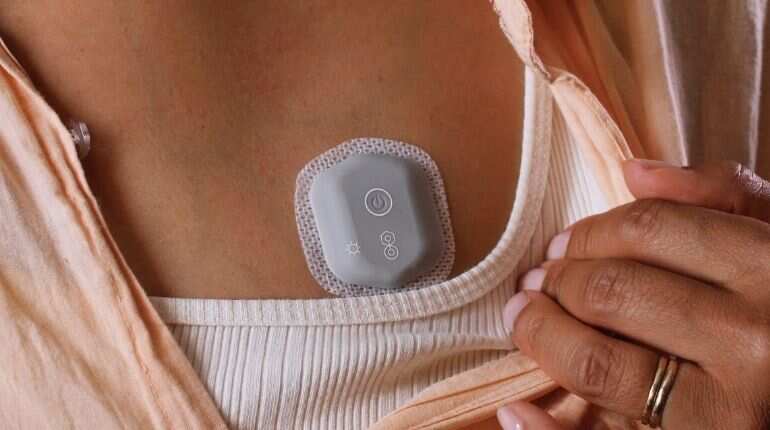
Oakland University, a public research university near Detroit, is at the forefront of schools and companies preparing to making the leap to the BioButton, a novel coin-size sensor attached to the skin 24/7 that uses algorithms to try to detect possible signs of COVID-19.
Whether such continuous surveillance of students, a young and largely healthy population, is beneficial is not yet known. Researchers are only in the early phases of studying whether wearable technology could help flag signs of the disease.
David A. Stone, vice president for research at Oakland University, said school officials had carefully vetted the BioButton and concluded it was a low-risk device that, added to measures like social distancing and mask wearing, might help hinder the spread of the virus. The technology will alert campus health services to students with possible virus symptoms, he said, but the school will not receive specific data like their temperature readings.
“In an ideal world, we would love to be able to wait until this is an FDA-approved diagnostic,” Stone said. But, he added, “nothing about this pandemic has been in an ideal world.”