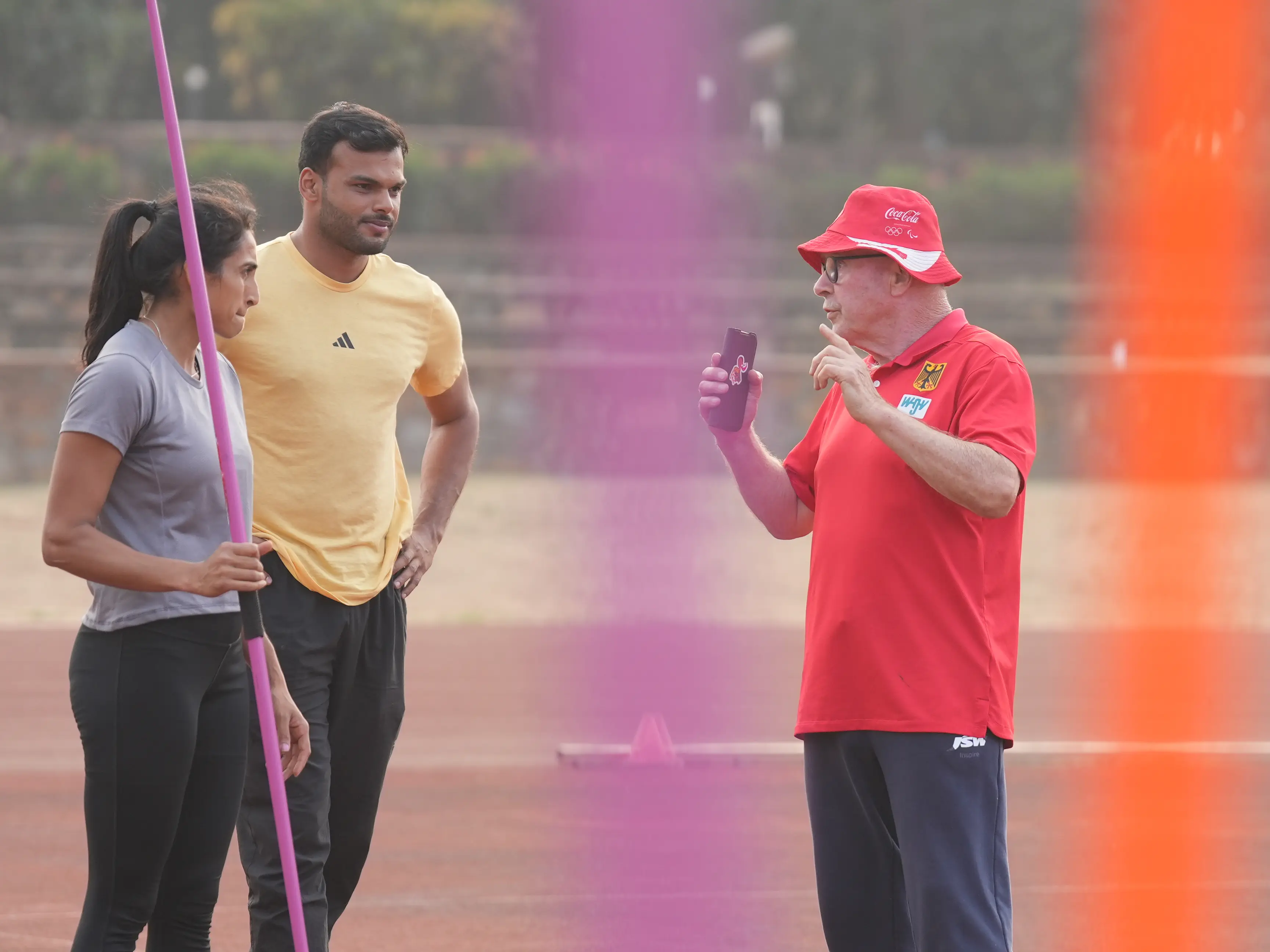
'You must be a competitor, not just a talker': Klaus Bartonietz explains the making of champions

&imwidth=600&imheight=450&format=webp&quality=medium "'You must be a competitor, not just a talker': Klaus Bartonietz explains the making of champions")
'You must be a competitor, not just a talker': Klaus Bartonietz explains the making of champions Photograph: (IIS Media)
Dr Klaus Bartonietz stresses power over strength, mental toughness, and smart training as he works to build world-class Indian throwers at IIS Hisar
Dr Klaus Bartonietz has spent decades decoding the science behind elite performance. The German biomechanics expert, who played a pivotal role in guiding Neeraj Chopra to Olympic gold at the Tokyo Games, believes that success in throwing events is not just about strength; it is about creating complete athletes capable of thriving under pressure.
Now serving as a technical expert for the Inspire Institute of Sport’s (IIS) throws programme in Hisar, Bartonietz is focused on shaping India’s next generation of track and field stars. Having previously contributed to Chopra’s Diamond League triumph in 2022 and his World Championship gold the same year, the veteran coach brings both scientific depth and practical experience to Indian athletics.
Reflecting on his journey, Bartonietz says his understanding of biomechanics has “dramatically increased” over the years, from early academic curiosity to hands-on coaching of elite athletes. “The goal was always to support athletes, not just do academic research. When you work closely with coaches, you know exactly what matters,” he explained in an exclusive conversation with WION.
Rather than pointing to a specific technical flaw among young Indian throwers, Bartonietz identifies a broader developmental gap. “What I’m missing is a well-structured, multi-sided preparation. We want an athlete, not just a javelin thrower or discus thrower,” he says. According to him, athletes who lack exposure to multiple disciplines often struggle to adapt to new challenges, ultimately limiting their performance ceiling.
Also Read: T20 World Cup 2026: England win thriller, Nepal win hearts as former champions kick start campaign
What makes a world-class thrower?
Trending Stories
&imwidth=280&imheight=210&format=webp&quality=medium)
&imwidth=280&imheight=210&format=webp&quality=medium)
&imwidth=280&imheight=210&format=webp&quality=medium)
&imwidth=280&imheight=210&format=webp&quality=medium)
&imwidth=280&imheight=210&format=webp&quality=medium)
&imwidth=280&imheight=210&format=webp&quality=medium)
&imwidth=280&imheight=210&format=webp&quality=medium)
&imwidth=280&imheight=210&format=webp&quality=medium)
&imwidth=280&imheight=210&format=webp&quality=medium)
&imwidth=280&imheight=210&format=webp&quality=medium)
&imwidth=280&imheight=210&format=webp&quality=medium)
&imwidth=280&imheight=210&format=webp&quality=medium)
&imwidth=280&imheight=210&format=webp&quality=medium)
&imwidth=280&imheight=210&format=webp&quality=medium)
&imwidth=280&imheight=210&format=webp&quality=medium)
&imwidth=280&imheight=210&format=webp&quality=medium)
&imwidth=280&imheight=210&format=webp&quality=medium)
&imwidth=280&imheight=210&format=webp&quality=medium)
&imwidth=280&imheight=210&format=webp&quality=medium)
&imwidth=280&imheight=210&format=webp&quality=medium)
&imwidth=280&imheight=210&format=webp&quality=medium)
&imwidth=280&imheight=210&format=webp&quality=medium)
&imwidth=280&imheight=210&format=webp&quality=medium)
&imwidth=280&imheight=210&format=webp&quality=medium)
&imwidth=280&imheight=210&format=webp&quality=medium)
&imwidth=280&imheight=210&format=webp&quality=medium)
&imwidth=280&imheight=210&format=webp&quality=medium)
&im=FitAndFill=(700,400)&imwidth=280&imheight=210&format=webp&quality=medium)
&imwidth=280&imheight=210&format=webp&quality=medium)
&imwidth=280&imheight=210&format=webp&quality=medium)
&imwidth=280&imheight=210&format=webp&quality=medium)
&imwidth=280&imheight=210&format=webp&quality=medium)
&imwidth=280&imheight=210&format=webp&quality=medium)
&imwidth=280&imheight=210&format=webp&quality=medium)
&imwidth=280&imheight=210&format=webp&quality=medium)
&imwidth=280&imheight=210&format=webp&quality=medium)
For Bartonietz, biomechanics is only part of the equation. Mental strength can be just as decisive. “Maybe it’s about 50 percent of the deal,” he notes, referring to psychological readiness in competition. He points to the Olympics as proof that pressure can make or break champions, with underdogs rising when favourites falter. “We have some people who excel in training much better than in competition — and that is not what we need.”
The Neeraj Chopra model
Having worked closely with Neeraj Chopra, Bartonietz reveals that the Indian superstar already operates close to the ideal technical blueprint. “Neeraj was and is not far from the technical model. In some elements, he represents it,” he says. While advanced motion analysis has transformed modern coaching, Bartonietz emphasises that experience and observational skill remain invaluable. “You must have a clear model of what you want to achieve and compare it with what the athlete is doing.”
One of Bartonietz’s most striking analogies captures his philosophy on athletic development. “It’s not about being a tractor; you want to be a Ferrari or a Porsche.” In other words, explosive power matters more than brute strength.
Quoting Bruce Lee, he adds: “Take the power from the ground to your legs, waist, and into the arm.” Many athletes, he says, rely too heavily on the upper body instead of generating force from the ground up.
Bartonietz warns that young athletes often underestimate recovery, a mistake that can derail careers. “When I came to Patiala, many young athletes had overuse shoulder and elbow problems. Throwing every day is not possible,” he says.
Regeneration, physiotherapy, ice baths, and strengthening smaller muscle groups must become central to training programmes, he adds.
The veteran coach is wary of popular training myths. “You don’t just train hard — you have to be hard but smart,” he says. He also challenges romantic notions of talent. “Talent is, first of all, hard work. Early success does not guarantee long-term excellence.”
Technology has changed the game
From film cameras to smartphone video, technological progress has revolutionised biomechanical analysis. “It changed very much the possibilities to influence training,” Bartonietz explains, noting that real-time data now helps coaches assess factors such as ground contact time and force generation within milliseconds. Yet, technology is only a tool, not a substitute for coaching wisdom.
Vision for India’s future
At IIS Hisar, Bartonietz sees enormous potential. “Helping to prepare top athletes and producing medals on the world stage, that is the goal,” he says. He believes professional structures, strong infrastructure, and results-driven systems will be key to India’s sporting rise.
“It’s a highly professional approach, and that is what we need.” For Bartonietz, success ultimately comes down to measurable impact. “Results count. Not the number of athletes, not how much movement you analyze, the effect is important.” With experts like him guiding emerging talents such as discus thrower Ujjawal and javelin prospect Himanshu, India’s throws ecosystem appears to be moving toward a more scientific, performance-driven era.

