Ancient justice: Chinese skeletons reveal limb amputation as punishment over 2,000 years ago

Chinese skeleton
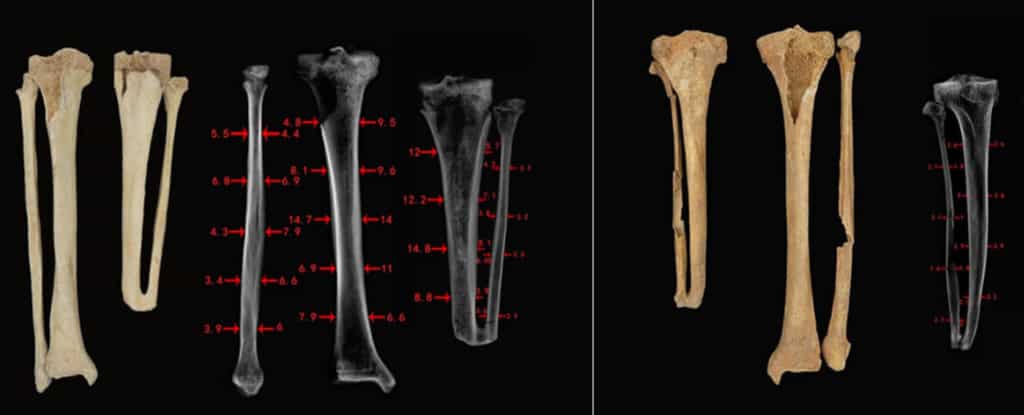
Researchers discovered two skeletons with identical injuries, indicating that, more than 2,000 years ago, the Eastern Zhou Dynasty of China employed limb amputation as a form of punishment with startling precision.
Paleoanthropologist Qian Wang of Texas A&M University and associates examined a skeleton that was probably male and lacking its left foot as well as roughly one-fifth of its lower left leg, which was 8 centimetres (3 inches) shorter than its right leg.
The second skeleton, thought to be male, likewise had its right leg severed at the same length of bone, but not roughly. The men's dismembered limbs are of identical length, cut within a centimetre of each other.

The skeletons were discovered during an excavation in Sanmenxia, a city in Henan Province, China. Their age, estimated at 2,300 to 2,500 years, places them in the Eastern Zhou Dynasty, whose rulers governed portions of China from 771 and 256 BCE.
Wang and colleagues write in their report released in March that "this discovery, along with some previous findings, corroborates with historic written records of law and punishment" employed during the Eastern Zhou Dynasty.
&imwidth=180&imheight=135&format=webp&quality=medium)
Poland: 19-year-old stabs several at Polish vocational school
&imwidth=180&imheight=135&format=webp&quality=medium)
'Baseless and misconceived': India issues statement after Elon Musk's 'oligarchs' claim over Starlink delay
&imwidth=180&imheight=135&format=webp&quality=medium)
‘Team first and team ahead’: India coach Gambhir pens heartfelt wish for chief selector Ajit Agarkar
&imwidth=180&imheight=135&format=webp&quality=medium)
Trump's naked 23-karat gold statue unveiled near European Parliament
&imwidth=180&imheight=135&format=webp&quality=medium)
Nana Patekar: Remembering a legend of the Indian cinema
&imwidth=180&imheight=135&format=webp&quality=medium)
Russia warns Lithuania over nuclear weapons, Europe braces for massive hybrid attack | Gravitas
&imwidth=180&imheight=135&format=webp&quality=medium)
Captain Smit Machchhar on feet again, walks 10 steps as recovery continues after Flydubai flight attack
&imwidth=180&imheight=135&format=webp&quality=medium)
'They came in, they hit us': New videos show Iranian attacks on US Camp Buehring in Kuwait | Watch
&imwidth=180&imheight=135&format=webp&quality=medium)
Trump distances himself from senior political advisers over work for pro-Russian government
&imwidth=180&imheight=135&format=webp&quality=medium)
Narendra Modi Stadium bomb threat declared hoax; India & Australia U19 squads safe
&imwidth=180&imheight=135&format=webp&quality=medium)
US midterms 2026: Why the Latino vote could shape control of Congress
&imwidth=180&imheight=135&format=webp&quality=medium)
US Midterms 2026: Barack Obama hits campaign trail to boost Democratic candidates
&imwidth=180&imheight=135&format=webp&quality=medium)
Shia LaBeouf and Mia Goth head for divorce after nearly 10 years
&imwidth=180&imheight=135&format=webp&quality=medium)
Nicolas Maduro, wife likely to face new charges over alleged torture of US citizens: Report
&imwidth=180&imheight=135&format=webp&quality=medium)
Texas man executed by lethal injection; first US execution since botched Christa Pike execution
&imwidth=180&imheight=135&format=webp&quality=medium)
Jon Rahm quits LIV Golf as breakaway tour attempts to relaunch itself
&imwidth=180&imheight=135&format=webp&quality=medium)
Christa Pike wakes after failed execution, asks 'Where am I and who are you?'
&imwidth=180&imheight=135&format=webp&quality=medium)
Christa Pike 'angry' and 'confused' after failed execution; judge orders to preserve evidence
&imwidth=180&imheight=135&format=webp&quality=medium)
Nigerian President Bola Ahmed Tinubu hails Modi’s 25-year leadership milestone, calls for deeper Nigeria-India strategic ties
&im=FitAndFill=(700,400)&imwidth=180&imheight=135&format=webp&quality=medium)
US midterms 2026: 10 leaders and candidates to watch in the battle for Congress
&imwidth=180&imheight=135&format=webp&quality=medium)
Africans knew how to build 20-storey skyscrapers 2,800 years ago
&imwidth=180&imheight=135&format=webp&quality=medium)
Nana Patekar's #MeToo controversy: From Tanushree Dutta’s allegations to court ruling
&imwidth=180&imheight=135&format=webp&quality=medium)
Veteran actor Nana Patekar dies at 75 after suffering cardiac arrest
&imwidth=180&imheight=135&format=webp&quality=medium)
Musk alleges ‘oligarchs’ blocking Starlink in India, here is what we know so far
&imwidth=180&imheight=135&format=webp&quality=medium)
Lightning strikes IndiGo Patna-Lucknow flight at 17,000 feet, damages nose; all 110 safe
&imwidth=180&imheight=135&format=webp&quality=medium)
Mall of America attack: FBI arrests man over alleged ISIS-inspired mass shooting plot with AK-47 and 200 rounds
&imwidth=180&imheight=135&format=webp&quality=medium)
France holds talks with Taliban government amid diplomatic outreach
&imwidth=180&imheight=135&format=webp&quality=medium)
'I should win it': Trump renews Nobel Peace Prize claim ahead of 2026 announcement
&imwidth=180&imheight=135&format=webp&quality=medium)
IndiGo flight struck by lightning at 17,000 feet, nose of Patna-Lucknow flight damaged
&imwidth=180&imheight=135&format=webp&quality=medium)
US readying to strike Iran? Report suggests Trump preparing to put on show of strength ahead of US midterms
&im=FitAndFill=(700,400)&imwidth=180&imheight=135&format=webp&quality=medium)
World’s top vehicle producers: Top 10 countries making the most cars. Check where India stands
&imwidth=180&imheight=135&format=webp&quality=medium)
Trump to honour Elon Musk, Sergey Brin and Jensen Huang with top science honour at White House. Check the full list here
&imwidth=180&imheight=135&format=webp&quality=medium)
'We don't think so': Trump says Russian plague lab worker's death not linked to bio-weapon
&imwidth=180&imheight=135&format=webp&quality=medium)
France protests: How a Gen Z school movement turned into a political war | The Verdict
It is hard to determine what these two guys were accused of based just on their bones. However, Wang speculates that one man may have had a more severe sentence than the other based on historical records because right leg amputations were only performed for more serious crimes.
"Since amputation by penalty was not an uncommon phenomenon, they might [have] returned to normal social life and were buried in a proper manner after death," Wang explains. Based on the findings that the researchers published in Archaeological and Anthropological Sciences, it is likely that the men's social rank was high enough to allow for their rehabilitation.
The two-layered casket in which each body was discovered was buried facing north-south, an orientation usually associated with the elite classes. Conversely, commoners were restricted to smaller, east-west facing graves.
Grave items, as well as isotopes in the bones indicating a protein-rich diet, imply the men were aristocrats, maybe low-level officials. Regarding the two Chinese men who paid for their unidentified crimes with their limbs, Wang says, "These cases enrich our understanding of the penal laws and their implementations, medical care capabilities, and the general benevolent attitudes towards those who were punished by law from the social and archaeological contexts of ancient China."
(With inputs from agencies)
