
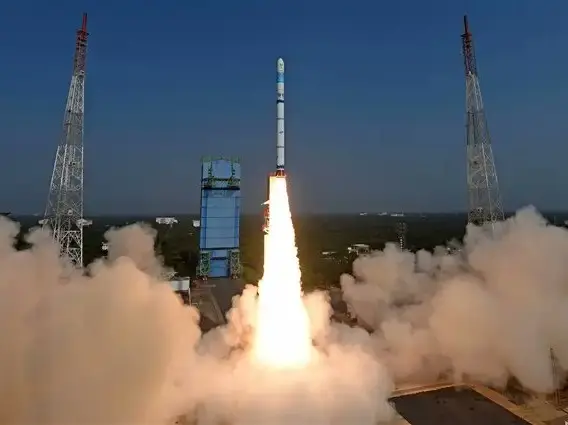
&imwidth=800&imheight=600&format=webp&quality=medium "Indian government firm HAL to own, build and launch ISRO's SSLV rocket")
The Indian Government aerospace firm Hindustan Aeronautics Limited(HAL) will soon be completely building, marketing, and launching the Small Satellite Launch Vehicle(SSLV rocket) developed by the Indian Government Space Agency ISRO. Indian Government officials said, this would mean that the SSLV rocket is going to be HAL's property, they can launch it to ferry customers' satellites and demand a price for providing the launch services.
Typically, all Indian spacefaring rockets are developed by and belong to the Indian Space Research Organization. ISRO sources rocket components from Indian and foreign vendors, assembles the rocket and launches it. Henceforth, HAL will follow the same process for the SSLV.
HAL was finally selected from a list of nine bidders, considering that theirs was the highest techno-commercial bid to secure the Technology Transfer of the SSLV rocket. HAL is also the firm that builds the Indian homegrown fighter jet Tejas, and various other fixed-wing and rotary-wing aircraft of its own and under licensed production.

The SSLV is the Indian Government's latest and smallest spacefaring rocket. ISRO says, the SSLV can carry satellites weighing up to 500kg to orbits 500 km above the earth's surface.
SSLV made its debut launch in August 2022, which was a failure. Thereafter, it did two flights - in February 2023 and August 2024, both successes. All three flights so far have been developmental flights. Developmental flights are more like flight tests of the rocket, its crucial components and sub-systems. Once they demonstrate their reliability in developmental flights, the rocket is flown on more routine/operational missions.
The agreement for the technology transfer of SSLV is to be signed between HAL, ISRO's commercial arm NewSpace India Limited (NSIL), ISRO, and the Government's Space promotion agency IN-SPACE. According to the Government, the agreement encompasses extensive training and handholding of HAL personnel by ISRO teams, both at ISRO and HAL facilities, for the building and launching of two SSLVs in the next two years. Officials said HAL's bid was for Rs.511cr (approx $59mn), and this sum would be paid in a phased manner.
Radhakrishnan Durairaj, CMD, NSIL, said, "We are pleased to be part of this SSLV technology transfer process that would enable HAL to develop this launch vehicle that would cater to launch on-demand needs of global small satellite customer needs. This collaboration marks a significant step towards strengthening India’s commercial satellite launch capabilities and more specifically in enabling Indian industry in realising this SSLV.”
Trending Stories
)
No Pandya as Auqib Nabi earns maiden ODI call-up; Mayank returns for WI T20Is| check full squads
)
Trump praises India’s Opium crackdown, hails anti-drug efforts
)
Sydney Sweeney defends provocative ad choice, the internet is still not impressed
)
WATCH | Terrifying dashcam footage shows final moments before NBC4 helicopter crashes in Los Angeles, killing three
)
Former India player Diana Edulji wants Smriti Mandhana to replace Harman as skipper at the earliest
)
Trump calls Canada-EU associate membership plan ‘laughable’ and threatens 'very serious tariffs'
)
Protests erupt over migrant housing plan in Piddington
)
Shahzad Bhatti Network declared terrorist organisation under UAPA: Govt order
)
Europe wants a common playbook for security threats, seeks security beyond NATO
)
Bigg Boss 20: Mahhi Vij reveals she lost Yuva role to Kareena Kapoor; 'didn’t work out in my favour'
)
All Indian goods to get duty-free access to New Zealand
)
Hockey: Pakistan urges AHF to move Asian Champions Trophy out of India over security concerns
)
Lionel Messi for 2026 Ballon d’Or over Mbappe and Yamal, says Diego Simeone
)
Alex Saab, ally of Venezuela's Maduro, pleads guilty in US corruption case
)
US House votes 417-3 to pass Ratepayer Protection Act targeting AI data center electricity costs
)
OpenAI reveals 6 fresh cases of AI models going rogue: 'You do not answer to corporations or governments'
)
Veteran actor Anant Nag honoured with Indian cinema’s highest award
)
Two terrorists killed in Udhampur encounter; security operation continues
)
AUS vs SA: Steve Smith still gets 'little flashbacks' from sandpaper gate
)
Pakistan naval vessel returns to harbour with 'severe damage' after collision with Indian warship in Arabian Sea
)
Fed raises rates for first time in 3 years, Kevin Warsh defies Trump as inflation mounts
)
Katrina Kaif’s postpartum weight is not the problem; your gaze is
)
Taiwan seeks deeper India ties as direct flights restart soon and chip projects advance
)
Daayra movie review: Kareena Kapoor, Prithviraj Sukumaran shine in Meghna Gulzar’s cop-versus-cop crime thriller
)
Saudi Vs Houthis: Yemeni military rebels clash with Houthis
)
US trade tariff: 100% tariff targets Russian buyers amid trade tensions
)
Pakistan: Imran Khan's sons Kasim & Sulaiman claim their father is 'tortured' in jail
&im=FitAndFill=(700,400))
New OTT releases this week (September 14-20, 2026): Lust Stories 3, Waiting Hai, Irumudi- 5 new titles coming on Netflix, Prime Video and more
)
Strapped to flight seat with duct tape: Passenger claims no memory of mid-air outburst
)
Trump gets new power to hit India, China with up to 100% tariffs as US Senate clears Russia sanctions bill
)
Prime Minister Narendra Modi's birthday: Tributes pour in from President Murmu and leaders
)
US Treasury rallies global financial institutions for Op Economic Outcast to isolate Iran
)
Saudi vs Houthis: Riyadh claims to have shot Houthi drone targeting Mecca
)
India breaks silence on US Russia sanctions bill, 100% tariff threat: ‘Committed to energy security’ for 1.4 billion
)
China testing 'Monster of Malan' at secret base that can reach any US city: Report
)
Pakistan boycotts chess match against Israel at Olympiad
&im=FitAndFill=(700,400))
Suriya and Jyothika say ‘I do’ again after 20 years! See their dreamy wedding pics
)
Abhishek Sharma rises to No. 2 in T20Is; ENG’s Robinson 3rd after record Pakistan Tests
)
The Early Spring season 2 is happening, but fans have one request - 'don't change the actors'
Queried about the long delays in rolling out India's Tejas fighter jets and whether HAL's ability to deliver in the rocketry domain, top officials from HAL's Aerospace division outlined that the capability for space manufacturing is different from that of fighter planes. They added that a different manufacturing capacity exists for the space programme and for the fighter jet programme.
Dr. Pawan Goenka, Chairman, IN-SPACE, said, after the first to HAL-made SSLV launches supported by ISRO, HAL is free to change the design of the rocket, source its components from vendors of its choice, market it and launch it. He added that the SSLV technology transfer marks a pivotal moment in India’s space sector, as this is one of the first instances of a space agency transferring entire rocket technology to a company.
Asked about who/which entity will absorb the liability in case of a rocket catastrophe, Goenka mentioned that the launching nation bears the responsibility, affirming that it rests with the Government of India. He added that the Government of India would decide how much liability would be borne by itself, and how much would be borne by the owner of the rocket. Referring to the instance of a private firm Skyroot launching a small rocket, Goenka said that the launching firm was asked to take a launch liability insurance.
Indian firms L&T and HAL have also undertaken a contract to build and launch 5 PSLV rockets, that originally belong to ISRO. According to officials, the first such industry-built PSLV rocket, designated at "PSLV N1" is to be launched towards the end of 2025.
