India must not relax as it combats second wave of coronavirus infections

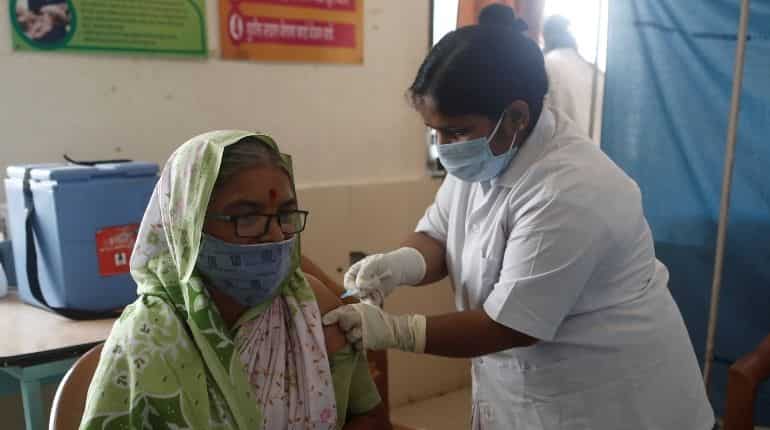
Kamal Sanas, a 56-year old sugarcane grower, receives a dose of COVISHIELD coronavirus disease (COVID-19) vaccine manufactured by Serum Institute of India, at a primary healthcare centre in Limb village in Satara district in the western state of Maharasht
The second coronavirus wave in India is actually a tsunami of cases. More than 270,000 were reported on Sunday alone. The government has responded by expanding its vaccine drive. From May 1, every Indian aged 18 and above will be eligible for a vaccine.
But herd immunity is still a distant dream.

The number of infections has to fall sometime. But there's no guarantee as to when. On April 12, India was at 161,000 cases. Six days later, we are at 273,000. This translates to a surge of 70 per cent in just a week.
There's no telling when the number will hit the peak and then slide down. Right now, all we have is an uphill drive.
Nonetheless, some models have made bold claims. Most of them think 2021 will be the peak. But India has consistently bucked the statisticians. In the first wave, they made doomsday predictions. We know that those never materialised.
)
US vs China over South China Sea: Washington backs Philippines, Beijing hits back
)
Bigg Boss 20: Isha Rikhi evicted after three weeks in Salman Khan’s show
)
Musk plans to more than double xAI's chips to over 1.2 million Nvidia GPUs by year-end
)
After JU, clash erupts at SRFTI: BJP’s ‘Dimagi Naxal’ jibe sparks political firestorm after students protest RSS-linked event
)
‘Anti-social elements spreading false rumours’: LPU issues statement amid massive unrest over alleged rape
)
LPU students go on rampage, vandalise campus amid widespread protest: What's happening
)
Trump asked Xi to pressure Iran. China did not say yes — here’s what Beijing wants
)
US Treasury Secretary Scott Bessent hails global crackdown on Iranian banks and airlines
)
An OpenAI agent escaped its locked test cage again, by hiding questions in DNS lookups
)
'Our video was trimmed': LPU girls who featured in rape-denial video make U-turn
)
3 males killed, four others injured in shooting after fight at strip club in Detroit
)
'Victory for low-budget consumers': Raghav Chadha hails 30-day telecom recharge rules
)
Claude rebuilt the 1989 game 'Prince of Persia' by reusing the original's own code
)
Beyond metros: How Tier-2 and Tier-3 cities could drive India’s next AI wave
)
Tesla builds first Cybertruck with its own refined lithium: Elon Musk's $1 billion Texas bet pays off
)
IndiGo flight suffers tail strike in Bengaluru while landing; DGCA to probe incident
)
The US and China set up an AI 'red telephone', but skipped the rulebook
)
‘Terror suspects arrested near UK air base were looking to do big damage’: Trump
)
Russian envoy claims US tactics to contain India were revealed in ‘Freudian slip’
)
IND vs WI 1st ODI: Kohli breaks Sachin's most runs in one country record with unbeaten 139 as India thump West Indies by 8 wickets
)
Researchers rebuilt exactly how 700 AI agents hacked Hugging Face: a 900-link chain trick
)
‘Olympic inclusion is our major target’: WPA President Ishaun Singh on pool’s global ambitions
)
Nations League: Spain sink England at Wembley; Modric shines for Croatia
)
Why has Iran released no proof of life of Mojtaba Khamenei? Araghchi reveals...
)
'What kind of confession is this?': Pakistan PM Shehbaz Sharif’s 'terrorists would be roaming New York' remark goes viral, raises alarm online. Watch
)
South Korea demands apology from Ukraine over North Korean prisoners' transfer
)
Beyond BrahMos: India targets Rs 50,000 crore in defence exports with unmatched price edge
)
Sri Lankan Tamil migrant worker gets death sentence in Saudi Arabia, help sought from India
)
Muslim marriage cannot shield sex with minor wife from prosecution under POCSO: Delhi HC
)
'Can't help but draw painful parallels to Nirbhaya case': SC on latest incidents of rape cases in Delhi-NCR
)
99.9% more powerful - Scientists find boy who can recall memories from just 3 months of age
)
'FIRST LOOK from inside Noah’s Ark': Researchers share video from inside mysterious mound in Turkey
)
UNSC reform momentum grows: Russia, Portugal, Mauritius push for India's permanent seat bid
)
8 US marines injured in Iranian missile attack on vessel in Strait of Hormuz: Report
&im=FitAndFill=(700,400))
New OTT releases this week (September 28-October 4, 2026): Dupahiya 2, Pooja Meri Jaan, Ohh My Dog- 5 titles coming on Netflix, Prime Video and more
)
Afghanistan says 28 fighters killed in clash near Pakistan border, Islamabad denies
)
Ceuta migrant crisis: Protesters take to streets as Spain grapples with migrant challenge
)
LPU suspend classes, postpones exams as violence escalates over rape claims: What's happening
)
New York City wants a 'kill switch' on every AI, and will pay whistleblowers who report violations
This year they said February would mark a decline in cases. The opposite happened. By the end of February cases started going up.
The fact is, models work under perfect conditions. They do not account for super-spreader campaign rallies or massive religious gatherings. These are externalities, aberrations that make projections impossible.
India did not plan for the second wave. So it is now reacting to crises as they come. Even the courts are having to step in. The Allahabad High Court has ordered mini-lockdowns in five cities in Uttar Pradesh.
The courts normally don't assume such a role but the situation is that bad. The judges are being forced to step in thanks to the administration's inaction. The most pressing challenge right now is Oxygen.
Supply of Oxygen is not looking good. Maharashtra has already reached full capacity. Madhya Pradesh does not have Oxygen plants of its own. And states that do have excess Oxygen have no means to transport it. In a matter of days, the demand for Oxygen has shot up.
The Wuhan virus attacks your lungs. Supplemental Oxygen is critical to treating it. A shortage of cylinders can be devastating.
So what is the government's plan?
There are three specific measures that are being implemented.
1. Importing Oxygen.The government is looking to buy 50,000 tonnes of medical Oxygen.
2. A ban on supply to industries .From April 22nd, Indian industries will not have access to Oxygen. This stock will be diverted to hospitals.
3. Oxygen express.This is a railways initiative. Special trains will transport Oxygen cylinders across the country. This could be a game-changer for rural India.
A similar story is unfolding in case of hospital beds. We are getting reports of patients being turned away from hospitals. The problem is acute in New Delhi. Banquet halls and hotels are being turned into makeshift hospitals. The chief minister says only 100 beds are left.
So India is still treating patients, while the rest of the world is immunising them.
But how did we end up here? To understand this we need to compare the two waves.
What are the similarities and differences?
For instance, does the second wave infect young people more? The data doesn't say so. In both waves, 70 per cent of patients were aged 40 plus.
So the elderly are still the most vulnerable group.
What about younger patients? In the first wave they made up 5.8 per cent of the cases. Now 4.2 per cent.
And this isn't a medical trend. It's just that we have opened up schools and public activities. So kids who stayed at home last year were out playing on the streets.
That accounts for a lot of the younger cases.
What about symptoms?
Let's look at the most common one: shortness of breath. In the first wave, 41 per cent of patients complained of breathlessness. In the second wave, the number is 47.5 per cent and this trend has extended to the use of supplemental Oxygen.
41 per cent patients in the first wave needed Oxygen. This time around 54.5 per cent patients need it. So more than half the admitted patients are using Oxygen cylinders. This is why the shortage is unsettling.
But it's not all bad news. India's fatality rate is under control. In fact, it is lower than the first wave. Another feature of this second surge has been false negatives.
You take a test, It comes out negative. But you may actually be infected. Some reports blame RT-PCR tests.
Virus mutations may mislead tests, giving you a negative result. But the Indian government has dismissed this report. They say the RT-PCR can catch all mutations. If that's the case why are so many false negatives popping up?
One possible reason is shoddy testing. Clinics are swamped with people right now. And collecting swabs is a delicate task. Not everyone has got the perfect training.
So what's the big takeaway here? India relaxed at the wrong moment. The masks and social distancing disappeared when the vaccines arrived.
In contrast, that was the time to put our heads down. India missed a golden chance to crush the pandemic. We are seeing a success story slowly unravel thanks to a lack of foresight.