IMD tracks El Niño growth as concerns mount over India's rainfall outlook

&imwidth=600&imheight=450&format=webp&quality=medium "IMD tracks El Niño growth as concerns mount over India's rainfall outlook")
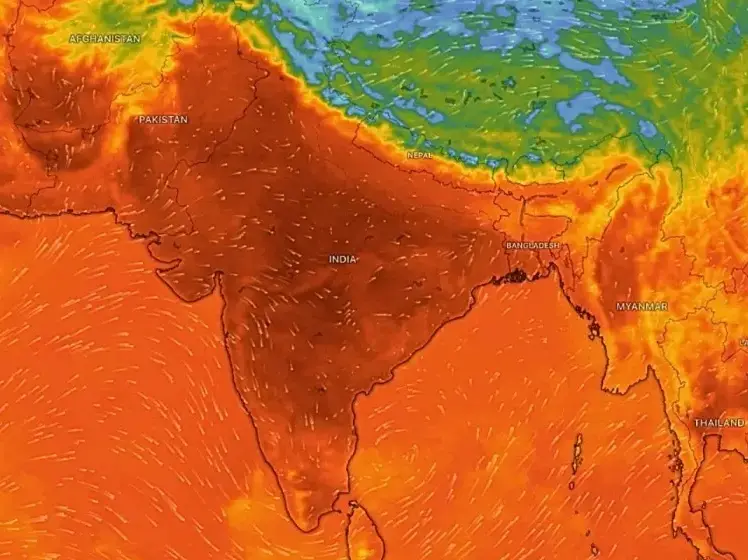
Weather map of India Photograph: (Windy)
The IMD has confirmed the development of El Niño conditions over the Pacific Ocean, warning that the phenomenon could suppress India's southwest monsoon and contribute to unusually low rainfall.
The Indian Meteorological Department on Friday said that El Niño conditions have developed over the equatorial Pacific Ocean and are likely to impact the Indian southwest monsoon. Weather forecast IMD’s own monsoon modelling system predictsa “moderate to strong” monsoon season ending in September, likely to cause the lowest rainfall of the country in decades. The El Niño Southern Oscillation (ENSO) and Indian Ocean Dipole (IOD) bulletin confirm that both the ocean and atmosphere now show clear signs of El Niño.
Sea surface temperature over the Pacific and Indian Ocean
In May, the Sea surface temperature over the Pacific Ocean, especially across the central and eastern equatorial Pacific, signalled a warming trend, which increased compared to April. Similarly, the Indian Ocean Sea surface temperature also showed an above-average temperature over the Arabian Sea and the Bay of Bengal, which increased compared to April.
ENSO development
ENSO moved from neutral in June-July 2025 to La Niña from August 2025 to February 2026, then back to neutral in March–May 2026, and by June 2026, the Niño 3.4 index crossed the El Niño threshold. Subsurface Pacific warming is strong and extending beyond the thermocline, the layer where temperature usually drops with depth. This further supports the development of El Niño.
Trending Stories
)
)
&im=FitAndFill=(700,400))
&im=FitAndFill=(700,400))
)
&im=FitAndFill=(700,400))
)
)
)
&im=FitAndFill=(700,400))
)
)
)
)
)
)
)
)
)
&im=FitAndFill=(700,400))
)
)
)
)
)
)
)
)
)
)
)
)
)
)
)
)
The Indian Ocean Dipole
The Indian Ocean Dipole (IOD) is currently neutral and likely to stay neutral throughout the southwest monsoon season. In a positive IOD, the western Indian Ocean is warmer than usual, and the eastern Indian Ocean is cooler than usual; in a negative IOD, the pattern is reversed. Neutral IOD does not impact the monsoon suppression by El Niño; a positive IOD can somewhat offset the monsoon suppression impact of El Niño. For the Indian Ocean, the forecast shows mostly positive SST anomalies broadly across the basin, but not a clear shift away from neutral IOD conditions.