
&imwidth=800&imheight=600&format=webp&quality=medium "'No report of sabotage': Indian Govt on ISRO's strategic mission failures")
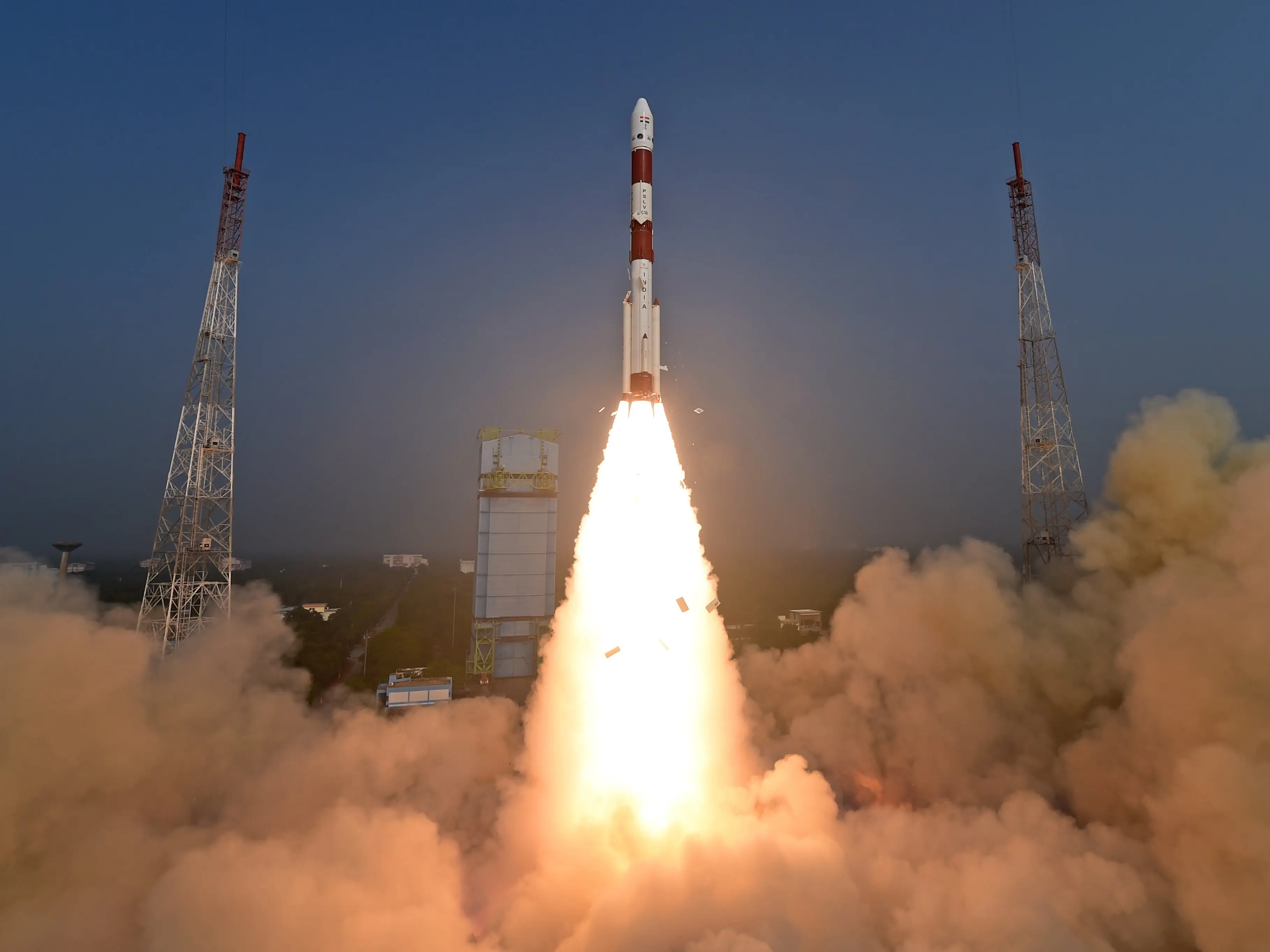
"We have not come across any report of sabotage as of now," India's Space Minister Dr. Jitendra Singh said in New Delhi, referring to multiple failures of the space agency ISRO's strategic missions in the past year. His remarks come after the Government-run Indian Space Research Organization failed in three of six missions that it carried out from home soil over the last 12 months. All three failed missions were meant for strategic purposes: NVS-02 satellite, PSLV-C61/EOS-09, PSLV-C62/EOS-N1. In 33 years of its spaceflight, the PSLV has had only four major failures. Which is why, the back-to-back mid-flight failures of ISRO's workhorse PSLV rocket in May 2025 and January 2026, have raised serious concerns.
"As a Minister of Space, I'm responsible for the launches, not for checking sabotages or even conducting sabotages... There are other Ministries... I think the question could be directed to the Ministry of Defence or Ministry of Home Affairs or Ministry of External Affairs," Dr. Singh said smilingly at a press briefing. But as of now, we have not come across any report(of sabotage), added the Minister, who holds strategic portfolios under the Indian Prime Minister's Office.

Referring to the back-to-back failures of the PSLV rocket, Dr. Singh said, "a popular notion that has gone around is that the fault happened last time(May 2025), it is happening again(Jan 2026), you are not able to rectify it... the answer is, what happened last time has not happened now". The Minister implied that, though both PSLV rockets failed during the third stage of flight, each failure had a different reason. The Minister also expressed faith in the appraisal(failure analysis) at ISRO, adding that it is done "analytically and minutely".
Trending Stories
)
Emmys 2026: Matthew Rhys wins Best Actor twice, sets historic 78-year record
)
3 Italians fly from Delhi to Munich without immigration clearance; Air India gets notice on major security lapse
)
Did India risk its US trade deal despite softer stance at BRICS?
)
Pakistan puts Pak Rs 70 lakh bounty on UN terrorist Masood Azhar; move draws skepticism in Delhi
)
‘US ensuring global energy supplies’: Trump demands reimbursement for securing Strait of Hormuz
)
'She married her brother': Ilhan Omar faces criminal probe over immigration fraud claims
)
Ukraine strikes Syzran Oil Refinery deep inside Russia, fires erupt
)
Emmy Awards 2026: Widow's Bay and The Pitt win in lead categories- check out the complete list of winners
)
Indian-origin woman, Nepali-American friend crushed to death by subway train in New York
)
Emmys 2026: Michael J Fox honoured with Bob Hope Humanitarian Award for Parkinson’s advocacy
)
Emmys 2026 In Memoriam: Catherine O’Hara honoured by on-screen children Macaulay Culkin, Annie Murphy, Dan Levy; Dolly Parton, Rob Reiner remembered
)
Iran, India agree to deepen humanitarian and political ties, President Pezeshkian says
&im=FitAndFill=(700,400))
Emmys 2026 Red Carpet: Zendaya, Nicole Kidman and Julia Garner lead the glamour peak
)
Turkish Airlines plane flies through a storm three times, triggering severe turbulence
&im=FitAndFill=(700,400))
Why Chinese PL-15 air-to-air missiles use dual-pulse motors compared to European interceptors
)
What is Hyrox, in news for athlete who soiled herself, but kept running and using common equipment?
)
Russia proposes to build 360 kmph Ivolga FG trains in India: What happened on sidelines of BRICS
)
800 million years old - Scientists discover 'fingerprints' of supercontinent Gondwana in ancient rocks
)
Former Pak PM Imran Khan's ex-wife Jemima Goldsmith marries Australian financier: Who is Cameron O'Reilly
)
Plane carrying prominent figure crashes at Libya’s Misrata airport: Report
)
UPI payments up to Rs 2,000 to stays free, but bigger transactions may soon cost you: Govt
)
Gurugram hit and run case: Police arrest car driver Kalyan Bainsla, book him for attempt to murder
&im=FitAndFill=(700,400))
New OTT releases this week (September 14-20, 2026): Lust Stories 3, Waiting Hai, Irumudi- 5 new titles coming on Netflix, Prime Video and more
)
Sent home midway from UK tour, Pakistan's Salman Agha hits 300* in domestic return
)
Who is Kalyan Bainsla, accused in the Gurugram hit-and-run case involving woman biker?
)
Nigerian Navy seizes 10,000 litres of suspected illegal fuel in Rivers State crackdown
)
Saudi Arabia discovers 110 million tonnes of Uranium-rich ore in Madinah region
)
Dodgers beat Reds for playoff berth in bid for third consecutive World Series
)
Ecstasy tablets are rage in 'drug haven' Libya | Gravitas
)
'Now Trump is copying us': Shivakumar links US $5,000 plan to Congress guarantees
)
Video of Pakistani lawmaker struggling to read English tribute to Jinnah goes viral - WATCH
)
Trump downplays China's alleged 'help' to Iran in strike on Jordan base | Gravitas
)
Trump loses Supreme Court battle over mail ballots ahead of US midterms: What happened?
)
BCCI VP Rajeev Shukla says Mohsin Naqvi 'did not object' India refusing trophy from ACC chief
)
Legendary costume designer Bob Mackie dies at 87: A look back at his iconic legacy
)
Delhi govt to roll out ₹13,820 crore development projects under Seva Sankalp Abhiyan: CM Rekha Gupta
)
UK man admits drugging, raping wife for 20 years in shocking abuse case
)
Extreme warming in Indian Ocean added 695 billion tons of ice to Antarctica ice sheet
)
China thinned Himalayan troop presence in 2025, India defence report says; terms border situation 'stable'
ISRO has had the practice of publicly sharing a summary of their mission failure analysis.
However, it must be noted that ISRO did not make public the failure analysis of the PSLV-C61/EOS-09 mission that failed in May 2025. While the report was submitted to the Prime Minister's Office, it has not been made public. Similarly, no specific updates have been provided about the PSLV-C62/EOS-N1 January 2026 failure, other than the Minister's remarks.
Here's the list of five Indian strategic space missions that have failed over the last nine years:
January 2026, PSLV-C62/EOS-N1
The PSLV-C62 flight on Monday (12th Jan 2026) marked PSLV's return to flight after a rare setback during the previous launch in May 2025, and this was also ISRO's first launch of 2026. The primary satellite was the 'EOS-N1' or 'Anvesha', an Earth Observation satellite built by India's Defence Research and Development Organisation (DRDO). This satellite was to be placed 511 km above the Earth. 'EOS-N1' was a Hyperspectral imaging satellite, which means it can see much more than the human eye or a conventional optical imaging satellite. As the surface of the Earth gets illuminated by sunlight, different materials(soil, water, metal, vegetation, and concrete structures) reflect light across various wavelengths. A hyperspectral sensor can capture these reflections, classify them and help identify what material it is made of. In addition to 'EOS-N1', there were 15 co-passenger satellites aboard the PSLV-C62. The rocket and all satellites were lost due to a mid-flight failure in the PSLV's third stage.
May 2025, PSLV-C61/EOS-09
On Sunday, 18th May, barely six minutes after liftoff, ISRO's PSLV-C61 rocket that was carrying the EOS-09 satellite faced trouble mid-flight. "Up to the second stage, performance was normal. The third stage ignited, but we made an observation regarding its functioning. Mission could not be accomplished," said ISRO Chief Dr V. Narayanan regarding the status of the four-stage PSLV rocket that was supposed to perform an 18-minute-long mission.
EOS-09 was a radar imaging satellite(earlier known as RISAT) that was capable of day and night imaging. It was meant to see through clouds and deliver images under all weather conditions. The mid-flight failure led to the loss of the rocket and satellite.
January 2025, GSLV-F15/NVS-02
On 29th January 2025, the NVS-02 was launched aboard the GSLV-F15 rocket, in what was the 100th rocket launch from the Indian spaceport in Sriharikota. While the GSLV rocket accomplished its task of placing the NVS-02 satellite in the initial orbit, the satellite encountered an anomaly. This anomaly prevented it from firing its on-board engines and moving to the final orbit. Owing to the on-board engines not firing, the satellite remained stuck in its initial orbit and was rendered unusable for its core purpose of Position, Navigation, Timing. NVS-02 is one among five satellites in India's planned five-satellite NAVIC constellation, which is meant to serve as a GPS-equivalent in India's neighbourhood.
August 2021, GSLV-F10/EOS-03
Amid the COVID-19 pandemic, ISRO had launched a sophisticated Earth-imaging satellite known as GISAT-1 aboard the GSLV-F10 rocket. GISAT-1 or EOS-3 was an agile earth observation satellite, which could use different types of imaging technologies to provide constant monitoring of a region of interest/calamity/weather pattern. GISAT-1 was meant to provide almost real-time imaging of large regions of interest at frequent intervals.
This mission was ready for launch in early-2020, but was delayed for "technical reasons". Finally, the rocket lifted off on August 12th 2021, but the mission ran into trouble mid-flight, after a malfunction in the Cryogenic upper stage that was meant to place the satellite into orbit. ISRO later revealed that a valve leak in the liquid hydrogen tank led to the failure.
August 2017, PSLV-C39/IRNSS-1H
Indian Regional Navigation Satellite System(IRNSS), later known as Navigation with Indian Constellation(NAVIC) is a Position, Navigation, Timing service meant to be used by the various ministries of the Indian Government and the country's Armed Forces. Simply put, NAVIC is an Indian-made, scaled-down equivalent of America's Global Positioning System.
During the late-night launch of PSLV-C39 on August 31st 2017, all flight events took place exactly as planned, except heat shield separation. Eventually, the satellite remained trapped inside the heat shield, which led to mission failure.
The impact of ISRO's strategic mission failures
The five aforementioned ISRO mission failures occurred in rockets and satellite variants or their components that have been operational with ISRO for decades. Going by rocket and satellite cost estimates, these five mission failures in the last nine years would have cost the Indian Government a few hundred million dollars, if not more. Further, the Government would have to spend the same amount of money once again to redo these missions. Also, one must factor in the cost of the lost opportunities. Because, in the absence of these homegrown strategic satellites, India would have to purchase similar satellite-based services from foreign firms. Having to commit resources to redo failed missions would also considerably slow down India's planned rocket launch missions and the overall pace of executing space launches.
As per limited information released by ISRO, each mission failure over the last nine years was caused by a different component/system. This re-emphasises that rocketry is a zero-error business, where even the smallest of errors or defects can lead to catastrophic failures and immense losses. While such losses offer valuable lessons for future missions, it is also important to note that these costly failures are delaying the deployment of several important space-based capabilities developed by Indian scientists.
