Fraudulent messages take over as Trump and Biden campaigns for US election gain pace

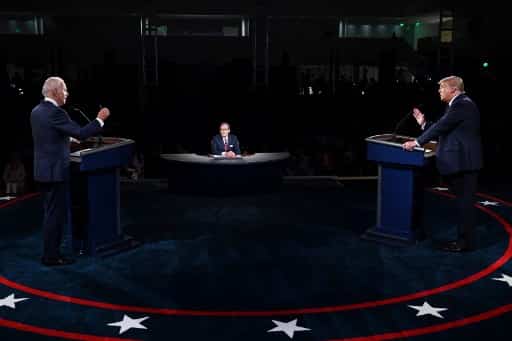
Opponents meet
Fraudulent messages are drawing attention as political campaigns in US presidential race ramp up data collection and voter targeting using their own technology to circumvent restrictions imposed by social media platforms following the Cambridge Analytica scandal.
"Your early vote has not been recorded," says one of the many fraud text messages -- with a link for more information.
Other messages tell voters they are not registered, or offer unverified information about a political opponent.

Facebook barred apps that scraped data on users and their contacts after revelations about the now-defunct British consulting group. But in response, President Donald Trump's campaign and some activist groups are using their own methods.
A team led by Samuel Woolley, a University of Texas professor who leads propaganda research at the school's Center for Media Engagement, examined messages such as the above-referenced ones.
It found that the Trump mobile app, and to a lesser extent those of Democrat Joe Biden and other political activist groups, scoop up data to create profiles to craft personalised, targetted messages by SMS, email or social media.
&im=FitAndFill=(700,400)&imwidth=180&imheight=135&format=webp&quality=medium)
What is the real meaning behind Pete Hegseth's tattoos?
&imwidth=180&imheight=135&format=webp&quality=medium)
UK navy hit by espionage scandal: Sailor accused of spying for Russia | Gravitas
&imwidth=180&imheight=135&format=webp&quality=medium)
Katie Zacharia likely to succeed Karoline Leavitt as Trump's White House press secretary
&imwidth=180&imheight=135&format=webp&quality=medium)
‘Never-ending flow of cheap labour’: JD Vance hits back at Indian-origin Congresswoman over US green card curbs for major tech companies
&imwidth=180&imheight=135&format=webp&quality=medium)
Trump's naked 23-karat gold statue unveiled near European Parliament
&imwidth=180&imheight=135&format=webp&quality=medium)
‘Ruh Roh’: Top US official mocks ‘Indian market collapse’ claim after Trump’s IT curbs. But did it? | FACT CHECK
&imwidth=180&imheight=135&format=webp&quality=medium)
Can you be mean to AI? Anthropic’s new rules explicitly ban cruelty to Claude
&im=FitAndFill=(700,400)&imwidth=180&imheight=135&format=webp&quality=medium)
Fastest-growing Asian economies in 2026: Who tops the chart? Where does India rank?
&imwidth=180&imheight=135&format=webp&quality=medium)
Houthis continue direct hits on Saudi targets, Türkiye and Pakistan missing in action | Gravitas
&imwidth=180&imheight=135&format=webp&quality=medium)
'Do not stop it altogether': SC asks Centre to review Delhi Metro curbs ahead of Oct 10 protests
&imwidth=180&imheight=135&format=webp&quality=medium)
Jewar airport in Noida to be renamed Narendra Modi International Airport: CM Yogi
&imwidth=180&imheight=135&format=webp&quality=medium)
Russia president Putin promises to 'do everything' to help settle Middle East conflict as US-Iran negotiations stall
&imwidth=180&imheight=135&format=webp&quality=medium)
Powerful 7.7 magnitude earthquake strikes Panama, tsunami warning issued
&imwidth=180&imheight=135&format=webp&quality=medium)
BTS agency HYBE announces first-ever Weverse Con Festival in India
&imwidth=180&imheight=135&format=webp&quality=medium)
Trump has a new 'enemy': Anyone who calls it 'artificial intelligence'. Here's what we wants instead
&im=FitAndFill=(700,400)&imwidth=180&imheight=135&format=webp&quality=medium)
New Friday OTT releases (October 9, 2026): Reporting Live, Animals, Take Charge of My Heart- 6 new titles coming on Netflix, JioHotstar and more
&imwidth=180&imheight=135&format=webp&quality=medium)
BTS' RM urges Peru fans not to gather outside hotel: 'We can't sleep', It's becoming a nuisance'
&imwidth=180&imheight=135&format=webp&quality=medium)
Is Trump playing a double game with Iran?
&imwidth=180&imheight=135&format=webp&quality=medium)
Trump announces Russian diesel deal as Zelensky criticises move
&imwidth=180&imheight=135&format=webp&quality=medium)
Pakistan denies reports of PAF jets being used in attacks against Iran-backed Houthis in Yemen
&imwidth=180&imheight=135&format=webp&quality=medium)
New York ICE shooting sparks protests as Mamdani to call on Trump to halt ICE operations
&imwidth=180&imheight=135&format=webp&quality=medium)
IND vs WI: West Indies set record for highest successful run chase in T20Is against India
&imwidth=180&imheight=135&format=webp&quality=medium)
French students light European bonfire, protests erupt in Belgium, Italy & Greece | Gravitas
&im=FitAndFill=(700,400)&imwidth=180&imheight=135&format=webp&quality=medium)
Food shortages, suicide attempts and more: USS Abraham Lincoln returns to US after 321 day deployment amid Iran war — The whole row explained
&imwidth=180&imheight=135&format=webp&quality=medium)
OpenAI shuts down Russian, Iranian influence operations using ChatGPT to spread propaganda
&imwidth=180&imheight=135&format=webp&quality=medium)
SC questions closure of 57 Delhi Metro stations, asks Centre to resume services in regulated manner
&imwidth=180&imheight=135&format=webp&quality=medium)
Bangladesh named as Pakistan’s replacement for Asian Hockey Champions Trophy
&imwidth=180&imheight=135&format=webp&quality=medium)
‘We will end ICC’: US sanctions International court, threatens to cripple hours after Navi Pillay wins Nobel Peace Prize
&imwidth=180&imheight=135&format=webp&quality=medium)
US midterm elections 2026: What a blue wave or blue tsunami could mean for Trump
&imwidth=180&imheight=135&format=webp&quality=medium)
SC asks Centre to frame mechanism against unethical pharma marketing practices
&imwidth=180&imheight=135&format=webp&quality=medium)
Man prays to Satan at an Iowa city council, pastor rushes to 'reverse the curse'
&imwidth=180&imheight=135&format=webp&quality=medium)
Trump honours Microsoft CEO Satya Nadella with top technology honour amid immigration scrutiny
&imwidth=180&imheight=135&format=webp&quality=medium)
Sri Lankan Tamil worker gets death sentence in Saudi Arabia over blasphemy, calls for pardon intensify
&imwidth=180&imheight=135&format=webp&quality=medium)
‘Real boss of India’: Elon Musk escalates attack over Starlink’s India entry
Some apps collect data not only on the user, but his or her contacts, and track location and other activities such as shopping or church attendance.
Campaigns can combine that with third-party information from data brokers or public records to finetune messages to specific individuals or groups.
Dozens of unsolicited texts, many with pro-Trump messages, surprise common people.
One of the many reads: "Looting. Rioting. Burning Cities. These are the realities of a Biden America."
Many message recipients have never downloaded a political app or signed up for notifications, according to researchers.
Some messages are effectively campaign ads, but without the disclosure required by social media platforms and other media.
The FBI has hence launched a "protected voices" project investigating potential criminal violations in such messages.
"Intentionally deceiving qualified voters to prevent them from voting is voter suppression -- and it is a federal crime," the FBI said in a September statement.
This brings attention to "microtargeting" -- delivering narrowly focused messages to specific individuals or groups. This also raised concerns in the 2016 elections.
Panagopoulos noted that campaigns have "massive amounts of information" on voters which they can gather themselves or purchase, making it easy to spread misinformation or dissuade people form voting.