Americas Counter Cartel Coalition: Will the US drag Latin America into another needless ‘war on drugs’?

&imwidth=600&imheight=450&format=webp&quality=medium "Americas Counter Cartel Coalition: Will the US drag Latin America into another needless ‘war on drugs’?")
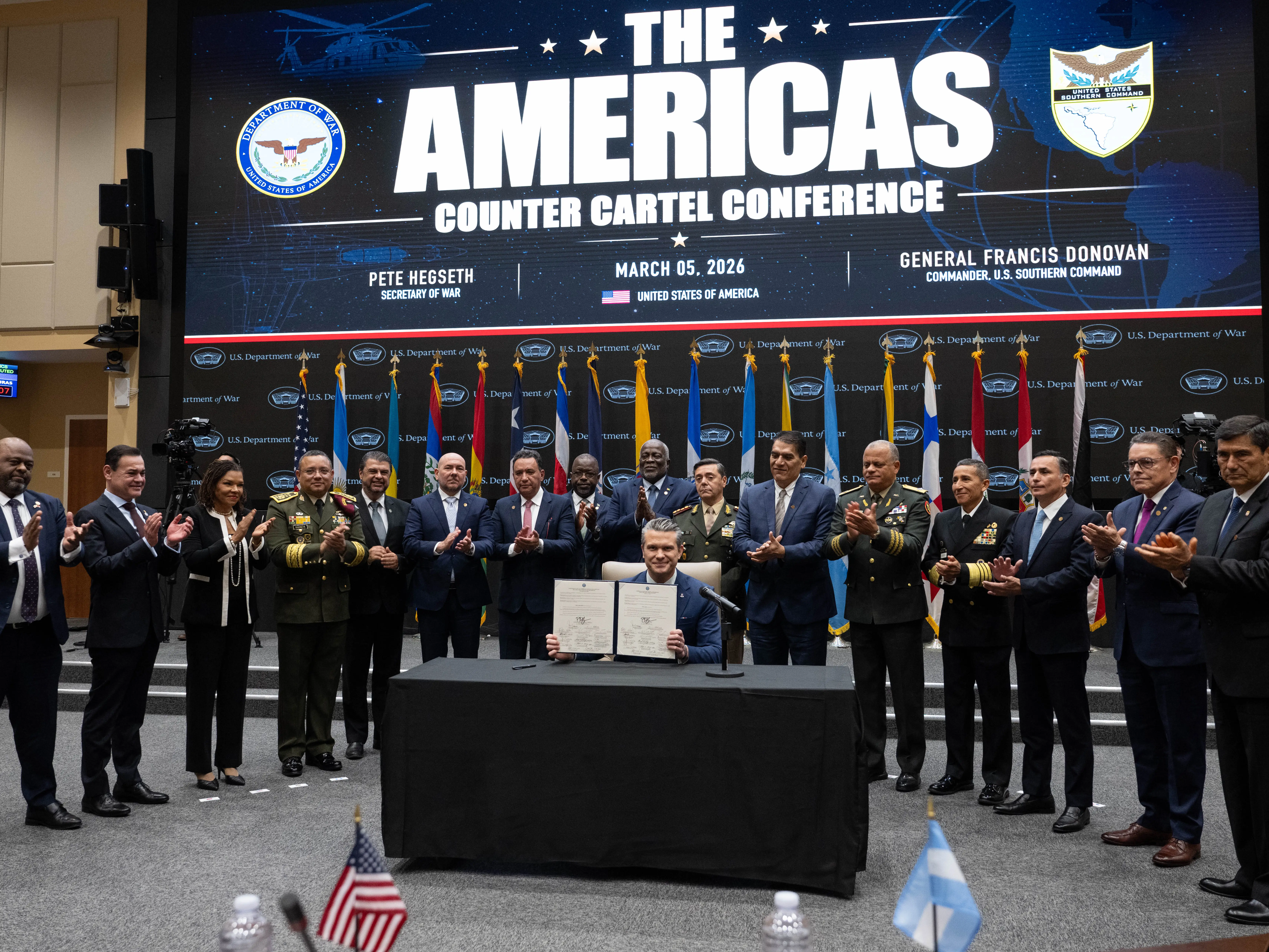
US Defence Secretary Pete Hegseth at the counter cartel conference Photograph: (Others)
The US-led Americas Counter Cartel Coalition seeks to combat drug cartels through joint military action across Latin America. This is already raising fears of a new regional drug war that could escalate tensions. Violence, displacements and threats to sovereignty could follow
Latin American nations are reportedly bracing for future impact as the US bulldozes its way through a counter-cartel alliance, for which the Defence Secretary Pete Hegseth led a conference recently. What exactly is the counter cartel alliance, and what is its scope of operation? Given the history of failed ‘wars on drug’, will it be different this time? Here is what you should know.
What is Pete Hegseth-led Counter Cartel Coalition?
The Americas Counter Cartel Coalition (ACCC) is a US-initiated and US-led ‘alliance’ for combating drug cartels and transnational crime groups across the Western Hemisphere. Spearheaded by Hegseth, the alliance is a pivot from traditional law enforcement to aggressive military action against drug cartels in the Americas, treating them as "narco-terrorists" similar to Islamic State or al-Qaeda terror groups.
Formally launched at the first Americas Counter Cartel Conference on March 5 at US Southern Command (SOUTHCOM) headquarters in Doral, Florida, the initiative is the latest move in President Donald Trump's long-standing promises to dismantle cartels.
How is the new US-led anti-cartel initiative different?
The new initiative is an escalation from previous operations like US military strikes on alleged drug-carrying vessels in international waters, and joint actions in countries like Ecuador and Venezuela.
Trending Stories
)
)
)
&im=FitAndFill=(700,400))
)
)
)
)
)
)
)
)
)
)
)
)
)
)
)
&im=FitAndFill=(700,400))
)
)
)
)
)
)
)
)
)
)
&im=FitAndFill=(700,400))
)
)
)
&im=FitAndFill=(700,400))
During his remarks at the conference, Hegseth positioned the counter cartel operation as a revival of the Monroe Doctrine. He described Western Hemisphere as "America's neighbourhood" that must be protected from external threats, including Chinese influence and drug flows poisoning American communities.
The Florida event brought together defence ministers and representatives from over a dozen Latin American and Caribbean nations. They were mainly from conservative, pro-Trump governments. Hegseth's keynote speech set the tone for what to expect from the coalition: A stress on American "hard power" and lethal force as opposed to criminal justice approaches. He warned bluntly that if the allies did not step up, the US would act unilaterally.
Speakers like Stephen Miller compared cartels to terrorist groups and called for ruthless treatment.
Joint defence operations against drug cartels in the offing?
A joint declaration of the conference, signed by 18 countries, made a commitment to intelligence sharing, joint military operations, border security enhancements, and offensive actions against cartels.
It talked about building "the most effective fighting force" to dismantle the drug networks. President Trump signed a proclamation endorsing the coalition on March 7.
The coalition is a step forward from earlier US moves like the Operation Southern Spear, which saw its military strike on alleged narco boats in the Caribbean and Eastern Pacific, killing dozens of people.
Who is in, who is out of counter-cartel coalition will determine how it will pan out
Hegseth firmed up the coalition after visits to countries like the Dominican Republic, making it almost a personal crusade and signature reform for him.
But a look at who is in, and who is outside the coalition could be an indication of the divisions in the region on how to tackle narcos.
The nearly 18 signatories of the joint declaration are mostly from right-wing governments that admire and support Trump's "iron fist" approach to organised crime and drug cartels. They include Argentina, Bahamas, Belize, Bolivia, Chile, Costa Rica, Dominican Republic, Ecuador, Guyana, Honduras, Peru and Trinidad and Tobago. Leaders like El Salvador's Nayib Bukele are vocal supporters, drawing parallels to their own anti-gang crackdowns at home.
But notable exclusions are mostly from left-leaning or adversarial governments. Most of them were reportedly deliberately left out, including Mexico, Brazil, Colombia and Nicaragua.
This brings up a key question as these excluded countries are major cartel strongholds: Will the US-led coalition conduct military operations in their countries, threatening their sovereignty? A look at the tactics the coalition could use is an indication of future tensions.
The counter cartel ops could include military attacks on cartel assets, international waters
The ACCC's aim is to “crush the cartels, stop the poison, and keep America safe”. Its joint military operations could include US-led strikes on cartel assets like boats, labs and leaders. The operations could take place in international waters too. Much of this has already been done by the US in the past six months.
Intelligence and resource sharing is another major aspect. The coalition will engage in enhanced coordination via mechanisms like Joint Task Force Southern Spear, led by units such as the II Marine Expeditionary Force.
Border security and ‘protecting christian civilizations’
The coalition is seeking to make border protection an issue of national security. There were calls made to "defend Christian civilization" against transnational threats like narco-terrorism.
There is also talk about countering Chinese and Iranian influence in the region, as part of a "Donroe Doctrine" mentioned by Trump.
Necessary escalation or agression?
According to multiple reports, there's consternation and confusion in several national capitals. The supporters of the initiative, however, point to tens of thousands killed annually by cartels, both as a result of overdose from drugs like fentanyl and violence. They see that previous policies failed, even as cartels have developed their own armies, in some cases better-armed and trained than the national militaries.
For critics, the aggressive posturing is bound to worsen violence and tensions, and is an echo of the failed US interventions in Latin American drug trade in the 1980s and 1990s.
Will the counter drug cartel ops drag Latin America into needless wars?
From a survey of recent analyst opinions, that appears to be the case. ACCC could drag participating Latin American countries into escalated conflicts. Past US-backed anti-drug campaigns fueled violence, while failing to eradicate the problem. Hegseth's violent rhetoric explicitly called for ‘offense’ and unilateral US action. This might pressure the allies into hosting US troops or joining strikes, which in turn will make them targets of cartel counterattacks. The US operations in Ecuador already was a joint military action, setting a template for broader interventions.
Nations like Mexico - which host most of the violent of cartels - might resist external action, leading to cross-border tensions or proxy conflicts.
Millions displaced, tens of thousands killed: How the past US-led drug wars panned out
The 1980s Contra wars or Plan Colombia did not succeed fully. These mostly military initiatives displaced millions and intensified violence. Most failed to fully dismantle cartels. Since 1971, the so-called US War on Drugs cost more than $1 trillion, with Latin America bearing most of the brunt. Even after that failed war, Mexico alone saw more than 400,000 deaths from cartel violence since 2006.
The military focus of the counter cartel coaliton risks repeating the same mistakes. History shows that cartels usually adapt to the situation by arming up or shifting operations. Often, the attacks on cartels lead to civil unrest or insurgencies in fragile states like Honduras or Bolivia.
Unilateral threats of counter cartel coalition risk backlash
If the US strikes civilian areas or provokes retaliations like cartel attacks on allied governments, it could lead to an all-out, asymmetrical war. Such a war will be low-burning and prolonged, dragging smaller nations in the region and draining their resources. This is a war they can't afford. We already have examples of how American involvement in Afghanistan or Iraq spiralled into decades-long quagmires.
Hegseth and Trump allies are framing the coalition as an urgent national security issue, citing more than 100,000 annual deaths due to fentanyl and other drugs, linked to cartels.
If successful, the war could help bring about regional stability. Perhaps Bukele's El Salvador crackdown could be a model, in which heavy-handed tactics reduced homicide rates by 70 per cent.
The real issue is US drug abuse
Analysts noted that no drug war will be successful unless the demand side issues are resolved, namely the drug addiction in American cities and inner cities. If not, the counter cartel coalition could end up only as a costly, cosmetic operation without curing the underlying American drug problem. The militarised approach to counter narcotics operations could once again entangle Latin American nations into conflicts they did not sign up for.

