NSA Ajit Doval meets Myanmar counterpart at BIMSTEC, warns against anti-India insurgency

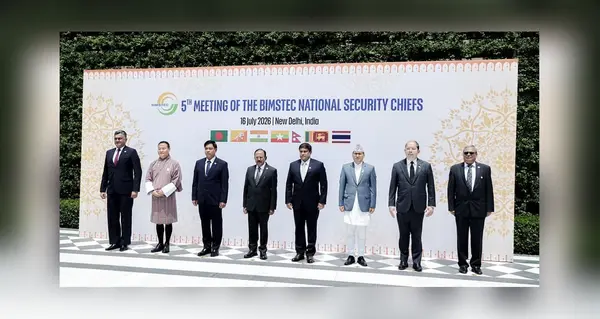
India presses Myanmar on border security at BIMSTEC meet
NSA Ajit Doval meets Myanmar's U Tin Aung San at BIMSTEC in Delhi, warning against anti-India activities, cross-border insurgency, and arms smuggling
Indian National Security Adviser Ajit Doval met with Myanmar's National Security Adviser U Tin Aung San on the sidelines of the 5th BIMSTEC National Security Chiefs' Meeting in New Delhi. During the high-level talks, India conveyed a clear message that Myanmar must not allow its territory to be used for anti-India activities, including cross-border insurgency, arms smuggling, and infiltration. As instability in Myanmar continues to affect India's Northeast, the meeting focused heavily on strengthening bilateral security cooperation, border management, and counter-terrorism coordination.
Why is India pressing Myanmar to prevent anti-India activities from its territory?
The ongoing civil conflict in Myanmar has created ungoverned spaces where Northeast insurgent groups establish camps, regroup, store weapons, and launch cross-border attacks. This instability has driven thousands of refugees into Mizoram and Manipur, straining public resources and aggravating existing local ethnic tensions. Furthermore, weak law enforcement has boosted transnational crimes like human trafficking, arms smuggling, and narcotics trafficking from the Golden Triangle, which finance these insurgent groups. The violence has also delayed strategic connectivity projects central to India's regional ambitions, such as the Kaladan Multi-Modal Transit Transport Project and the India-Myanmar-Thailand Trilateral Highway.
How important is Myanmar to India's Act East Policy and regional security strategy?
Trending Stories
&im=FitAndFill=(700,400))
)
)
)
)
)
)
)
)
)
)
)
)
)
)
&im=FitAndFill=(700,400))
)
)
)
)
)
)
)
)
)
)
)
)
)
&im=FitAndFill=(700,400))
In response, India has prioritised ensuring stability in the Northeast and denying safe havens to insurgents. New Delhi has tightened border controls by suspending the Free Movement Regime (FMR), introducing biometric systems, and accelerating fencing and smart surveillance along the shared border. To reinforce its Neighbourhood First and Act East policies, India is seeking enhanced bilateral cooperation through coordinated patrolling, intelligence sharing, and joint action against cross-border crimes.
Beyond bilateral ties, both nations are leveraging the BIMSTEC platform, which brings seven member countries together to tackle common security challenges. The regional grouping promotes intelligence sharing, capacity building, and training to combat terrorism, cybercrime, and organised trafficking. At the meeting, NSA Ajit Doval stressed the need for quick, practical, and coordinated action to deal with these emerging threats. Continuous engagement through BIMSTEC and regular security dialogues remains essential for building trust, improving maritime and border security, and ensuring long-term peace and stability in India's Northeast and the wider Bay of Bengal region.

