

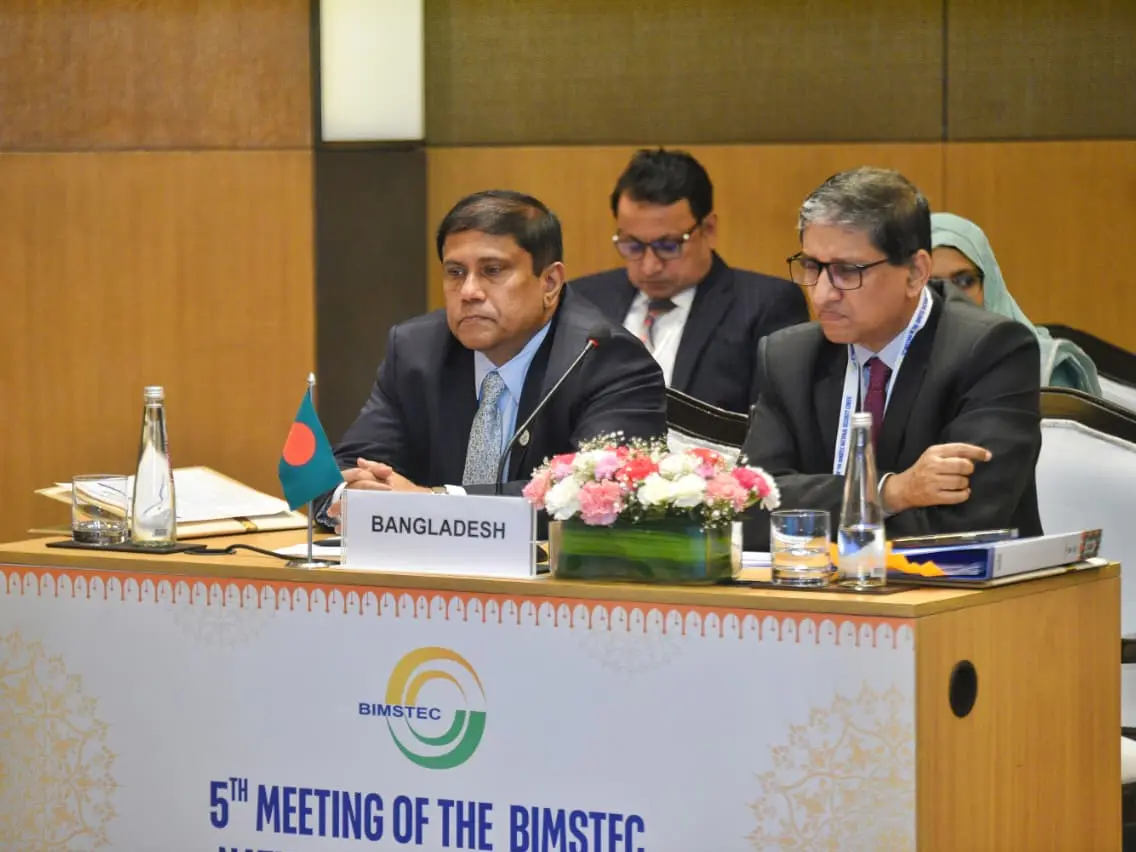
&imwidth=800&imheight=600&format=webp&quality=medium "Bangladesh urges stronger BIMSTEC security cooperation amid Rohingya crisis, regional threats at Delhi NSAs meet")
New Delhi: Bangladesh has called for deeper regional collaboration on security issues, highlighting the Rohingya refugee crisis, maritime threats, and cyber risks, at the Fifth Meeting of BIMSTEC National Security Chiefs in New Delhi. In a detailed country statement, Dr Shamsul Islam, Defence Adviser to Bangladesh Prime Minister Tarique Rahman and head of the delegation, stressed that security and development in the Bay of Bengal region are "inseparable".
A major focus of Bangladesh's intervention was the prolonged Rohingya crisis. The country currently hosts over 1.2 million Rohingya refugees, incurring high economic and security costs.
Also read | Why BIMSTEC NSA meet matters: Secure Bay of Bengal is crucial for trade flows
"This prolonged crisis is an exceptional humanitarian issue," Dr Islam stated. "Also, with complex border, maritime, and transnational security challenges that stand to affect the security and stability of our entire region. Safe, voluntary, and dignified repatriation remains the only durable solution." He urged all BIMSTEC member states to collectively create conditions for the Rohingyas' return.
The adviser outlined Bangladesh's domestic priorities under Prime Minister Tarique Rahman, including restoring public confidence, safeguarding communal harmony, and countering disinformation, hate speech, and AI-enabled manipulation.
On maritime security, Dr Islam emphasised the Bay of Bengal's importance for the livelihoods of millions. "They face threats from maritime crime, trafficking, illegal fishing, pollution, and natural disasters," he said, calling for enhanced cooperation among navies, coast guards, and disaster-response institutions, including the use of technological tools.
Also read | BIMSTEC NSA meeting: Security cooperation in a world of conflict
The meeting, chaired by India's National Security Adviser Ajit Doval, brought together security chiefs from Bangladesh, Bhutan, India, Myanmar, Nepal, Sri Lanka, and Thailand to address evolving non-traditional security challenges in the region.
Bangladesh's Dr Islam stressed that BIMSTEC, now three decades old, must prioritise security and stability ahead of economic undertakings. He advocated drawing on lessons from SAARC and building cooperation on "mutual trust and shared benefits".
"Connectivity may be the engine of BIMSTEC, but security is the foundation," he declared. "Our success will be measured not by declaration, but by the cooperation we deliver." Bangladesh, as the current BIMSTEC Chair, expressed readiness to work with all member states towards a "safer, resilient, and prosperous Bay of Bengal region".
