French parliament to vote new climate law criticised by green groups

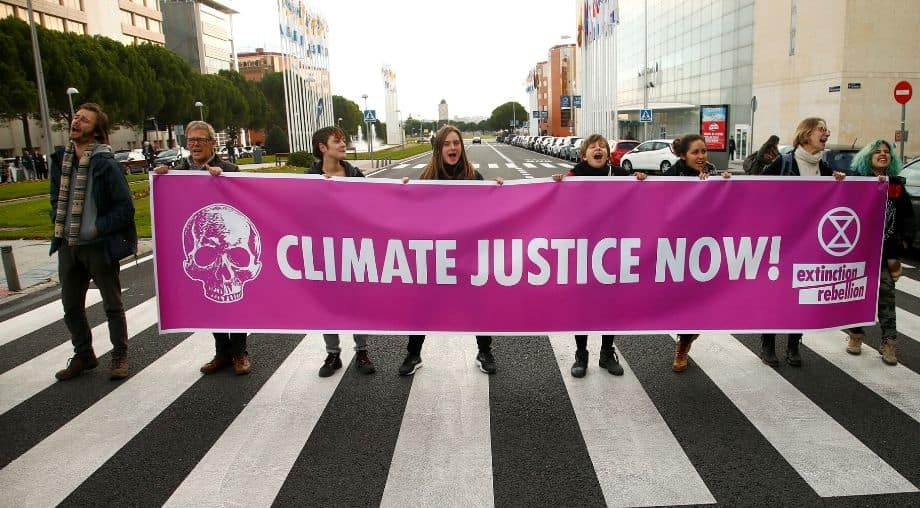
Climate change protest
TheFrenchparliamentis set tovotethrough anewclimatechangelawon Tuesday intended by President Emmanuel Macron to reinforce hisgreencredentials one year ahead of nationalelections.
The draft legislation is almost certain to be approved in a first reading by the lower house ofparliament, where Macron has a working majority, but it has been heavilycriticisedby environmentalgroups.
Campaigners see it as too timid given the pace ofclimatechange globally and accuse theFrenchleader of half-hearted commitment to a cause he has admitted to embracing belatedly.

France's environment minister, Barbara Pompili, has defended the text, saying it "will affect the daily life of all of our citizens" and is "one of the biggestlawsof the (president's) term".
Measures include bans on domestic flights under two and half hours that can be done by train, restrictions on renting badly insulated properties, or the creation of anew"ecocide" crime to punish polluters.
)
Nigeria: Protesters take to the streets, police fire shots
)
US-Iran war: Tehran draws red lines — seven demands before any peace talks
)
Russia-Europe tensions: Polish PM warns Russian attacks could test NATO's unity
&im=FitAndFill=(700,400))
‘Not the US or China’: These are the countries leading the world in arable land
)
Trump says he'll build an 'AI Force' and appoint a czar, for 'high IQ' people only
)
EXCLUSIVE | Singer Hanita Bhambri on her Toxic debut, working with Vishal Mishra and more
)
Sikh bus driver assaulted, bus stolen and rammed into cars in England; video surfaces
)
Mark Carney mimics Trump in hilarious moment over C$70 billion clean-energy investment; room erupts in laughter
&im=FitAndFill=(700,400))
Before Extraordinary Minami Minami, these popular K-dramas got Japanese versions
)
'Were you here to sell chickpeas?': Wasim Akram criticises Babar Azam's captaincy
)
Aravana prasadam shortage at Sabarimala temple in Kerala triggers protests, TDB questioned
)
‘End of my career...’: NSA Doval recalls tense Sikkim mission when China captured Indian intelligence team
)
Report: Iran rebuilding Taleghan 2, nuclear site tied to past weapons research, hit twice by Israel
)
Trump defends AI amid growing alarm, announces new 'AI force' and promises an 'AI czar'
)
Iran sets 7 conditions to end war with US: What are Tehran’s demands?
)
Trump announces ‘AI Force’ as debate grows over AI risks and regulation
)
China may have gained access to US's classified F-35 jets; parts meant for repairs diverted to Hong Kong, sparking Pentagon inquiry
)
Man breaks open wall hiding hundreds of books since 15 years
)
Gaza under attack: Health chief's son killed in IDF strikes
)
S Jaishankar, former Army chief among high-profile names issued Delhi SIR notices
)
Arvind Kejriwal, family members, Delhi CM Rekha Gupta get SIR notices
)
AI actress Tilly Norwood glitches mid-interview, switches from English to Chinese | Watch
)
Saudi vs Houthis: Houthis claim missiles & drones used in attack on key Saudi sites
)
Ed Sheeran addresses Macklemore's removal, Gaza conflict during Philadelphia concert: 'I cannot hide how I feel'
)
‘Will go to any extent’: Pakistan vows to defend Saudi Arabia amid Houthi attacks
66 years of the Indus Waters Treaty: How India and Pakistan settled a bitter river dispute
)
The Verdict | When precision fails: US commits war crime in Minab school strike, UN finds
)
9 women found dead near Johannesburg: South Africans rally, demand 'enough' to femicide
)
Kampala-Ankara rift deepens: Uganda suspends military ties, seeks Fred Lumbuye's extradition
)
Several petrol pumps, other businesses to refuse UPI payments above Rs 2,000 from Oct 16: Is it legal?
)
US-Iran war: Tehran sets seven conditions to re-engage in talks with US
)
Reacher star Alan Ritchson opens up about alleged blackmail, suicide attempt during difficult period
)
West Indies Squad for India Series: Hetmyer included for T20Is, Holder rested
)
China now makes advanced memory chips without the machines it was banned from buying
&im=FitAndFill=(700,400))
How many F-35s does Britain, Japan and Israel have?
)
Harry Brook targets long reign at top of T20I rankings after Sri Lanka sweep
)
Russia's deadly Ukraine strikes kill 2 in Sumy, hit Dnipro mall
)
Russia holds first parliamentary elections since the beginning of the Ukraine war
&im=FitAndFill=(700,400))
Meet top 5 Indian batters with fastest T20I centuries
)
Raphinha hat-trick powers Barcelona to 3-1 win over Sevilla in La Liga
)
The overall aim is to put in place measures that will enable France to meet its target of reducing its greenhouse gas emissions by 40 per cent compared with 1990 levels by a deadline of 2030.
Lobbygroupssuch as Greenpeace have called it a "lost opportunity of Macron's term", while even the president's own environmental advisory council said it would "have a potentially limited impact".
It is also less ambitious thannewtargets for 55 per cent cuts agreed at the EU level and falls short of a German plan which was rejected last week by the country's constitutional court as "insufficient".
Climatechange and protection of the environment are likely to be bigger themes in next year's presidentialelectionthan the last one in 2017, which Macron won while barely campaigning on the issue.
The mainGreenparty in France made major gains in cities such as Strasbourg, Bordeaux and Lyon in localelectionslast year, mirroring a Europe-wide trend in favour of environmentalgroups.
In Germany, theGreenparty has overtaken Chancellor Angela Merkel's conservatives in recent polls.
Theclimatelawhas also been a test of what Macron billed as a more inclusive form of government that has seen members of the public invited to help draft the legislation.
After anti-government riots by so-called "yellow vest" protesters in 2018, he pledged to change his leadership style which was seen by critics as too centralised and removed from the wider public.
A hundred and fifty people were chosen at random to form a "Citizen's Convention onClimate" which was tasked with recommending measures that would enable the country to meet its emissions targets.
But after seeing the legislation submitted toparliament, many members felt let down and accused Macron of reneging on a commitment to adopt their ideas.
Cyril Dion, a leading figure from the convention, attended a protest rally calling for bolder action in March and said thelaw"absolutely does not enable France to meet its objectives."
The government counters that is trying to find a balance between reducing emissions while protecting workers and industry at a time when the economy has been battered by the Covid pandemic.
"With thelaw, we are walking a fine line, making big changes while keeping it economically and socially acceptable," Pompili told the Financial Times last week.
Macron was stung by the "yellow vest" protests which were initially sparked by environmental policies such as raising taxes on diesel as well as old, polluting cars.
His predecessor Francois Hollande was forced into a U-turn by truck drivers, known as the "red hats", who protested against his efforts to impose an environmental tax on heavy-goods vehicles.
Even if passed by the lower house and the Senate, thenewlawwill almost certainly need to be updated in order for France to keep up with evolving European Union targets for emissions reductions.
The EuropeanParliamentand EU member states agreed a target in late April of cuts of at least 55 per cent by 2030 from 1990 levels -- compared to the 40 per cent target set in theFrenchlaw.