Explained: French elections ended in a hung parliament. What happens next?

France elections
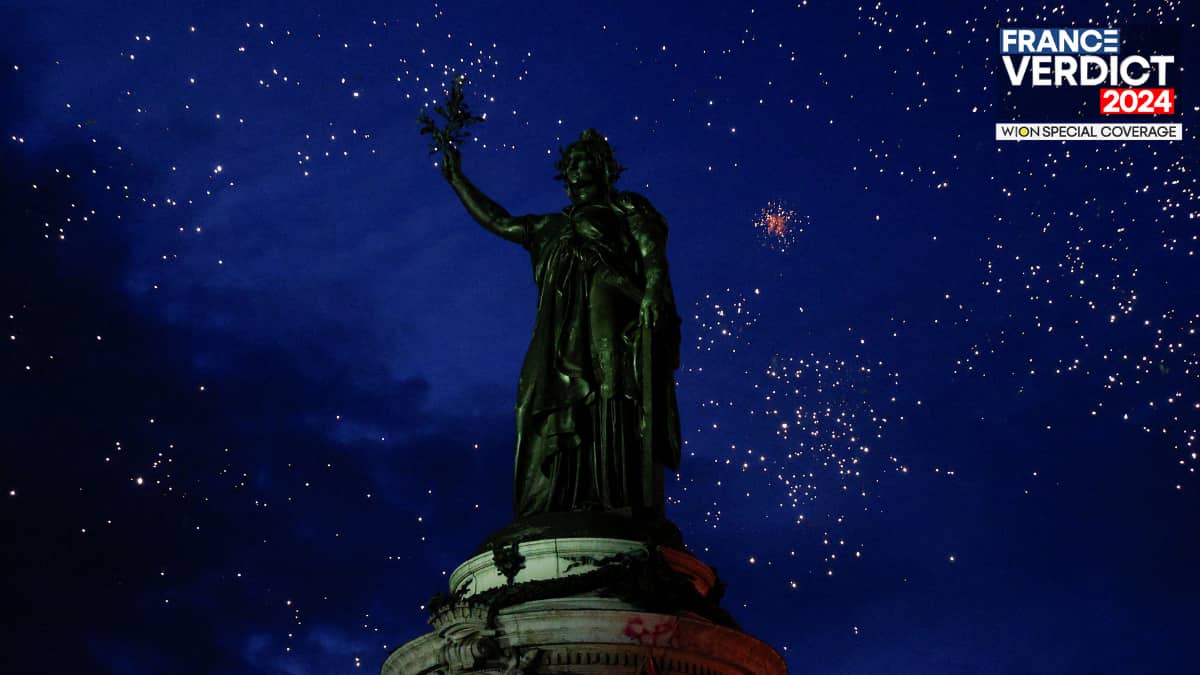
France on Monday (Jul8) delivered a crippling blow to the far-right that looked set to win what was labelled a "seismic" election.
The nation is in a state of political uncertainty. Even as the left defeated the far right in the French elections, neither party won the absolute majority, leaving the nation with a hung parliament.
What happened in the elections?

On Sunday (Jul 7), contrary to what the exit polls predicted, Marine Le Pen’s far-right National Rally did not achieve the majority to form a government. But, neither did Emmanuel Macron's centrists nor any other party, coalition for that matter.
Emerging on top with 182 seats is the left-wing New Popular Front. As per reports, it was followed by Macron's Together alliance with 163 seats while Le Pen finished in third place with 143 seats in the bag, much less than 289 needed for an absolute majority in the 577-seat National Assembly.
Also read |Who is Jordan Bardella? Far-right leader poised to become France's youngest Prime Minister
)
AI kill switch explained: Why shutting down a dangerous AI may not be as simple as pressing a button
)
US ships in Indian Ocean ‘will be attacked’ if war resumes, warns Iran
)
SNL UK takes aim at Ed Sheeran with AI Princess Diana sketch
)
Trump says he'll build an 'AI Force' and appoint a czar, for 'high IQ' people only
)
‘0% chance’: Nvidia CEO Jensen Huang dismisses AI extinction fears by 2030
&im=FitAndFill=(700,400))
What TSMC's 2nm technology means for Apple
)
'Were you here to sell chickpeas?': Wasim Akram criticises Babar Azam's captaincy
)
Mark Carney mimics Trump in hilarious moment over C$70 billion clean-energy investment; room erupts in laughter
&im=FitAndFill=(700,400))
Top 10 countries in mathematics: See the world’s best performers in 2026
)
Apple reportedly building AI server with M8 Ultra chips, may use Nvidia technology
)
TIFF 2026: Theja Rio’s Angh wins Platform Prize, puts Nagaland story on global stage
)
BTS' fans question iHeartRadio’s treatment of group after brief festival set
)
Inside the lethal rebirth of India’s super Sukhoi
)
Samsung raises Galaxy S26 prices by Rs 20,000: Here’s what each model now costs
)
Operation Sindoor’s hidden naval dimension | MoD reveals Indian Navy Special Forces joined May 7 strikes
)
Bessent meets China’s He Lifeng to prepare for Trump-Xi summit
)
Trump defends AI amid growing alarm, announces new 'AI force' and promises an 'AI czar'
)
S Jaishankar, former Army chief among high-profile names issued Delhi SIR notices
)
Iran sets 7 conditions to end war with US: What are Tehran’s demands?
)
Trump announces ‘AI Force’ as debate grows over AI risks and regulation
)
Arvind Kejriwal, family members, Delhi CM Rekha Gupta get SIR notices
)
AI actress Tilly Norwood glitches mid-interview, switches from English to Chinese | Watch
)
Saudi vs Houthis: Houthis claim missiles & drones used in attack on key Saudi sites
)
Ed Sheeran addresses Macklemore's removal, Gaza conflict during Philadelphia concert: 'I cannot hide how I feel'
)
Saudi Arabia exits China-led mBridge digital currency platform amid Saudi-Houthi conflict
)
'Lot of things to learn from experienced players': Jayasuriya backs Rohit, Virat for 2027 ODI World Cup
)
Chancellor Friedrich Merz vows to stay on as exit polls signal major poll setback
)
North Korea's nuclear tests triggered 1,399 earthquakes: Earth is still shaking | Gravitas
)
Several petrol pumps, other businesses to refuse UPI payments above Rs 2,000 from Oct 16: Is it legal?
)
Trump wants to rename ‘Artificial Intelligence’, gives 3 options: Which one would you pick?
&im=FitAndFill=(700,400))
New OTT releases this week (September 21-27, 2026): Shaque: Trust No One, Hunkkaar, Don’t Be Shy- 5 new titles coming to Netflix, Prime Video and more
)
AUS vs ZIM, 3rd ODI: Ellis stars as Australia edge Zimbabwe by one wicket in last-over thriller
)
West Indies Squad for India Series: Hetmyer included for T20Is, Holder rested
)
China now makes advanced memory chips without the machines it was banned from buying
)
Trump in ‘deciding mode’ on Iran, says ‘very big things’ going to happen soon
)
Harry Brook targets long reign at top of T20I rankings after Sri Lanka sweep
)
Microsoft executive called AI training the ‘largest theft of labour in human history’
How did this happen?
Two words: Republican Front. The exit poll predictions spurred the centre and the left wing to take some decisive steps and form over 200 tactical voting pacts between them to prevent RN from winning.
They revived the anti-far right "Republican Front" which was first summoned when Marine Le Pen's father Jean-Marie faced Jacques Chirac in the run-off of the 2002 presidential elections.
What happens next?
None of the three blocs have an absolute majority and thus cannot form a majority government and would need support from others to pass legislation.
The question here is whether a left-leaning coalition is a possibility. France, as per Reuters, is not accustomed to the kind of post-election coalition-building common in northern European parliamentary democracies like Germany or the Netherlands.
France's Fifth Republic system of government was designed in 1958 by war hero Charles de Gaulle. This system focuses on giving a large, stable parliamentary majority to presidents. This is not to say that Macron's centrists and the leftist coalition cannot unite. However, they must collaborate for at least one year, as 12 months is the minimum constitutional delay for a new election.
What if the left and the centre can't come to an agreement?
This is exactly what makes the situation so precarious. France is in its most severe political uncertainty in years. A state of no agreement is "uncharted territory".
As per the French constitution, Macron decides who to ask to form a government. However, it's not that easy. Whoever he chooses must be acceptable to the majority of lawmakers.
Risk analysis firm Eurasia Group said there was "no obvious governing majority" in the new parliament.
"It may take many weeks to resolve the muddle while the present government manages current business."
(With inputs from agencies)

