As Cape Town drought bites, residents prepare for 'Day Zero'

cape-town-water-crisis
Reducing household use has been prioritised over slashing industry's consumption as residential use accounts for 70 per cent of consumption.
Cape Town is in the grip of a catastrophic three-year-long drought as winter rains have repeatedly failed causing dam levels to drop to dangerously low levels.
The city has announced that it could be forced to shut off the taps in the middle of May - a deadline that has become known as 'Day Zero'.
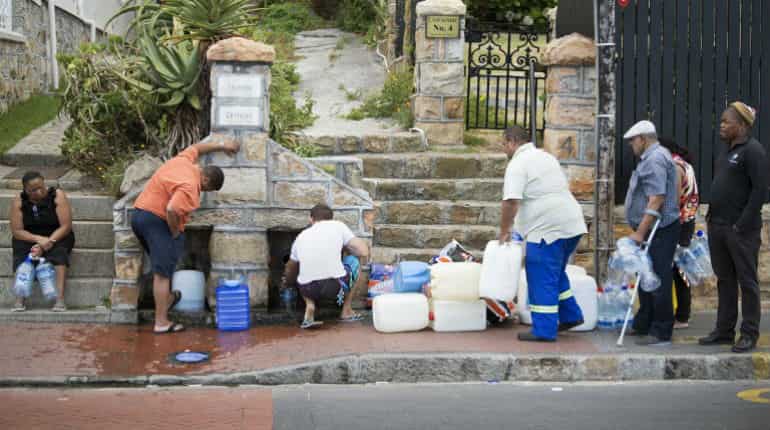
Meanwhile, anxious residents are doing what they can to reduce their daily water consumption, collecting an additional 25 litre ration at one of the city's natural springs.

"We've just sort of had to reconfigure our lives, in a way that there is no municipal water because thats what it is required of us in terms of preparing for 'Day Zero', opening that tap and there's nothing!" said Fairuz Mullagee, a researcher at the University of the Western Cape.
We explain what that would mean for the "Mother City", as South Africans affectionately call Cape Town:
What is Day Zero?
)
Three labourers killed as DU student loses control of his car, rams into them on Dwarka Expressway
)
Pentagon revives mandatory testosterone testing for male troops aged 30 and above
)
FACT CHECK: Why did PM Modi ask Xi ‘is it okay’ at BRICS Summit? New video reveals...
)
India seeks to build a full semiconductor supply chain
&im=FitAndFill=(700,400))
From Abhishek Sharma to Sahil Chauhan, 5 batters with fastest T20I hundreds
)
Indian activist-lawyer Prashant Bhushan's post brings focus on ‘conflict of interest’ appointments of ex-govt officials at Reliance, Adani groups
)
US And Denmark reach Greenland deal, Trump announces expanded military presence
)
Former India player Diana Edulji wants Smriti Mandhana to replace Harman as skipper at the earliest
)
China may have gained access to US's classified F-35 jets; parts meant for repairs diverted to Hong Kong, sparking Pentagon inquiry
&im=FitAndFill=(700,400))
Meet top 5 batters in the latest ICC T20I Rankings
)
Godfather of AI Geoffrey Hinton gives US lawmakers a one-year warning on AI
)
Shivakumar attends 79th Kalyana Karnataka Utsav in Kalaburagi
)
Trump signs Russia sanctions law: India faces fresh 100% tariff threat over Russian oil
)
Why Ranveer Singh’s Dhurandhar missed India’s Oscar entry; FFI jury member reveals what happened
)
How did an Australian river with 500 crocodiles pass the Olympic test? Here's how
)
‘Will go to any extent’: Pakistan vows to defend Saudi Arabia amid Houthi attacks
)
The Verdict | When precision fails: US commits war crime in Minab school strike, UN finds
)
Trump signs Russia sanctions bill into law, targets Moscow’s energy sector
&im=FitAndFill=(700,400))
New Friday OTT releases (September 18, 2026): Lust Stories 3, You+Me, Best of the Best- 8 new titles coming on Netflix, Prime Video and more
)
Fast bowler Brydon Carse faces no charges over Derby nightclub incident
)
Flying cars in UAE: Ras Al Khaimah signs deal with Chinese company to test new transport
)
Africa is splitting, and a lot sooner than estimated, giving way to a new ocean
)
'Gangsta' crab shoves knife blade at man and his dog in Florida - Watch
)
Trump bans CNN, MS NOW and Politico from White House over ‘FAKE NEWS’
)
Trump 2.0: Dark days ahead for America’s ‘imperial presidency’
)
Trump's Greenland dream comes true? POTUS announces 'Infinite Life' deal with Denmark, claims permanent US control
)
Laura Wolvaardt sets new world record for most WT20I runs in a year
)
Drone strikes cooling tower at Russia's Kursk Nuclear Plant, IAEA confirms
)
Who is Khalilur Rahman? All you need to know about 81st UN General Assembly President
&im=FitAndFill=(700,400))
Meet top 5 bowlers in latest ICC T20I rankings
)
Indian Cinema bets big on mythology, brings ancient stories to modern audiences
)
Ukraine plans record $109 bn defence spending, nearly two thirds of budget amid Russia war
)
Russia holds first parliamentary elections since the beginning of the Ukraine war
&im=FitAndFill=(700,400))
Meet top 5 Indian batters with fastest T20I centuries
"Day Zero" is the day when city officials will be forced to cut off the normal water supply to 75 per cent of the city's homes - more than one million households.
Instead, families and some commercial users will be forced to queue at 200 water collection points across the city to collect a daily allocation of 25 litres (6.6 US gallons) until water reserves are boosted.
Authorities have said that the collection sites will likely be guarded by police or military personnel.
What's being done to keep taps on?
At the start of February, the target for personal daily water usage was slashed from 87 litres to 50 litres.
A single toilet flush uses nine litres. It is hoped that usage cuts will buy the city time to find a solution - or for the rains of the southern winter to refill depleted dams.
Reducing household use has been prioritised over slashing industry's consumption as residential use accounts for 70 per cent of consumption.
Among the other plans being considered to avert a shut-off is an increase in desalination efforts with the first city-run plant expected to come on line later this month.
The site, located at the tourist-magnet Victoria and Alfred waterfront, will initially produce two million litres a day. The city's demand is almost 600 million litres.
Three other plants are half way to completion - but are running behind schedule.
Water is also being trucked in from elsewhere in South Africa by the Gift of the Givers charity which has sourced water from more than 70 collection points to be used to supply Cape Town's most vulnerable people.
Boreholes will also be key to averting "Day Zero".
City officials hope to draw 80 million cubic metres from an aquifer on the Cape Flats, east of the city centre, 30 million cubic metres from the Atlantis aquifer and 40 million cubic metres from an aquifer at Table Mountain.
When will Day Zero happen?
The day shifts. It depends on the amount of water above 450 million litres used by the city each day.
For each day it exceeds that target, the shut-off draws nearer. But if the city uses less than that amount it moves further away.
It is currently forecast for May 11 with dam levels currently at 25.9 per cent. Experts say anything below 10 per cent may be unusable.
Will anyone be spared?
"Economically essential" sites will be spared the shut-off, officials say, as will impoverished informal settlements that already rely on communal taps.
The regional government has said that health facilities - both public and private - will also be guaranteed water supplies.
Schools will also be spared any initial shut-off.