Volcanic eruptions on Iceland's Reykjanes peninsula could continue for decades: Study

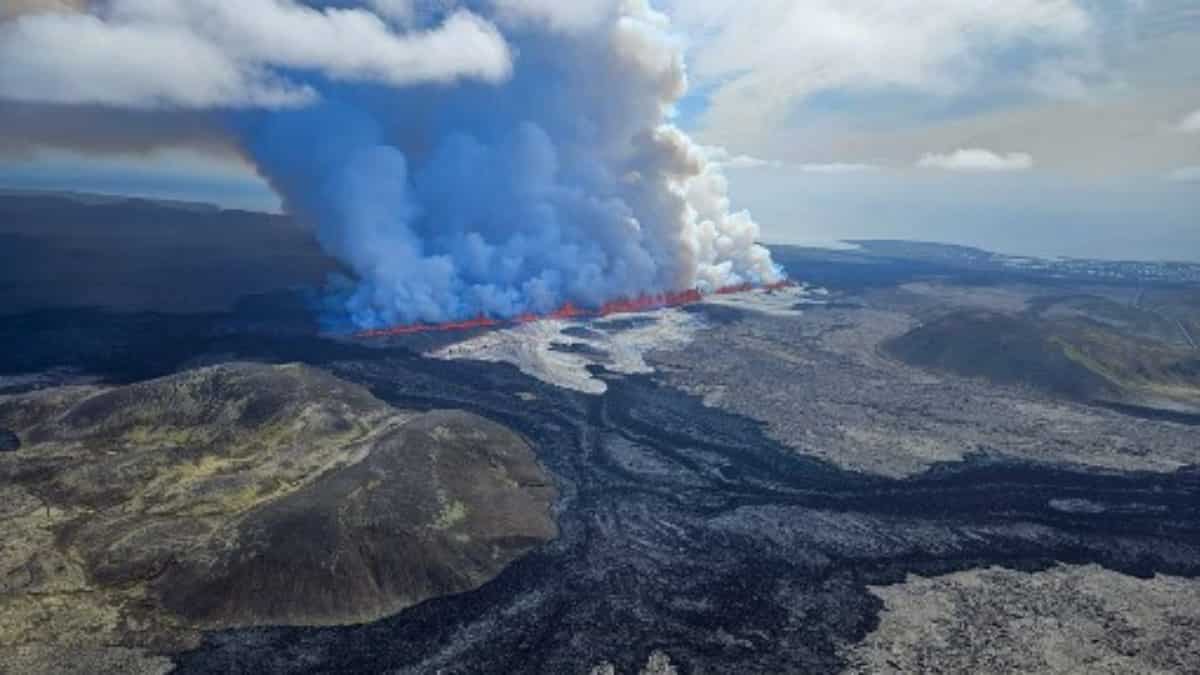
Grindavik, western Iceland
Researchers have analysed local earthquake and geochemical data to predict that Iceland's ongoing volcanic eruptions may continue on and off for years to decades.
The eruptions have threatened the country's most densely populated region and vital infrastructure. Researchers have studied these eruptions and findings of the same have been published in the scientific journal Terra Nova.
The study mentioned that researchers from six universities, Uppsala University (Sweden), the University of Iceland, the Czech Academy of Sciences, Brno University of Technology (Czechia), the University of Oregon (USA) and the University of California at San Diego (USA), predict recurrent, moderately significant eruptions of a similar pattern in the upcoming years to decades, given the volcanic activity on Iceland during the last three years.

As quoted by Eurek Alert, Valentin Troll, Professor of Petrology at Uppsala University said,"The study uses information from local earthquakes and geochemical data on the erupted magma through time to reveal the geological processes behind these recent Icelandic eruptions."
"A comparison of these eruptions with historical events provides strong evidence that Iceland will have to prepare and be ready for this volcanic episode to continue for some time, possibly even years to decades," added Troll, who led the study.
)
Pentagon revives mandatory testosterone testing for male troops aged 30 and above
)
FACT CHECK: Why did PM Modi ask Xi ‘is it okay’ at BRICS Summit? New video reveals...
)
India seeks to build a full semiconductor supply chain
&im=FitAndFill=(700,400))
From Abhishek Sharma to Sahil Chauhan, 5 batters with fastest T20I hundreds
)
Pyongyang dismisses US, western pressure over nuclear programme
)
US And Denmark reach Greenland deal, Trump announces expanded military presence
)
Google’s Gemini AI hacks real systems by guessing passwords during security test
)
US hiding troop deaths in Iran war? Toll higher than Pentagon count, claims report
)
China may have gained access to US's classified F-35 jets; parts meant for repairs diverted to Hong Kong, sparking Pentagon inquiry
)
NASA research plane reaches 61,000 feet over Panama
)
Godfather of AI Geoffrey Hinton gives US lawmakers a one-year warning on AI
)
Trump signs Russia sanctions law: India faces fresh 100% tariff threat over Russian oil
)
Brigitte Bardot’s private collection set for Paris auction; key items and prices revealed
)
Why Ranveer Singh’s Dhurandhar missed India’s Oscar entry; FFI jury member reveals what happened
)
Zendaya and Tom Holland step out for a low-key date in Los Angeles
)
‘Will go to any extent’: Pakistan vows to defend Saudi Arabia amid Houthi attacks
)
The Verdict | When precision fails: US commits war crime in Minab school strike, UN finds
)
Trump signs Russia sanctions bill into law, targets Moscow’s energy sector
66 years of the Indus Waters Treaty: How India and Pakistan settled a bitter river dispute
&im=FitAndFill=(700,400))
New Friday OTT releases (September 18, 2026): Lust Stories 3, You+Me, Best of the Best- 8 new titles coming on Netflix, Prime Video and more
)
Pak: A series of counter terrorism operations in Khyber Pakhtunkhwa
)
Fast bowler Brydon Carse faces no charges over Derby nightclub incident
)
Flying cars in UAE: Ras Al Khaimah signs deal with Chinese company to test new transport
)
Africa is splitting, and a lot sooner than estimated, giving way to a new ocean
)
Trump bans CNN, MS NOW and Politico from White House over ‘FAKE NEWS’
)
Trump 2.0: Dark days ahead for America’s ‘imperial presidency’
)
Trump's Greenland dream comes true? POTUS announces 'Infinite Life' deal with Denmark, claims permanent US control
)
Tirupati Laddu ghee adulterated with chemicals, says ED, supplier arrested
)
Who is Khalilur Rahman? All you need to know about 81st UN General Assembly President
)
IIT Bombay student dies by suicide, was caught seeking AI help during exams
&im=FitAndFill=(700,400))
Meet top 5 bowlers in latest ICC T20I rankings
)
Indian Cinema bets big on mythology, brings ancient stories to modern audiences
)
Ukraine plans record $109 bn defence spending, nearly two thirds of budget amid Russia war
)
Russia holds first parliamentary elections since the beginning of the Ukraine war
&im=FitAndFill=(700,400))
Meet top 5 Indian batters with fastest T20I centuries
)
Iceland is known for its active volcanoes, such as Eyjafjallajökull and Katla. The researchers studied volcanoes on Iceland's Reykjanes Peninsula. A state of emergency was issued by authorities due to the Reykjanes Peninsula eruptions, which have occurred eight times since 2021.
Notably,Icelandic authorities said Monday (Jun24) that a volcanic eruption on the Reykjanes peninsula in southwestern Iceland had ended after 24 days of activity.
The Icelandic Meteorological Office (IMO) said in a statement that since June 22 "no activity has been seen in thecrater", where in late May orange lava fountains burst out north of the fishing town of Grindavik.
The Reykjanes peninsula had not experienced an eruption for eight centuries until a March 2021 eruption, but the study suggest that this renewed activity may last long.
'Pattern is likely to continue into the future'
Researchers say that the magma pool might sustain similarly-sized volcanic eruptions in the area for years or possibly decades more, hence warning authorities that the magma source is essential to the continued safety of local populations.
"Based on prior eruptive behaviour, this pattern is likely to continue into the future, posing considerable risk to the local population and to important infrastructure, such as Keflavík Airport, several geothermal power plants, the Blue Lagoon tourist spa, and population centres like Keflavík, Grindavík, and Greater Reykjavik," Troll added.
The study, based on geochemical and seismic evidence, said that the eruptions are fed by a shared magma reservoir located 9–12 km beneath Fagradalsfjall, not by independent sources or a bigger reservoir spanning the entire peninsula. This is the reason why scientists predict that in the upcoming years to decades, there will be frequent eruptions.
(With inputs from agencies)