Data Lab | From India to 'Bharat': What's the price tag of a national rebrand?

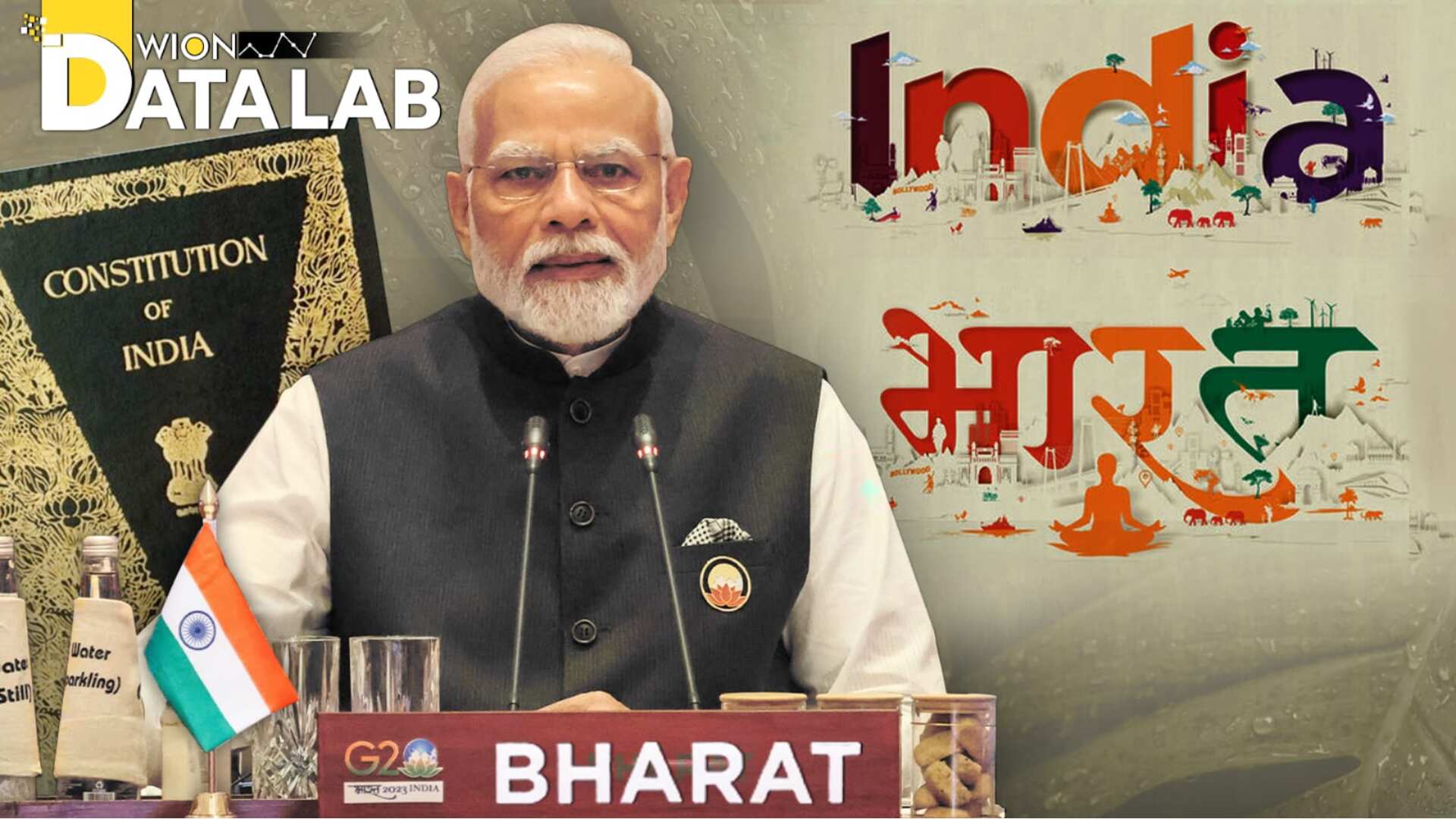
India's Prime Minister Narendra Modi
India is currently caught in a whirlwind of uncertainty, with rumours of a significant change in the pipeline – the prospective rebranding of the nation as "Bharat".
The speculations stem from the recent G20 Summit hosted by India on September 9 and 10, whereinPresident Droupadi Murmu's invitation for the dinner reception referred to her as the "President of Bharat," in Hindi, instead of the conventional "President of India."
The conjecture is further fuelled by the forthcoming five-day special parliamentary session starting on September 18, with heightened expectations of a significant government decision.

Following initiatives like the Uniform Civil Code and 'one-nation, one election,' speculation now revolves around the formal change of our country's name from 'India' to 'Bharat' through a constitutional amendment under Article 368.
"From a constitutional perspective, any name change would introduce a normative shift in the interpretation of the constitution itself. Using the name 'Bharat' would also raise the question of what the term 'Bharat' signifies," explained Ashit Srivastava, Professor of constitutional law,National Law University, Jabalpurto WION.
In many theocratic states, when terms signifying a specific religion are employed, the laws tend to align closely with that religion's teachings. If we examine the constitutions of countries like Pakistan, Sri Lanka, or those in the Middle East, a common feature emerges: they explicitly define the state's religion and often use it as the normative foundation guiding all legislative alignment, explained Srivastava.
)
‘I have a big decision coming up’: Trump says he’s approaching major ‘crossroad’ in Iran war
)
Chiefs tight end Travis Kelce named one of the victims in $35 million ponzi scheme
Mandakini breaks silence on Dawood Ibrahim photo: 'I was not invited by him'
)
Former India player Diana Edulji wants Smriti Mandhana to replace Harman as skipper at the earliest
)
Formula One reveals the 2027 race calendar; Monaco to host sprint race for the first time
&im=FitAndFill=(700,400))
Meet top 5 batters in the latest ICC T20I Rankings
)
All Indian goods to get duty-free access to New Zealand
)
240-million-year-old bizarre 'pig with a tusk' creature creates new dilemma over origin of dinosaurs
)
US House votes 417-3 to pass Ratepayer Protection Act targeting AI data center electricity costs
)
China urges Iran to rein in Houthis after Saudi Arabia’s appeal for help: Report
)
US to sell 48 F-35 Lightning fighter jets to Saudi Arabia, help it deter threats
)
Hong Kong unveils 11 new measures to boost birth rates, offers higher cash bonuses and housing perks
)
Former OpenAI researcher warns of growing risks from Artificial Intelligence
)
Veteran actor Anant Nag honoured with Indian cinema’s highest award
)
Dolly Parton dies at 80: Country legend’s team reveals cause of death
)
Tata Trusts chairman Noel Tata calls Chandrasekaran’s reappointment ‘illegal’, rejects Tata Sons listing
)
Fed raises rates for first time in 3 years, Kevin Warsh defies Trump as inflation mounts
&im=FitAndFill=(700,400))
Widow's Bay, Pitt and Hacks: Where to watch these 2026 Emmy winners
)
US drone firm linked to Trump’s sons signs MoU with Pakistan army, gets initial order
)
Pak batter Rizwan's petition against being questioned by cyber crime agency rejected by court
)
Daayra movie review: Kareena Kapoor, Prithviraj Sukumaran shine in Meghna Gulzar’s cop-versus-cop crime thriller
)
Prince William and Kate Middleton take royal titles to Rothesay during Scotland visit
)
Trump gets new power to hit India, China with up to 100% tariffs as US Senate clears Russia sanctions bill
)
‘Imagine 50 AI fighters cornering one manned jet’: India’s mobbing doctrine eyes a new era of air warm
)
Saudi vs Houthis: Riyadh claims to have shot Houthi drone targeting Mecca
)
Trump’s rare gesture for Xi: US president to personally welcome Chinese leader at airport
)
The Verdict | Hostile to whom? Canada looks to Europe — and Trump threatens tariffs
)
Want to get married within a year? Why 18 lakh people rush to Jaipur for ‘sacred henna’
&im=FitAndFill=(700,400))
Suriya and Jyothika say ‘I do’ again after 20 years! See their dreamy wedding pics
)
Laura Wolvaardt sets new world record for most WT20I runs in a year
)
Mahua Moitra moves UN over alleged exclusion of Muslim officers from Amit Shah events
)
The Early Spring season 2 is happening, but fans have one request - 'don't change the actors'
)
Ukraine plans record $109 bn defence spending, nearly two thirds of budget amid Russia war
)
If India, proclaiming itself a secular country, relinquishes the name 'India' and adopts 'Bharat,' it would raise questions about what it might mean.
"In a secular nation like ours, adopting the name 'Bharat' might carry a distinct leaning towards a specific community," opined Srivastava.
How much would it cost?
This very idea of a name change has alsoprompted experts to calculate the financial implications of such a rebranding venture on the nation's treasury.
While the act of changing a country's name may initially seem symbolic, it would necessitate significant modifications at local, national, and international levels. From revising government documents and maps to updating highway signage and promoting the rebranding, each aspect would bear a financial burden for the nation.
Drawing insights from the experiences of other countries that have undergone similar transitions, such as eSwatini (formerly Swaziland), offers valuable perspective.
In 2018, the cost estimation for eSwatini's rebranding was not explicitly disclosed, but intellectual property lawyer and blogger Darren Olivier, based in South Africa, devised a noteworthy formula.
Olivier proposed that, for a large company, the average marketing budget represents about sixper cent of its revenue. In eSwatini's case, this would amount to $60 million, with rebranding budgets typically constituting 10 per cent of these marketing costs. This formula yielded an estimated $6 million cost for the eSwatini government, a significant sum for a smaller nation.

Applying this formula to a country as vast as India, the projected cost stands at approximately Rs 14,000 crore ($1.75billion),using Olivier's methodology. However, this figure is an estimate, and the actual cost could vary considerably depending on the extent of financial resources the Indian government chooses to allocate to publicise this monumental change, if it really goes ahead with aplan to change the name.
WATCH WION LIVE HERE: