CBSE's third language policy: Who must study R3 and what happens if you fail? WION Decodes

&imwidth=600&imheight=450&format=webp&quality=medium "CBSE's third language policy: Who must study R3 and what happens if you fail? WION Decodes")
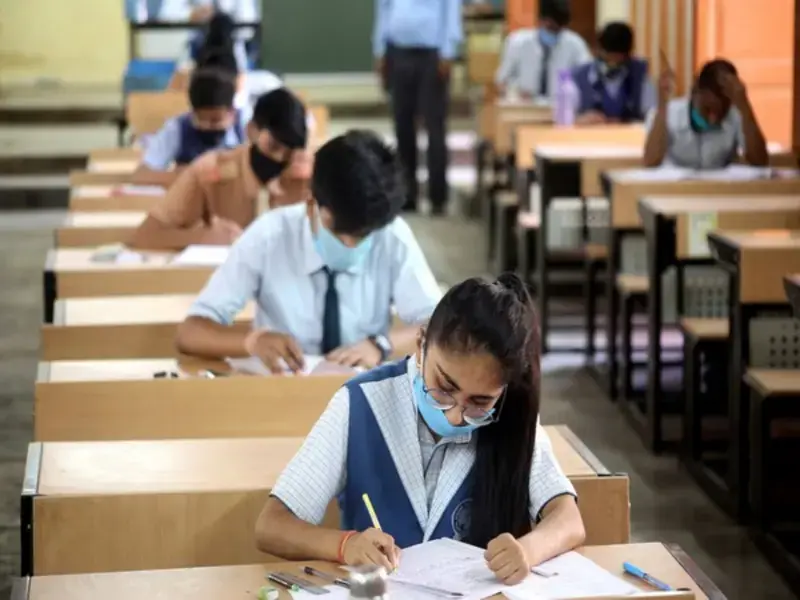
Students appearing in CBSE exam Photograph: (ANI | Representative Image)
CBSE has clarified that the third language will not be part of the Class 10 Board exam for the current Class 9 batch. However, students must pass the school-based assessment in the subject to receive the CBSE Secondary School Examination Pass Certificate.
The Central Board of Secondary Education (CBSE) on Tuesday (July 14) has clarified that the third language (R3) will not be part of the Class 10 Board examination for the current batch of Class 9 students, who will appear in Class 10 Board in Academic year 2027–28, but clearing the school-based assessment in the subject will be mandatory. The clarification was given by CBSE in a notice dated July 10. It comes amid continued debate over the Board's revised three-language policy.
Also Read: Paper leak, re-NEET and trauma: What's the mental cost of India's medical entrance exam crisis
What is CBSE's three language policy?
CBSE has mandated students entering Class 9 to study three languages, with at least two required to be ‘Bhartiya Bhashas’ (Indian languages). Languages are categorized as Core/First (R1), Additional/Second (R2), and Third (R3). Foreign languages can only be chosen for the third language (R3) if the other two chosen languages are native Indian languages. The Ministry of Education and CBSE specifically structured this framework to fulfill the mandate laid out in the National Curriculum Framework for School Education (NCF-SE), which was built to operationalise the National Education Policy (NEP) 2020. Current Class 10 students are exempt from the policy and remain on the old two-language system.
Also Read: 'They don't have shame': Students flag multiple technical issues as CBSE opens re-evaluation portal
Why is there a confusion over it?
Trending Stories
&im=FitAndFill=(700,400))
)
)
)
)
)
)
)
)
)
)
)
)
)
)
&im=FitAndFill=(700,400))
)
)
&im=FitAndFill=(700,400))
)
)
)
)
)
)
)
&im=FitAndFill=(700,400))
)
)
)
)
)
)
&im=FitAndFill=(700,400))
There has been widespread confusion over the new rule because of CBSE's unclear directives and circulars. Initially, CBSE stated that the compulsory three-language policy for Class 9 would be deferred until the 2029-30 academic session to give schools time to wait for new NCERT textbooks. A month later on May 15, a major flip came from CBSE's side, in which it said that the three-language rule would indeed become compulsory for Class 9 starting July 1, 2026. In June, it laid out guidelines explaining how the transition would happen. In it, it said that the third language would not feature as an external Class 10 Board Exam subject. It also said that students currently in Classes 7, 8, and 9 who previously opted for two foreign languages have received a "one-time relaxation" allowing them to keep those combinations, provided they study one Indian language as well. Now, even as confusion continued, in July, it has said that students must clear the school-based internal assessment to receive the CBSE passing certificate.
Major FAQs with answers
- Will the third language (R3) be part of the Class 10 Board exam?
For students entering Class 9 in the 2026–27 academic session, the third language will not be included in the Class 10 Board examination. For all others, though it will be not included in final paper, passing the school-based assessment in R3 is mandatory to receive the CBSE Secondary School Examination Pass Certificate.
- What if a student already studies two Bhartiya Bhashas?
The student can choose: Another Bhartiya Bhasha, or any non-native language such as English or French
- What if a student studies one Bhartiya Bhasha and one non-native language?
The third language must be a Bhartiya Bhasha
- What happens if a student fails the third language assessment in Class 9?
The student will still be promoted to Class 10. However, they must clear the Class 9 R3 assessment while studying in Class 10 to become eligible for the CBSE Secondary School Examination Pass Certificate.
- What if a student fails the R3 assessment again in Class 10?
CBSE says schools must reassess the student before the Class 10 Board results are declared. However, the circular does not clarify what happens if the student fails the reassessment as well.
- How will schools arrange teachers for additional languages?
CBSE has allowed schools to use:
Existing teachers with functional proficiency,
Retired teachers,
Postgraduate language experts,
Sahodaya school clusters,
Virtual or hybrid teaching methods

