US spy satellite from Cold War shatters 775 km above Earth

&imwidth=600&imheight=450&format=webp&quality=medium "US spy satellite from Cold War shatters 775 km above Earth")
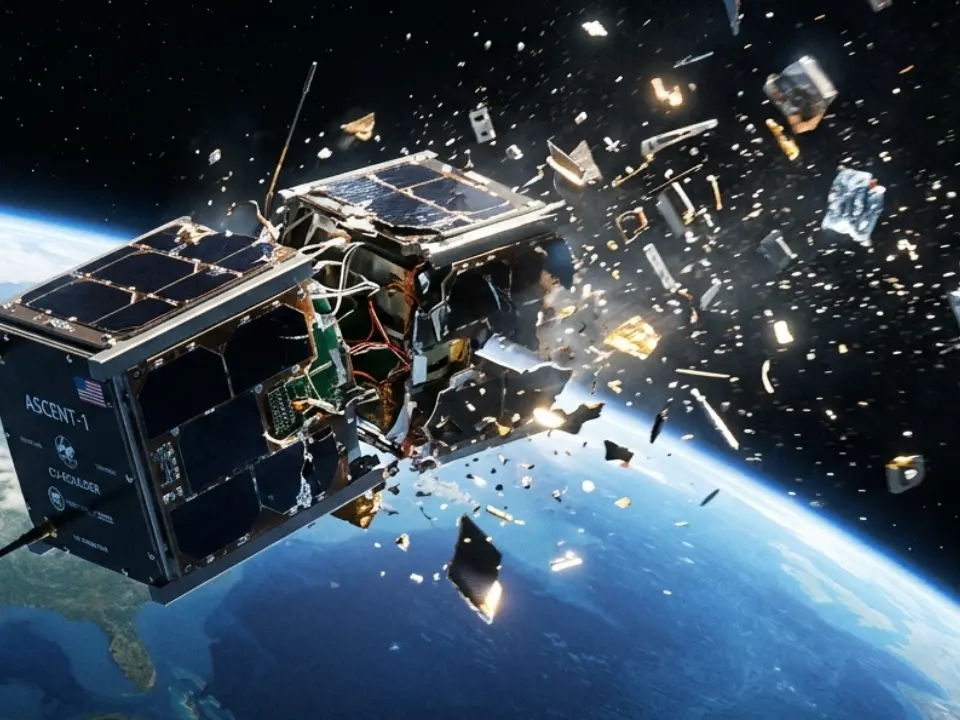
American satellite launched in 1988 to watch Soviet Union radar signals shattered without a known cause Photograph: (AI-Generated image)
Spy satellite USA 32, codename FARRAH III, reportedly broke unexpectedly earlier this month. No reason for the occurrence has been given, while Space Force said it is monitoring the debris. It was launched in 1988 during the Cold War to monitor the Soviet Union's radar signals.
An American spy satellite launched in 1988 to monitor radar signals from the Soviet Union has broken into pieces in orbit. Space Force confirmed that satellite USA 32, codename FARRAH III, fragmented on September 13, 2026. "U.S. Space Forces–Space (S4S) confirms the fragmentation of USA 32 (#19460) in LEO on 13 Sep 2026 (JDay 256) at approximately 2113 UTC," Space Force said. The break-up occurred around 775 kilometres above Earth, and no reason has been revealed yet.
It further added that all "debris is being incorporated into routine conjunction assessment screenings" and the pieces do not pose any danger to other satellites. A report by Spaceweather.com suggested that a pressurised tank or battery possibly exploded after heating and cooling for years. Another likely cause is a meteorite strike, or collision with debris. Low-Earth orbit is an extremely congested place, and experts have warned that such events can become common.
Satellite debris could trigger further collisions
The newly created debris is now at risk of further collision with other objects in the region. Space Force has said that it is monitoring the situation and checking the size of each piece and the risk it poses to other spacecraft. Astronomers are also hoping to reconstruct how the satellite came apart by studying the paths of the new objects.
FARRAH III was launched on September 5, 1988, to keep an eye on radar from the Soviet Union. It processed some data on board and sent it to astronomers and military officials on Earth. The satellite's codename was inspired by American actor Farrah Fawcett. It was described as a "tuna can" because it wasn't a grand satellite that used spin to stabilise itself. It is not known how long it remained functional, although it was observed spinning in 2021.
In order to reduce debris in orbit, space agencies bring down satellites in a planned manner that mostly break up in the atmosphere. They also passivate them, a process where all the propellant is utilised to prevent any explosions. NASA says launch vehicles and payload satellites have "several types of stored energy sources on board, any of which might result in energetic breakups and the creation of debris after their mission has ended."
Trending Stories
)
)
)
)
)
)
)
)
)
)
)
)
)
)
)
)
)
)
)
)
&im=FitAndFill=(700,400))
)
)
)
)
)
)
&im=FitAndFill=(700,400))
)
)
)
)
)
)
)
)
)
Whether FARRAH III was passivated or not is not known.

