Something happened on secret Soviet base 194 years ago that was a mystery till now

&imwidth=600&imheight=450&format=webp&quality=medium "Something happened on secret Soviet base 194 years ago that was a mystery till now")
Simushir volcanoes have not erupted since 1957.
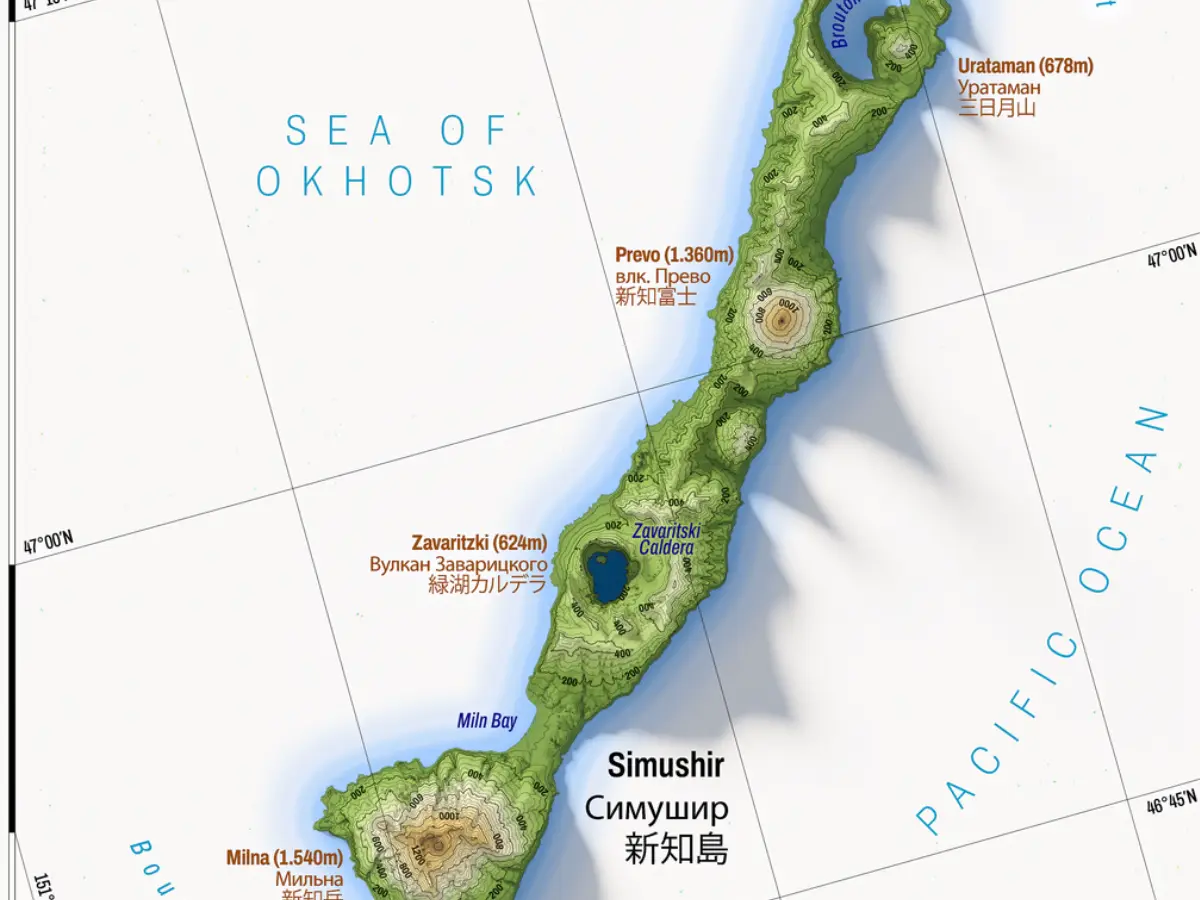
Simushir is part of the Kuril Islands, comprising 50 volcanic islands in the North Pacific Ocean. It stretches for eight kilometres and is visible from space.
A Russian island hosts four volcanoes, one of which significantly altered Earth's climate 200 years ago, a study has found. Simushir is a quaint island which was once a Soviet naval base. It has four volcanoes, all neatly lined up - Milna, Zavaritski, Prevo and Uratman. One of the volcanoes witnessed the most massive eruption in the recorded history of the Earth. This event proved detrimental for the planet's atmosphere, Live Science reported.
Simushir is part of the Kuril Islands, comprising 50 volcanic islands in the North Pacific Ocean. It stretches for eight kilometres and is visible from space. Russia currently controls this region, although Japan has also ruled the islands at some points in time in the past 400 years. Until 1994, a secret Soviet nuclear submarine base operated here, but today it is uninhabited.
Nearly 200 years ago, in 1831, the Northern Hemisphere suddenly cooled down. The temperature fell by an average of about 1 degree Celsius. At the same time, reports suggest that the weather turned gloomy. The sun also donned different colours, making things worse.
NASA says that Simushir and the other Kuril Islands are volcanic hotspots. This region resides in the "Ring of Fire" — a 40,000 km arc located above tectonic plate boundaries that surround the outer edge of the Pacific Ocean. This led the scientists to conclude that a volcanic eruption had occurred in the region, causing the skies to turn a dark colour, blocking the sun.
It wasn't known which volcano was the culprit, and it was only revealed in December last year. According to a team of scientists, Zavaritski blew up, as proven by the ash deposits in polar ice cores. However, this left them even more confused since there was no record or evidence of any eruption on Simushir in 1831.
Of the four volcanoes, Milna stands the tallest at 5,050 feet. It erupted in 1914. A smaller volcano, Goriaschaia Sopka, stands near it and seems to be connected to Milna. Zavaritzki stands next to it and is around 2,047 feet tall. It last blew up in 1957. A large crater can be seen next to it in satellite images.
Trending Stories
&im=FitAndFill=(700,400))
)
)
)
)
&im=FitAndFill=(700,400))
)
)
)
)
)
)
)
)
)
)
)
&im=FitAndFill=(700,400))
)
)
)
)
)
&im=FitAndFill=(700,400))
)
)
)
)
)
&im=FitAndFill=(700,400))
)
)
)
Prevo comes next and is 4,460 feet tall and last erupted in 1825. Uratman stands at a height of 2,224 feet and has not erupted in 12,000 years. The Soviets used a deep lagoon, known as Brouton Bay, near Uratman for their nuclear submarines.

