Injured pelican knocks on NOAA facility door in Florida seeking help

&imwidth=600&imheight=450&format=webp&quality=medium "Injured pelican knocks on NOAA facility door in Florida seeking help")
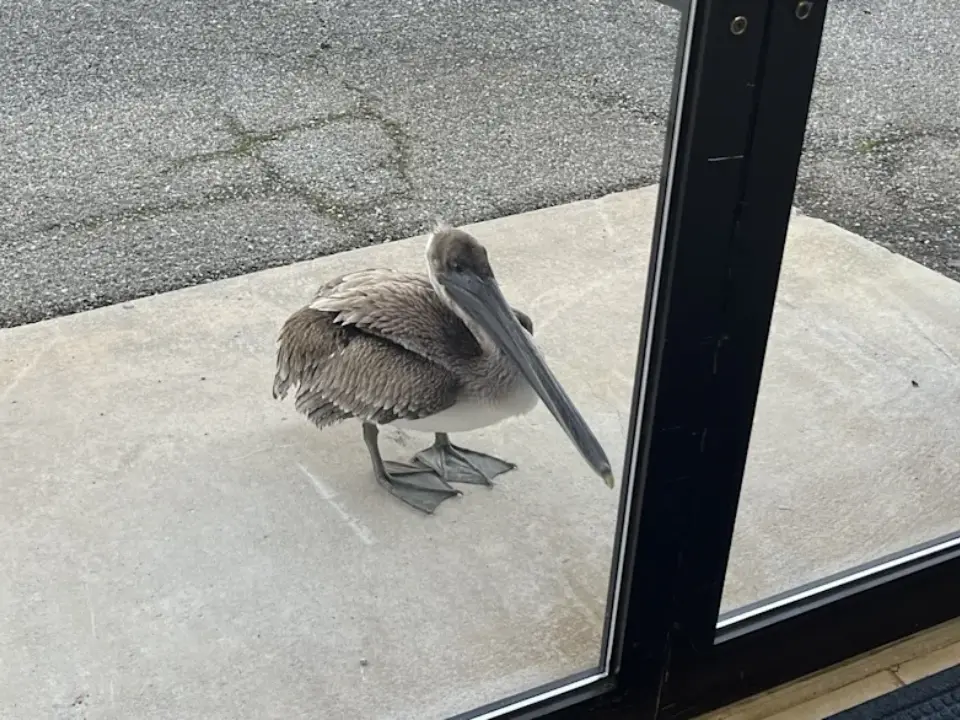
The pelican stood outside the door and pecked its beak on the glass door. Photograph: (NOAA Fisheries)
The pelican was injured and reached the facility looking for help or food, experts say. They are sure no one carried it to the building. Scientists are wondering how the bird knew to ask for help by knocking on the glass.
Scientists at a Florida marine research facility were left pleasantly surprised when a pelican knocked on the door seeking help. One of the researchers heard a knock on the back door and went over to check. The biologist saw a brown pelican standing outside and pecking on the glass with its beak. It continued to stand as if waiting for someone to answer. Upon inspection, they noticed that the bird was injured.
The researchers noticed that a fishing line was wrapped around the pelican's right wing. A double-barbed treble hook was stuck in the wing, and its left foot had nearly a dozen cactus spines embedded in it. A research associate at the National Oceanic and Atmospheric Administration (NOAA) facility said that the bird likely walked about half a kilometre to reach the building.
Annsli Hilton told The Washington Post that when she heard other researchers talking, she thought someone had brought the bird to the in Panama City facility. She was left shocked when she learned that the pelican had come on its own. Hilton said she always thought that animals in need of help might reach out on their own. "But I never thought it would happen," she said.
Pelican was treated at the facility
Hilton said pelicans are common in St. Andrew Bay and the bird supposedly came from there. The incident happened on September 8. Researchers who study fish and sharks treated the pelican, as one of them held its beak to avoid getting bit by the bird. The fishing line was nearly 6-foot-long and was cut off with a scissors. The fish hook was removed with wire cutters and forceps were used to pick out the small barb.
Hilton said even though she had never treated a pelican before, she used the technique of inserting tags into small tooth sawfish to remove the objects. The pelican was treated in about five minutes, but it felt like an hour to the biologists helping the bird. It was taken back to the basin where it flew away.
Trending Stories
)
)
)
)
)
)
&im=FitAndFill=(700,400))
)
)
)
)
)
)
)
)
)
)
)
)
)
)
)
)
)
)
)
)
)
)
)
)
)
)
&im=FitAndFill=(700,400))
)
&im=FitAndFill=(700,400))
)
)
)
)
)
)
How did the pelican know to ask humans for help?
Scientists are still wondering how the pelican knew to ask humans for help. The laboratory is gated from the road, so they are sure no one carried the bird. Gerald Hough, a professor who studies bird behaviour at Rowan University in New Jersey, told the outlet that the bird may have seen the biologists carry fishes in and out of the facility, and likely went there for food.
As for how it knew to peck at the glass door, Hough said it may have confused its reflection, thinking it was another bird and was likely asking it for help.

