Homo Sapiens used sunscreen to survive the Laschamps excursion 41,000 years ago. What was it?

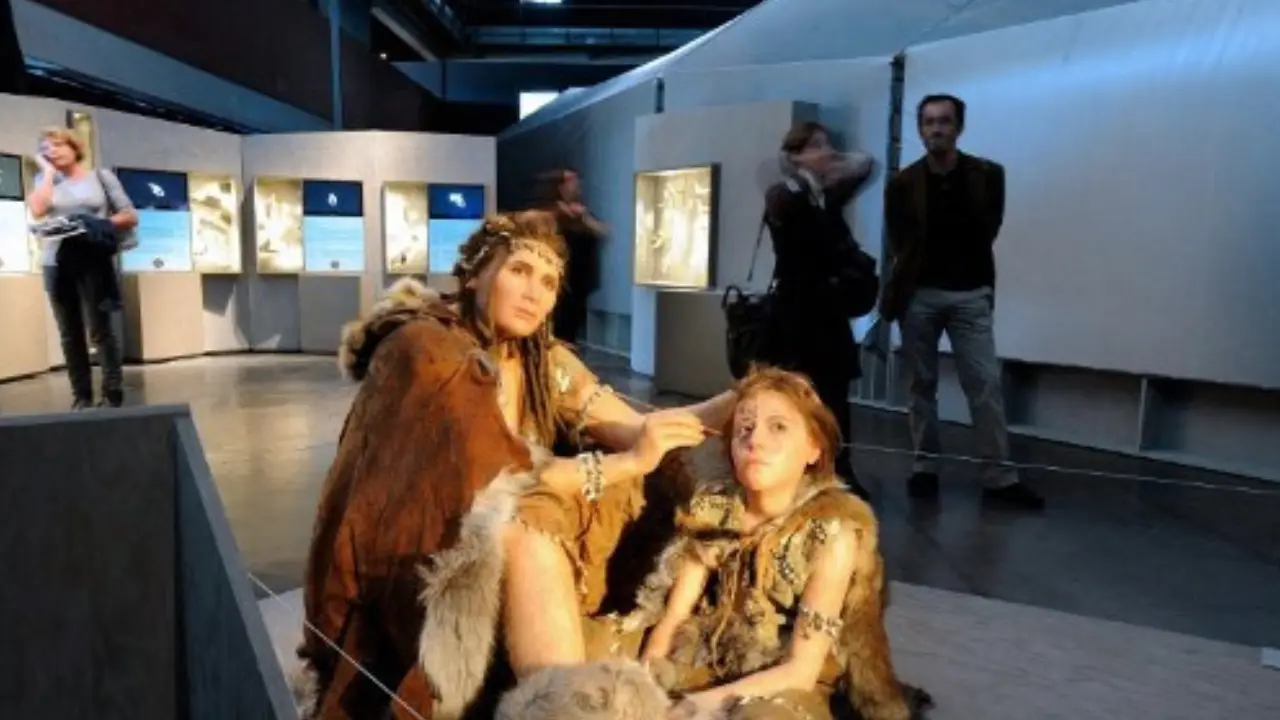
Earth's magnetic poles started flipping 41,000 years ago. Homo Sapiens were ready for the UV radiation from space, but Neanderthals, not so much. Science & Tech Trending
When Earth's magnetic North Pole shifted over Europe about 41,000 years ago, solar radiation likely spelt doom for Neanderthals. However, Homo Sapiens managed to survive and a paper has revealed how. According to a study, Homo Sapiens used sunscreen, tailored clothes and caves to protect themselves from the event.
A study published in Science Advances and led by researchers at Michigan Engineering and the U-M Department of Anthropology says that Home Sapiens had access to these things and knew how to use them. On the other hand, solar radiation wreaked havoc on Neanderthals, who supposedly did not know about these things and disappeared around 40,000 years ago.
Magnetic field flipped 41,000 years ago
Earth's magnetic field flips every few years and has happened around 180 times since it has been in existence.
Also Read: Largest single flood on Earth happened 5 million years ago, and filled an empty Mediterranean Sea
The researchers found that when the poles started flipping 41,000 years ago, the North Pole was over Europe. The pole reversal process did not reach its end, and the magnetic field weakened considerably.
Trending Stories
)
)
&im=FitAndFill=(700,400))
&im=FitAndFill=(700,400))
)
&im=FitAndFill=(700,400))
)
)
)
&im=FitAndFill=(700,400))
)
)
)
)
)
)
)
)
)
&im=FitAndFill=(700,400))
)
)
)
)
)
)
)
)
)
)
)
)
)
)
)
)
Auroras happened over several parts of the planet, and Earth was exposed to harmful UV radiation from space. This created unfavourable conditions for those who lived on the planet at the time.
Homo Sapiens used sunscreen
The study notes that Homo sapiens were likely making tailored clothing at this time.
Also Read: Meet Lucy: Scientists reveal what one of our earliest human ancestors looked like
They were also using ochre, a mineral that had the properties to protect against the harmful sunlight. The way of living spread to Asia and Europe, but the Neanderthal population was already on the decline.
Agnit Mukhopadhyay, lead author and U-M research affiliate in climate and space sciences and engineering, said, "In the study, we combined all of the regions where the magnetic field would not have been connected, allowing cosmic radiation, or any kind of energetic particles from the sun, to seep all the way in to the ground."
Also Read: How many Earth-like planets are in the Milky Way? AI has the answer
“We found that many of those regions actually match pretty closely with early human activity from 41,000 years ago, specifically an increase in the use of caves and an increase in the use of prehistoric sunscreen.”
The Laschamps excursion
The magnetic field acts like a shield which protects Earth from cosmic radiation. Mukhopadhyay studied the interaction between the plasma from the sun and Earth’s magnetic field. The magnetic fields are the strongest at the poles, so auroras only appear in these regions.
However, sometimes the poles shift from their places. Mukhopadhyay said that the last time this happened was 41,000 years ago and was known as the Laschamps excursion.
He worked with Sanja Panovska, a researcher at Germany’s GFZ Helmholtz Centre for Geosciences, to learn more about what would have happened at the time. They found that Earth’s magnetic field was only about 10% of its current strength, allowing the magnetic poles to weaken near he equator.
They also discovered that the time period of the Laschamps excursion was almost the same as the change in human groups.
Raven Garvey, U-M associate professor of anthropology, said that Homo sapiens arrived in Europe roughly 56,000 years ago. "By about 40,000 years ago, Neanderthals were no longer identified as a species in Europe."
Archaeologists have, over the years, found items related to sewing in places where modern humans are thought to have lived. Garvey said that this means they were tailoring their clothes. They also "ramped up their use of ochre, a naturally occurring pigment composed of iron oxide, clay and silica."
All this likely provided them protection against the UV rays when the magnetic poles flipped.

