Singapore warns Hormuz crisis was a 'dry run' for US-China conflict

&imwidth=600&imheight=450&format=webp&quality=medium "Singapore warns Hormuz crisis was a 'dry run' for US-China conflict")
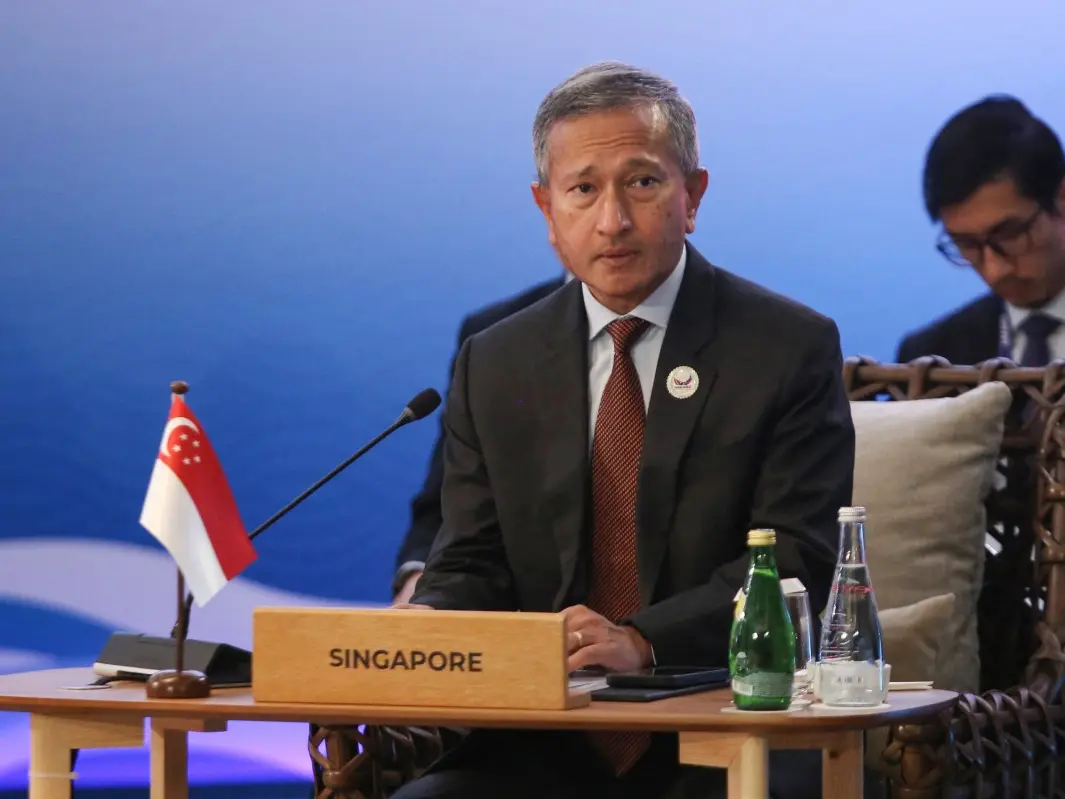
Singapore's Minister of Foreign Affairs Vivian Balakrishnan attends the Association of Southeast Asian Nations (ASEAN) Foreign Ministers' Retreat in Cebu City on January 29, 2026. Photograph: (AFP)
Singapore’s Foreign Minister Vivian Balakrishnan warns that the Hormuz crisis could be just a prelude to a potential US-China conflict in the Pacific Ocean.
Singapore's Foreign Minister Vivian Balakrishnan warned on April 22 that the current disruption in the Strait of Hormuz is just a “dry run” for a potential conflict between the US and China in the Eastern Pacific that has been in the making for decades now. Speaking at the CNBC’s CONVERGE LIVE event in Singapore, Balakrishnan said that a potential escalation in the Pacific will be far more catastrophic to global stability. Responding to questions about whether Singapore is facing any pressure from either the US or China, he asserted that Singapore will “refuse to choose sides” and act in its “long-term national interest”.
“The way we conduct our affairs is we assess what is in Singapore’s long-term national interests, and if I have to say no to Washington or Beijing or anyone else, we don’t flinch from that.” He added, “We are acting in our own long-term national interest. We will be useful, but we will not be made use of.”
Singapore shares an equally good relationship with Beijing, and Washington has a unique position to either get stretched between the two or benefit from both. It maintains a goods trade deficit with the US of about $3.6 billion; at the same time, the US is the largest foreign investor in Singapore. At the same time, China is the largest trading partner of Singapore.
Weaponisation of “choke point”
Singapore sits at the southern entrance of the vital choke point, the Singapore Strait, in the Indian Ocean, through the Strait of Malacca, at the junction of the Andaman Sea and the South China Sea, leading to the Pacific Ocean. Balakrishnan pointed out that the US-Israel-Iran war has revealed the importance of trade choke points.
Trending Stories
&im=FitAndFill=(700,400)&imwidth=280&imheight=210&format=webp&quality=medium)
&imwidth=280&imheight=210&format=webp&quality=medium)
&imwidth=280&imheight=210&format=webp&quality=medium)
&imwidth=280&imheight=210&format=webp&quality=medium)
&imwidth=280&imheight=210&format=webp&quality=medium)
&imwidth=280&imheight=210&format=webp&quality=medium)
&imwidth=280&imheight=210&format=webp&quality=medium)
&im=FitAndFill=(700,400)&imwidth=280&imheight=210&format=webp&quality=medium)
&imwidth=280&imheight=210&format=webp&quality=medium)
&imwidth=280&imheight=210&format=webp&quality=medium)
&imwidth=280&imheight=210&format=webp&quality=medium)
&imwidth=280&imheight=210&format=webp&quality=medium)
&imwidth=280&imheight=210&format=webp&quality=medium)
&imwidth=280&imheight=210&format=webp&quality=medium)
&imwidth=280&imheight=210&format=webp&quality=medium)
&imwidth=280&imheight=210&format=webp&quality=medium)
&imwidth=280&imheight=210&format=webp&quality=medium)
&imwidth=280&imheight=210&format=webp&quality=medium)
&imwidth=280&imheight=210&format=webp&quality=medium)
&imwidth=280&imheight=210&format=webp&quality=medium)
&imwidth=280&imheight=210&format=webp&quality=medium)
&im=FitAndFill=(700,400)&imwidth=280&imheight=210&format=webp&quality=medium)
&imwidth=280&imheight=210&format=webp&quality=medium)
&imwidth=280&imheight=210&format=webp&quality=medium)
&imwidth=280&imheight=210&format=webp&quality=medium)
&imwidth=280&imheight=210&format=webp&quality=medium)
&imwidth=280&imheight=210&format=webp&quality=medium)
&imwidth=280&imheight=210&format=webp&quality=medium)
&imwidth=280&imheight=210&format=webp&quality=medium)
If the Strait of Hormuz accounts for 20 per cent of global energy trade, the Strait of Malacca accounts for more than 25 per cent of global energy trade. It has strategic interest to both China, Japan, and India. At its narrowest point its two nautical miles compared to the 21 nautical miles of the Strait of Hormuz.
In March, there were reports that Iran was considering legislation for the extraction of toll, to which many analysts predicted that Singapore must be considering the collection of a similar tax in the Strait of Malacca. The minister told CNBC that the three nations, Singapore, Malaysia and Indonesia bordering the Strait, have an interest in keeping it open.
“The right of transit passage is guaranteed for everyone. We will not participate in any attempts to close or interdict or to impose tolls in our neighbourhood.”
However, with the increase in the militarisation of Japan, China is already alarmed, creating new faultlines. Singapore shares major ethnic and cultural relations with China. “Trust is basically a way of lowering transaction costs. Being predictable, being boring, being reliable, being trustworthy has got real value,” said Balakrishnan, hinting at the US unpredictability in Ukraine and tariffs sowed a sense of distrust. Deputy Prime Minister Gan Kim Yong, in the keynote address, said, “Trust can no longer be assumed; it has to be built and strengthened.”