Ancient Saudi Arabia had monumental buildings, not just barren lands: Study

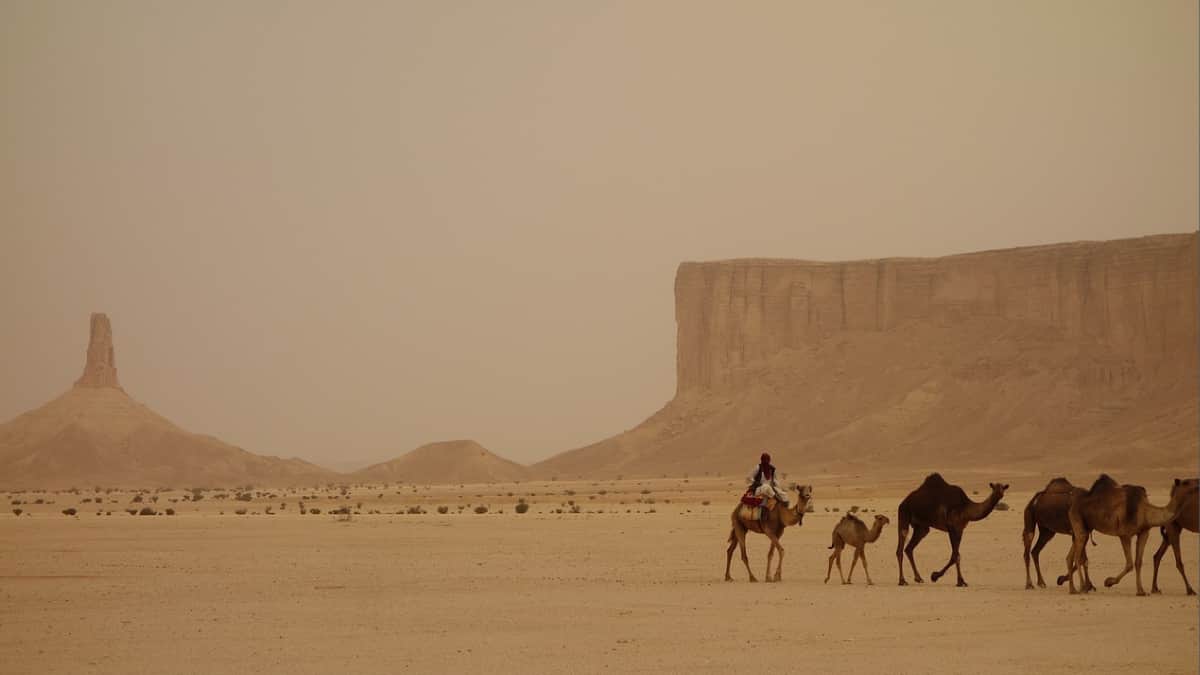
Representational image of Saudi Arabia.
During the Neolithic period, the people who lived in north-western Saudi Arabia have remained a mystery.
It has been said that the period saw a shift in the humans who started controlling food production and started to settle in communities along with domesticated animals and practised agriculture.
Also Read:Saudi Arabia's petrodollar deal with US expires with no new agreement in place

However,new evidence suggeststhat this picture of struggling people,who constantly travelled on barren lands,needs to be changed.
What did the researchers find about Saudi Arabia?
A team of Australian researchers published a study on monumental buildings in the journalLevant, which are called "standing stone circles."
)
‘Will go to any extent’: Pakistan vows to defend Saudi Arabia amid Houthi attacks
)
Three labourers killed as DU student loses control of his car, rams into them on Dwarka Expressway
)
Indian activist-lawyer Prashant Bhushan's post brings focus on ‘conflict of interest’ appointments of ex-govt officials at Reliance, Adani groups
)
Ukraine plans record $109 bn defence spending, nearly two thirds of budget amid Russia war
&im=FitAndFill=(700,400))
New Friday OTT releases (September 18, 2026): Lust Stories 3, You+Me, Best of the Best- 8 new titles coming on Netflix, Prime Video and more
&im=FitAndFill=(700,400))
From Abhishek Sharma to Sahil Chauhan, 5 batters with fastest T20I hundreds
)
'Gangsta' crab shoves knife blade at man and his dog in Florida - Watch
)
Who is Khalilur Rahman? All you need to know about 81st UN General Assembly President
)
How did an Australian river with 500 crocodiles pass the Olympic test? Here's how
)
US And Denmark reach Greenland deal, Trump announces expanded military presence
)
Trump's Greenland dream comes true? POTUS announces 'Infinite Life' deal with Denmark, claims permanent US control
)
The Verdict | When precision fails: US commits war crime in Minab school strike, UN finds
)
Trump signs Russia sanctions bill into law, targets Moscow’s energy sector
)
Africa is splitting, and a lot sooner than estimated, giving way to a new ocean
)
Trump 2.0: Dark days ahead for America’s ‘imperial presidency’
)
Drone strikes cooling tower at Russia's Kursk Nuclear Plant, IAEA confirms
)
FACT CHECK: Why did PM Modi ask Xi ‘is it okay’ at BRICS Summit? New video reveals...
)
Trump bans CNN, MS NOW and Politico from White House over ‘FAKE NEWS’
)
Shivakumar attends 79th Kalyana Karnataka Utsav in Kalaburagi
)
Laura Wolvaardt sets new world record for most WT20I runs in a year
)
China may have gained access to US's classified F-35 jets; parts meant for repairs diverted to Hong Kong, sparking Pentagon inquiry
)
India seeks to build a full semiconductor supply chain
)
Flying cars in UAE: Ras Al Khaimah signs deal with Chinese company to test new transport
)
Indian Cinema bets big on mythology, brings ancient stories to modern audiences
)
Pentagon revives mandatory testosterone testing for male troops aged 30 and above
)
Godfather of AI Geoffrey Hinton gives US lawmakers a one-year warning on AI
)
Trump signs Russia sanctions law: India faces fresh 100% tariff threat over Russian oil
)
Fast bowler Brydon Carse faces no charges over Derby nightclub incident
)
Why Ranveer Singh’s Dhurandhar missed India’s Oscar entry; FFI jury member reveals what happened
&im=FitAndFill=(700,400))
Meet top 5 batters in the latest ICC T20I Rankings
)
Russia holds first parliamentary elections since the beginning of the Ukraine war
)
Former India player Diana Edulji wants Smriti Mandhana to replace Harman as skipper at the earliest
&im=FitAndFill=(700,400))
Meet top 5 bowlers in latest ICC T20I rankings
&im=FitAndFill=(700,400))
Meet top 5 Indian batters with fastest T20I centuries
The new findings are helping people in rewriting about those who lived in the land of Saudi Arabia between 6,500 and 8,000 years ago.
The evidence hints at the things they ate, the tools they used and the jewellery they wore. It becomes clearer how the people in those times figured out complex ways to survive on the land for millennia.
How the project was carried out by researchers?
Nearly 431 standing stone circles present in the AlUla and Khaybar regions of north-west Saudi Arabia were studied by the team of researchers, as part of the ongoing project.
Among those 431 structures, 52 were surveyed in detail and 11 of them were also excavated.
The new findings were made after analysing some buildings present on the Harrat 'Uwayrid,a volcanic plateau which wascreated more than a millennia ago.
Watch:Indian national in Saudi Arabia to be freed from prison, Abdul Rahim to return to Kerala
The researchers said that the standing stone circles explained how the mobile pastoralist communities were in ancient times.
The team also recovered remnants of people who stayed in these buildings for more than 1,000 years.
A range of modern and traditional techniques was used by the researchers to manage the practical limitations of working in remote and rugged landscapes.
Based on the tools and animal remains discovered, it appearsthat the people used animal skins to enclose the top of the structure,like a roof.
They also found evidence of stone tool-making, eating and cooking along with lost and broken tools which are used for processing animal hides.
(With inputs from agencies)