Flock of critically endangered vultures feed on deer carcass at Mudumalai Tiger Reserve

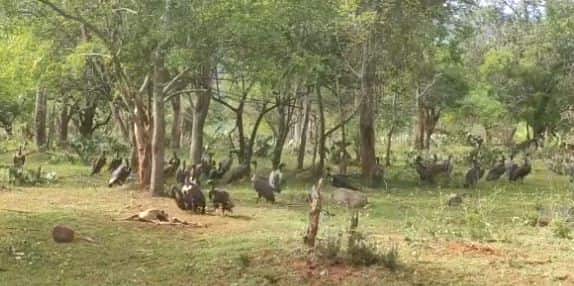
Large flock of white-rumped vultures feast on carcass of a spotted deer
A video showing a large flock of white-rumped vultures feasting on the carcass of a spotted deerat a restricted location inthe Mudumalai Tiger Reserve has enthused wildlife enthusiasts and conservators alike.
According to forest officials, thesighting of a large flock of critically endangered vultures(scavengers) indicates not only the increasing vulture populationbut is also a sign of a significant Tiger (predator) population, both of which are said to be the resultof successful conservation efforts.
Officials suspect that the deer kill was by a tiger in the region. They believe thathad the deer been hunted by a leopard it would havetaken the carcass atop a tree branch. Tree branches are unreachable spots for wide-winged vulturesthat often perch only on treetops.

Likewise, in the case of a pack of wild dogs or dholes hunting an animal, only the bones would remain. However, the carcass being left behind for the vultures to feedindicates the hunting style of the tigersthat often involves leaving the kill behind.
As per the latest 2019-20 census for the Mudumalai Tiger Reserve,there are sevenlong-billed vultures, twoEgyptian vultures and 125 white-rumped vultures.
)
Why asking questions could be more important than memorising answers
)
Osama Bin Laden ‘planned’ to target India, CIA reveals dozens of declassified documents
)
'Iran won't surrender': Pezeshkian sends blunt message to US while attending BRICS Summit in India
)
BRICS Summit 2026: Global leaders of BRICS nations attend main open session
)
Celine Dion makes emotional stage comeback after six years: 'I'm so delighted to see you'
)
PM Modi and China's Xi offered to help resolve Russia-Ukraine war: Kremlin
)
Why dehydration is the hidden cause of travel fatigue on long flights
&im=FitAndFill=(700,400))
Meet top 5 batters fastest to 3000 runs in T20Is
)
Top 5 places to visit in Goa beyond its famous beaches
)
'He is popular...': Malaysian PM Anwar Ibrahim's praise for PM Modi during bilateral meeting | WATCH
)
BRICS Summit 2026: PM Modi, Xi reach key consensus on ties, China to assume BRICS chairmanship in 2027
)
BRICS Summit 2026: Consensus on joint declaration, diplomatic win for India
)
Trump says Canada eager to reach a deal, it could come ‘fairly soon’ if Ottawa treats US farmers better
)
‘Partners, not rivals’: Xi outlines four point plan for stronger India-China ties
&im=FitAndFill=(700,400))
Why Chinese PL-15 air-to-air missiles use dual-pulse motors compared to European interceptors
)
Could staying indoors all day affect your health?
)
BRICS Summit 2026: PM Modi addresses Day 2 of 18th BRICS summit
)
Who is the smiling man beside Modi, Putin and Xi at BRICS Summit 2026?
)
800 million years old - Scientists discover 'fingerprints' of supercontinent Gondwana in ancient rocks
)
Why going digital does not always mean becoming more efficient
&im=FitAndFill=(700,400))
Why do air defence missiles explode near their target instead of hitting it?
)
Russian drone hits Warsaw-bound train near Polish border, Zelensky accuses Moscow of ‘deliberate’ targeting
)
War is making Russia stronger? How Ukraine is shaping Moscow’s next generation of weapons
)
Migration protests return to Portsmouth as rival demonstrations face off
)
From severe mobility problems to recovery: Madhuri the elephant’s journey of wildlife care
)
BRICS Summit day 1: New Delhi declaration adopted with full consensus, big diplomatic win for India
)
Did Iran President Pezeshkian touch feet of Hindu spiritual leader at Delhi event as shown in viral video?
)
9-year-old Chennai prodigy clears Cambridge IGCSE grade 10 exams
)
Why does your body need time to adjust after a long journey?
)
BRICS Summit 2026: PM Modi to hold bilateral with leaders of seven countries
)
Ramanathaswamy temple takes centre stage as PM Modi welcomes world leaders at BRICS
)
Houthis launch cross-border strike on Saudi Arabia as Yemen war escalates
)
BRICS Summit 2026: Chinese president Xi Jinping departs from New Delhi after attending BRICS summit
)
Why does your skin need protection from UV rays?
)
How does the loss of forests affect the way wildlife lives and moves?
)
IND vs AFG, 1st T20I: When and where to watch live streaming in India?
)
Why do wild animals need quiet places to survive?
)
Bigg Boss 20: Qazi Touqeer gets a special ‘rockstar’ moment from Salman Khan
)
Humans may lose control of AI: Anthropic CEO calls for slowdown, Altman, Musk back him
The abundant availability of feed for scavengers such as vulturesis said to be an ample indicator of a healthy predator(carnivore) population and an overall conducive ecosystem.
In the 1980s, the white-jumped vulture was abundantly spotted across South and South EastAsiawhen their global population was in millions. However, their numbers fell sharply and recent estimates point out that there are just a little over 10,000 such mature birds around the world.
According to reports, a major reason for the vulture population in the South Asia region has been the widespread use of the drug ‘Diclofenac’for the treatment of common ailments, pain, wounds in cattle and swine.
Vultures that feed on carcasses that contain traces of the drugdie of kidney failure as their blood crystallises around the organs. Despite the ban on the drug in the country since 2006, it is reportedly in use across parts of India. In certain cases, the carcasses that are purposefully laced with poison to kill tigersend up claiming the lives of vultures as well.
The non-steroidal anti-inflammatory drug (NSAID) Diclofenac is not alone in indirectly claiming vulture lives,other unsafe drugs like Aceclofenac, Ketoprofen and Nimesulide also are regarded as dangerous andtoxic for vultures.
