Voyager 2’s journey into interstellar space raises more questions than answers!

In November 2018, Voyager 2 became only the second human-made object to cross the boundary of the heliosphere, the vast bubble of particles and magnetic fields created by the Sun. What it has found since then has raised more questions than it has answered.

Introduction
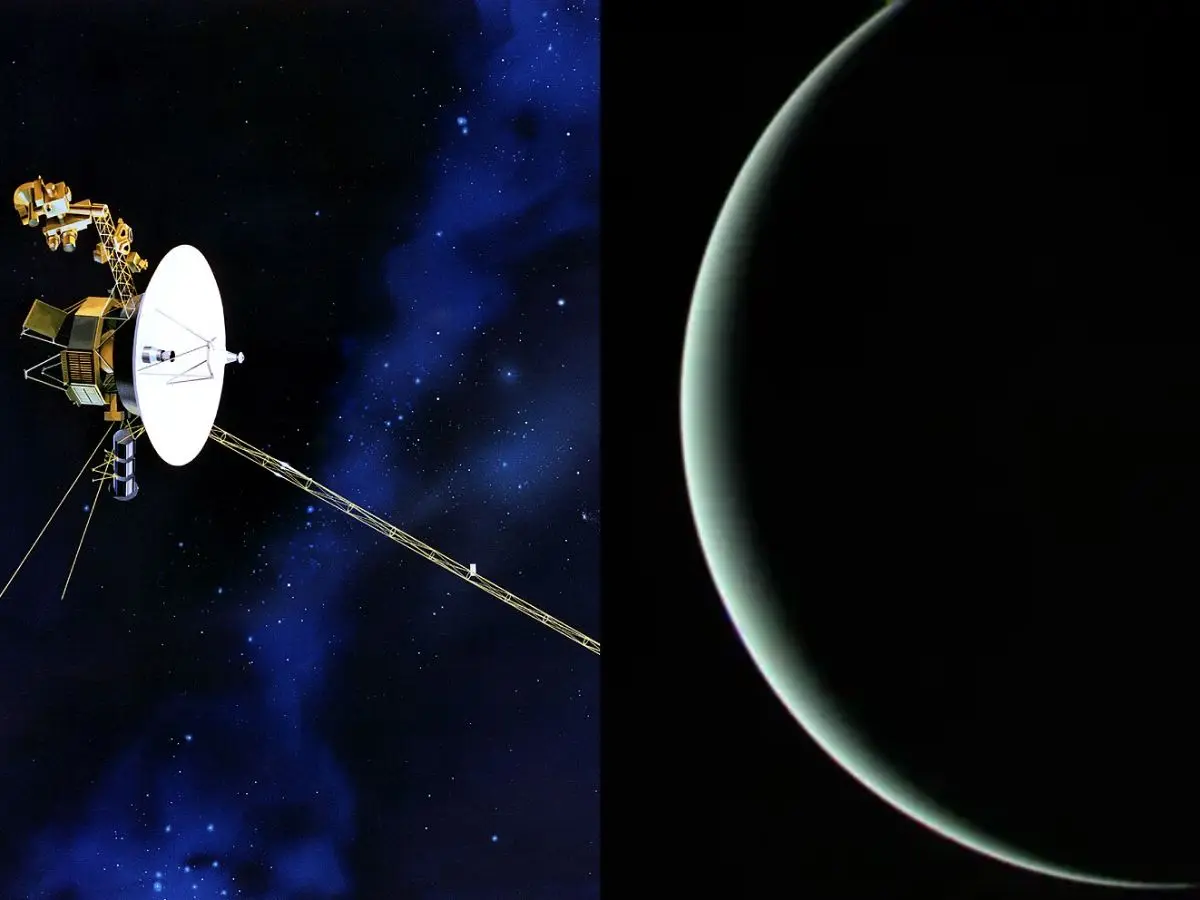
When NASA launched Voyager 2 in 1977, the spacecraft was designed to explore the outer planets of our Solar System. More than four decades later, it continues its journey, now travelling through interstellar space. In November 2018, Voyager 2 became only the second human-made object to cross the boundary of the heliosphere, the vast bubble of particles and magnetic fields created by the Sun. What it has found since then has raised more questions than it has answered.
Crossing the heliopause
The boundary where the solar wind meets interstellar plasma is called the heliopause. Voyager 2 crossed this threshold about 18 billion kilometres from Earth. Surprisingly, its measurements showed the transition was not as abrupt as expected. Instead of encountering a dramatic shift in magnetic fields and particles, the spacecraft recorded only subtle differences, leaving scientists puzzled about the true nature of this frontier.

The mystery of magnetic fields
Voyager 2 confirmed what Voyager 1 had seen earlier: the magnetic field just outside the heliosphere points in nearly the same direction as the one inside. This was unexpected, as many scientists assumed interstellar space would have a very different magnetic orientation. Why the fields appear so aligned remains one of the great puzzles of heliophysics.

A surge in cosmic rays
Beyond the heliosphere, both Voyager spacecraft detected a marked increase in galactic cosmic rays,high-energy particles from outside our Solar System. The heliosphere appears to act as a shield, blocking much of this radiation. Yet the exact way this barrier works, and how it varies over time, is not fully understood. These findings are crucial for predicting how cosmic rays might affect future interstellar travel.

The shape of the solar bubble
Voyager 1 and Voyager 2 exited the heliosphere at different distances and in different regions of space. This suggests the heliosphere is not a perfect sphere but distorted, perhaps shaped by the motion of the Solar System through the galaxy or by pressure from interstellar material. Determining its true structure remains a challenge.

How long will the Sun’s shield last?
Another unanswered question concerns the longevity of the heliosphere. Voyager 2’s data offer clues about how this protective bubble evolves and how it may eventually collapse as the Sun ages and its solar wind weakens. Understanding this process is key to predicting how habitable our planetary system might remain in the distant future.

Into the deep unknown
Voyager 2 continues to travel at over 55,000 kilometres per hour, moving deeper into interstellar space. Its power supply is expected to last until around 2030, after which it will fall silent. By then, it will have travelled further than any spacecraft except its twin, Voyager 1. Yet the questions it has raised, about magnetic fields, cosmic rays, and the shape of the heliosphere, ensure its mission will remain one of the most intriguing in the history of space exploration.
)
)
)
)
)