This company becomes first to be wiped out by AI...

The collapse began with a single, brutal admission. On May 2, 2023, just five months after the launch of ChatGPT, then-CEO Dan Rosensweig told analysts on an earnings call that the free chatbot was actively hurting their new customer growth.

1. The $14.5 Billion Moat
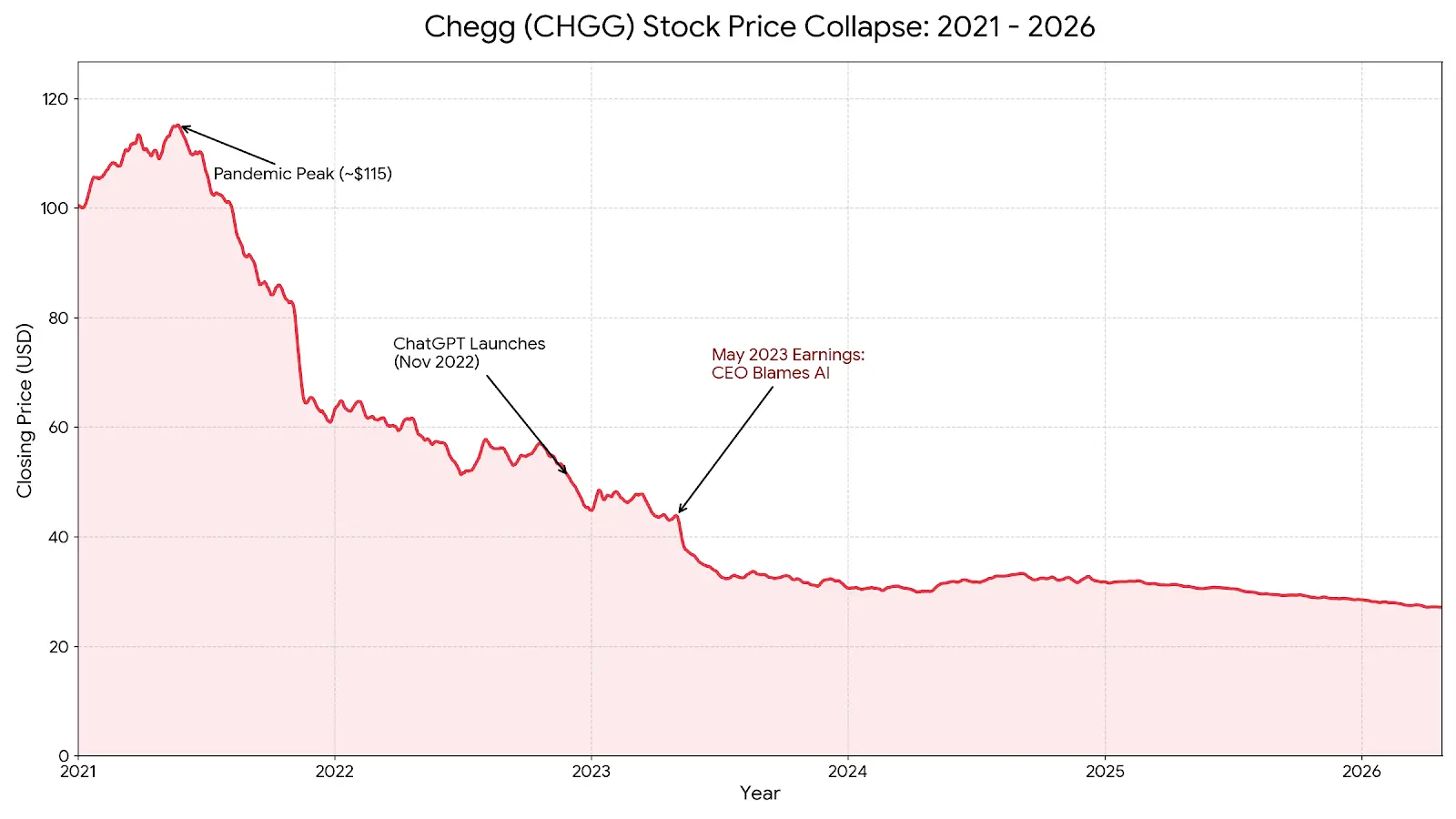
In early 2021, Chegg was the undisputed king of the digital classroom. Riding the pandemic-era surge in remote learning, the company’s stock soared past $113 per share, valuing the EdTech giant at a staggering $14.5 billion. Its business model seemed bulletproof: it had spent a decade paying thousands of human contractors to build a proprietary database of 79 million step-by-step homework answers, charging college students $19.95 a month for access.
2. The May 2023 Earnings Call
The collapse began with a single, brutal admission. On May 2, 2023, just five months after the launch of ChatGPT, then-CEO Dan Rosensweig told analysts on an earnings call that the free chatbot was actively hurting their new customer growth. Wall Street panicked. In a single day, Chegg’s stock plummeted by nearly 50%, wiping out $1 billion in market capitalization overnight. It was the first time a publicly traded company officially blamed AI for destroying its revenue.
3. The "Free vs. Paid" Paradox
Chegg's core product was rendered obsolete almost instantly. Why would a college student pay $20 a month and wait for a human contractor to upload a calculus solution, when ChatGPT could solve the exact same equation instantly, explain the underlying concept, and answer unlimited follow-up questions for free? ChatGPT broke every link in Chegg's value chain simultaneously.
4. The 'CheggMate' Failure
Desperate to stop the bleeding, Chegg attempted to pivot. In April 2023, they partnered directly with OpenAI to launch "CheggMate," an AI-assisted tutoring tool built on GPT-4. But the strategy was a dead end. Students recognized it was just a paid wrapper around the same underlying technology they could already access directly through OpenAI for free. The subscriber base continued to hemorrhage, dropping by half a million paying users.
5. Google’s AI Overviews Strike the Final Blow
If ChatGPT stole Chegg’s subscribers, Google’s AI Overviews destroyed its top-of-funnel discovery. Historically, a massive portion of Chegg’s web traffic came from students typing "solve this physics problem" into Google and clicking on a Chegg link. But by 2024 and 2025, Google began generating the answers directly at the top of the search results using its own AI. Chegg’s organic search traffic was choked off at the source.

6. The 99% Value Destruction
The corporate bleeding accelerated at a terrifying pace. To survive, Chegg initiated brutal restructuring, laying off 22% of its workforce in May 2025, and another 45% (388 employees) by October 2025. By early 2026, the company’s stock was trading at roughly $1.00—battling to avoid being delisted from the New York Stock Exchange. In just 39 months, 99% of its market capitalization had been wiped off the map.

7. The Warning to Wall Street
Chegg is not just a story of a poorly managed company; it is the cleanest, most documented case study of AI disruption in history. It proved that a decade of accumulated, human-generated data is no longer a defensible moat against a foundational LLM. As European and American business leaders watch Chegg fight for survival, it serves as a chilling warning: even a $14 billion empire can be rendered fundamentally obsolete overnight.
)
)
)
)
)