Physicists achieve 'perfect randomness'. Here is why it matters

Physicists at ETH Zurich achieved perfect randomness using entanglement in quantum mechanics. The breakthrough is huge for cryptography, passwords, and security keys.
Why unpredictable randomness is important
Achieving unpredictable randomness is one of the hardest things to do in physics. But a team of physicists at ETH Zurich have done the unthinkable by generating perfect random numbers for the first time using quantum physics. "Random" numbers generated by software become predictable since classical electronics and computers follow fixed rules. Even existing quantum random-number generators can fail to be perfectly unpredictable because of manufacturing flaws or environmental biases. However, true randomness is critical for cryptography, passwords, and security keys. This is why this breakthrough achievement stands out. Generating numbers that appear random is not the main problem, but showing that no one could predict the outcomes and that subtle hidden rules or biases aren’t secretly affecting the system.
Real-world failures of "imperfect" randomness
There have been two instances recently where flawed random-number generation risked compromising global security. In 2024, PuTTY, one of the world's most widely used SSH clients, suffered a severe flaw where its random-number generator produced biased cryptographic signatures. This incident compromised secure server access across the tech industry. Then, in 2025, the AMD Zen 5 RDSEED bug made headlines when a hardware random-number instruction generated predictable values, but reported that it was actually a success.

Quantum mechanics: How they started with a flawed, imperfect random source
For this, the scientists used a phenomenon known as entanglement in quantum mechanics. They did not build a flawless machine, but relied on randomness amplification. "The resulting sequence of zeros and ones is now really perfectly random, and we can even certify that," says physicist Renato Renner of ETH Zurich. They started with a flawed, imperfect random source and removed the bias using quantum mechanics. They placed two superconducting quantum bits (qubits) separated by 98 feet and cooled to temperatures close to absolute zero. The qubits were entangled by having microwave photons travel between the chips. The 30-meter distance meant that information could not travel between them fast enough, even at the speed of light, to interfere with the measurement.

Absolute unpredictability became completely impossible to decode
The Bell test proved that the particles' behaviours were completely unpredictable and free of hidden rules. An algorithm helped process the results and transformed 5.4 gigabits of low-quality, biased input into over 45 million bits of perfectly random output that was backed by mathematics. This makes the absolute unpredictability completely impossible for an attacker to decode or guess.
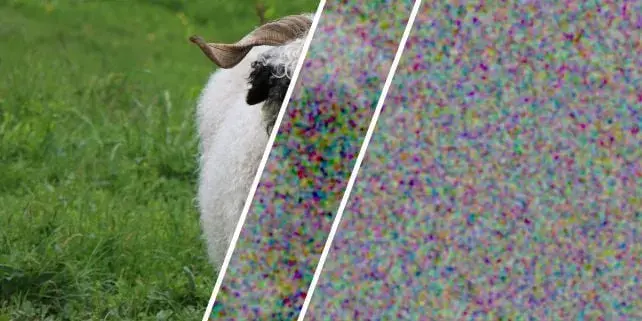
Encrypted image of a sheep
To demonstrate how their randomness was different, the scientists encrypted an image of a sheep. Under ordinary randomness, faint traces of the sheep could still be detected. But under the new perfect randomness, the image completely collapsed into pure, unrecoverable static.
)
)
)
)
)