Large Hadron Collider to restart after three years and hunt for ‘dark matter’


Collider to aid in search of 'Dark matter'
Scientists are hoping that restarting the collider will aid their search for the “dark matter” that exists beyond the observable cosmos.
Dark matter is five time denser as ordinary matter, yet it does not absorb, reflect or emit light.
As of now, the searches have turned up nothing.
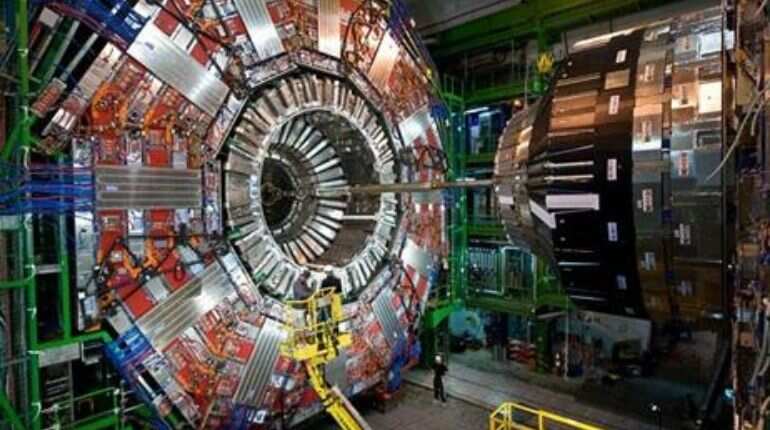
What is a Large Hadron Collider?
The Large Hadron Collider was built to learn more about the Higgs field, including what it is and how it functions. It is the world’s largest most powerful and largest particle accelerator.
It was built by the European Organisation for Nuclear Research (CERN) in collaboration with more than 10,000 scientists and engineers from more than 100 nations and institutions, and laboratories between the year 1998 to 2008.

Restarting the collider a complex procedure
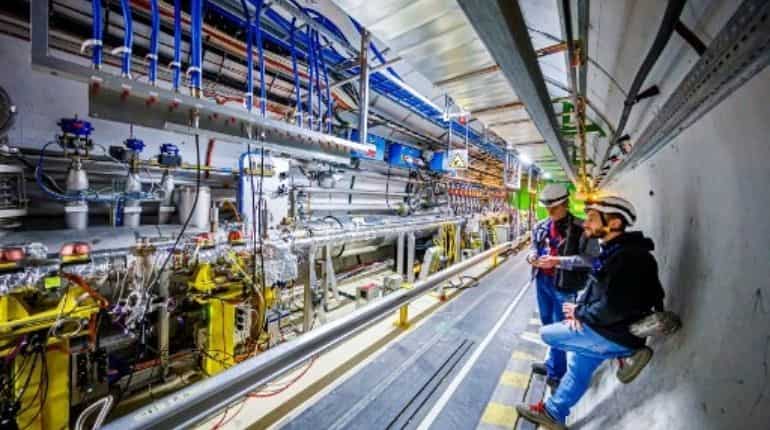
After a closure for maintenance and upgrades was prolonged by COVID-19 delays, the scientists at research centre will restart the 27-kilometre collider. But according to the scientists restarting the collider is a complicated task and researchers said if everything goes well, it’ll be ready to join a row of bottles in the control room commemorating milestone such as the discovery of subatomic particle’s discovery ten years ago.
LHC collisions proved presence of Higgs boson particles
Between the year 2010-2013, a batch of LHC collisions seen at Cern proved the presence of the long-sought Higgs boson particles which together is associated with energy field, is thought to be crucial to the universe’s development following the big bang 13.7 billion years ago. However, there’s a lot to be discovered.
)
)
)
)
)