In pics: Contemporary artists showcase incredible installations at Great Pyramid of Giza

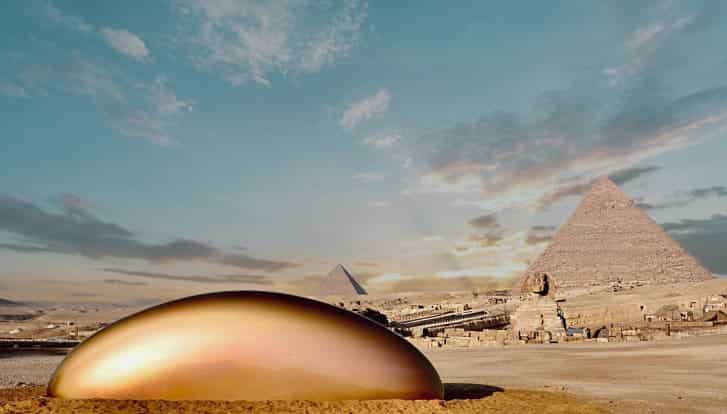
‘Eternity now’
The site-specific installation, Eternity Now, embodies a timeless moment, where past, present, and future merge on the historic 4500-year-old UNESCO site of the Great Pyramids of Giza. The 30-foot-long golden elliptical dome pays tribute to the deep historic legacy of ancient Egypt, known as a birthing site or ‘cradle’ of ancient culture
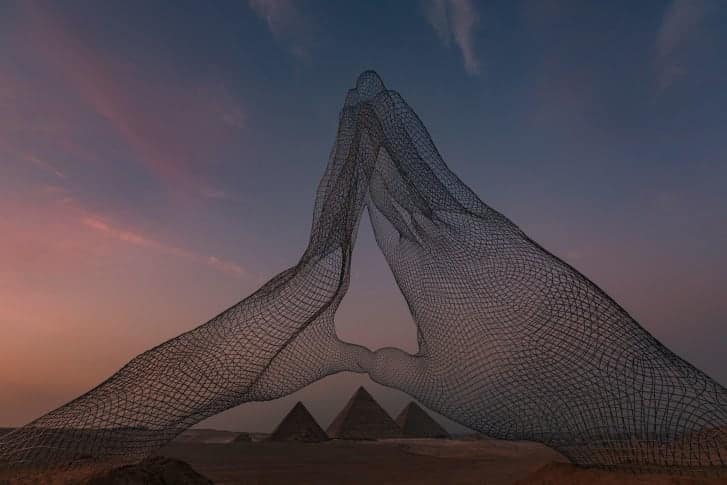
‘Together’
Two wireframe hands touch fingertips in this Lorenzo Quinn's creation
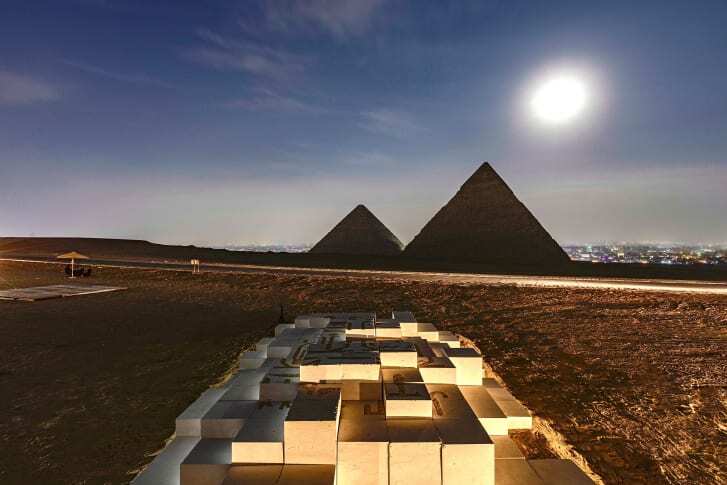
'R III'
A view of Sultan bin Fahad's ‘R III’ before the Pyramids. Saudi archaeologists discovered a hieroglyphic inscription belonging to King Ramses III, one of the kings of ancient Egypt, in the Zaydania area of Tayma Governorate in northern Saudi Arabia. This inscription is the first hieroglyphic inscription found in the Arabian Peninsula; it is on a fixed rock and bears the royal signature. The path to the discovery is marked with cartouches (royal signatures) of King Ramses III, and its presence near Tayma raised the question of civilizational context that could explain a cartouche deep in the northwest of the Arabian Peninsula.
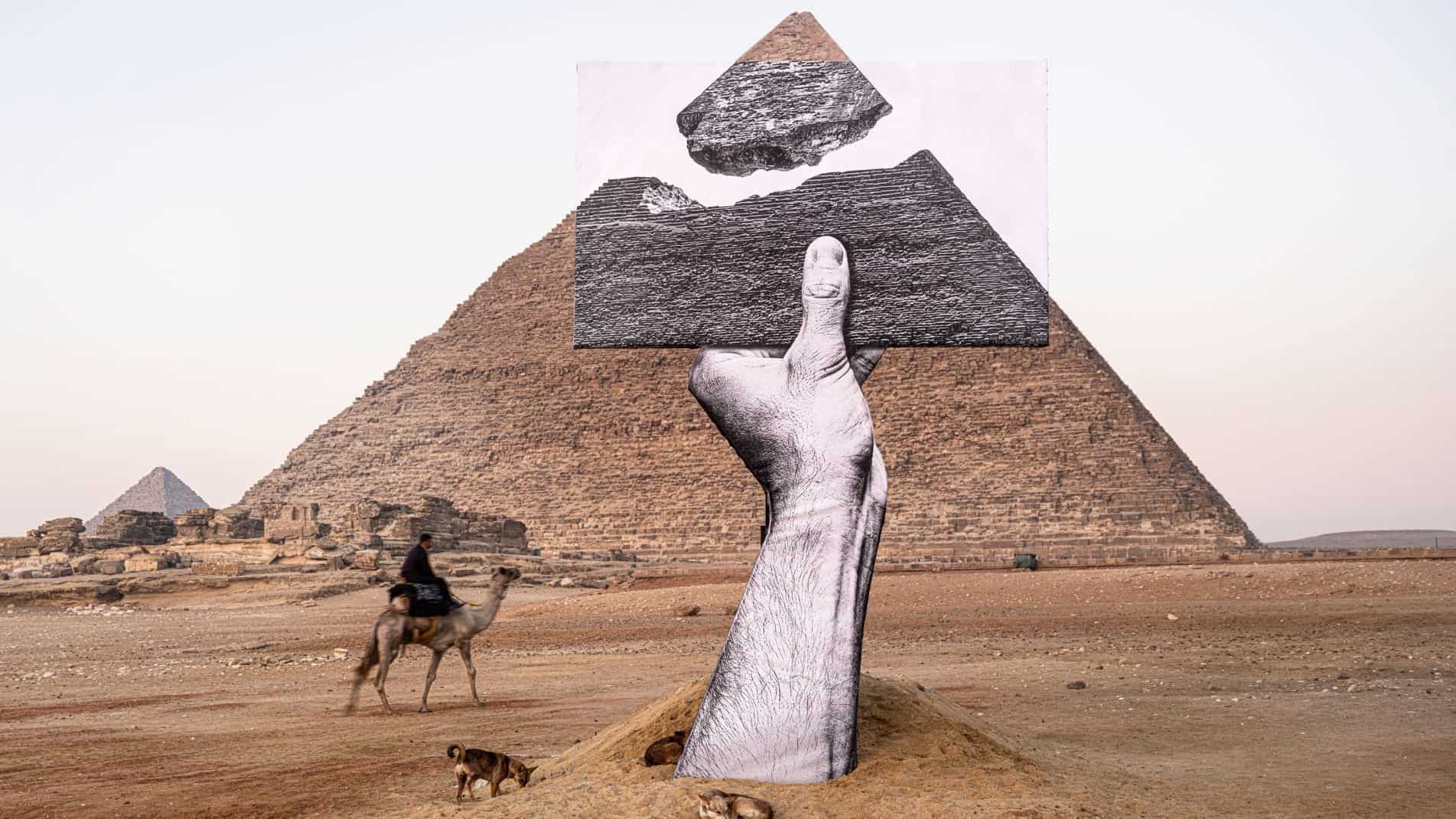
Optical illusion
In his latest optical illusion, the street artist JR has ripped open the top of one of the Great Pyramids of Giza in Cairo, Egypt. He said the exhibition represents a merging of ancient heritage and contemporary art and that he wanted to show the link between Egypt's history and its present that will last forever
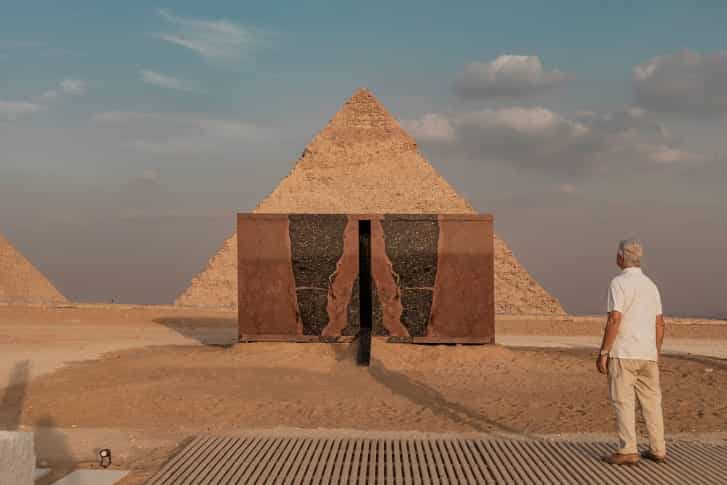
'Interior Space: Khafre'
A spectator views Stephen Cox Ra's "Interior Space: Khafre. He says the for his sculpture was inspired by the Tombs of the Apis Bulls at Saqqara. "These massive monolithic granite boxes fitted in with my ‘minimalist’ aesthetic, however, their power was layered with highly evocative meaning. Contemporary industrial processing enabled me, here in Cairo, to devise a method of producing sarcophagal forms of great size that exhibited the magnificence of Egyptian stone initially from the Eastern Mountains that were the source of rare porphyry and breccia."
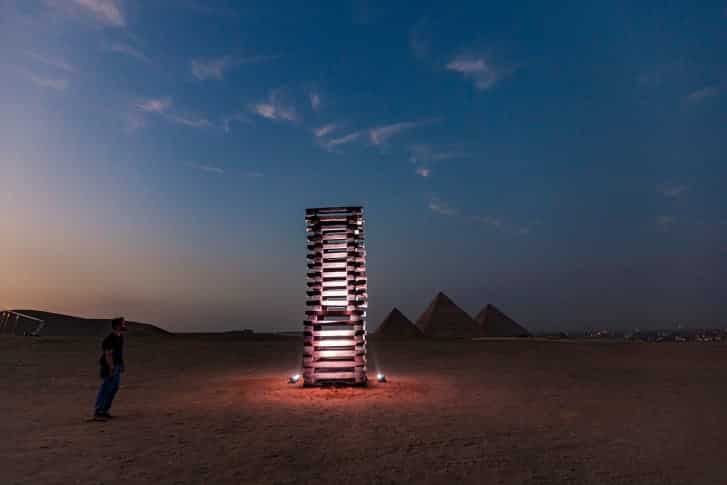
‘Body That Rises’
Body That Rises is a 7m-high sculpture built from 74 wood beams stacked to form a rising, square grid. Sculptor João Trevisan said, ‘The piece is designed for the Giza plateau, and I’d like viewers to imagine that the shape echoes the framework of a large obelisk pointing skyward.’ The project includes a vertically mounted structure that points to the Egyptian sky, a sculpture for viewing on the Giza Plateau in Forever Is Now.
The material used is Trevisan's signature material: wood railroad sleepers, and in doing so, engages Egypt's immediate past — the train tracks laid down in the nineteenth century.
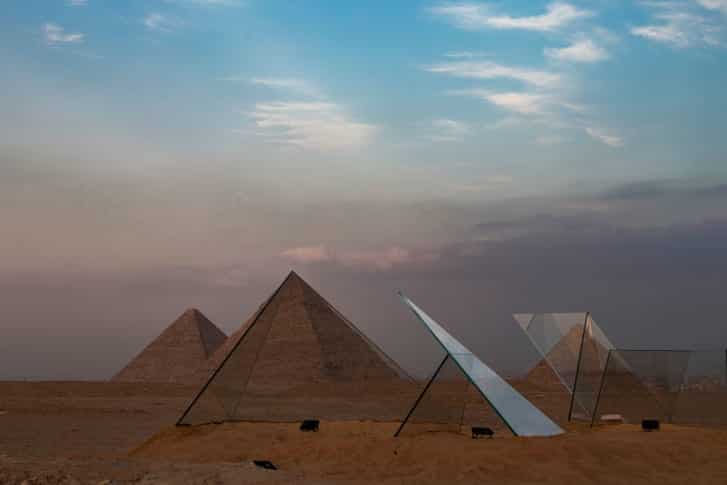
‘Plan of the Path of Light’
The work counterbalances expressions of geometric form and measure that are aligned to celestial points and stellar horizons, creating a kind of optical clockwork that reveals itself in an ever-shifting paradigm of illuminated planes. It interfaces between the viewer and the cosmos, with shapes counterpoised to create glyphic expressions of materiality, balanced on the terrestrial horizon but activated by the path of the sun and stars.
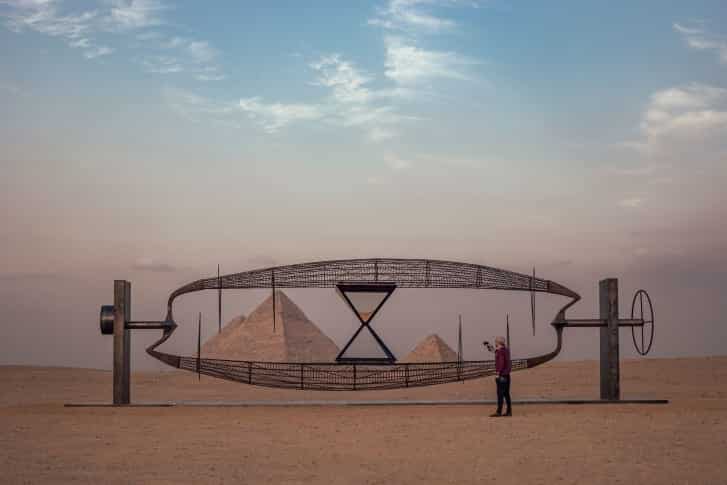
‘Ouroboros’
Named 'Ouroboros', it has been created by Alexander Ponomarev. According to the creator, the pyramids are connected to the cosmos where the globe of the earth flies and where the River Kronos closes in the Okeanos and the serpent Ouroboros consumes its tail!
)
)
)
)
)