How US-built 'Ninja bomb' with 'halo of long blades' destroyed ISIS-K target in Afghanistan


Ninja bomb
The US reportedly deployed the deadly R9X variant of the AGM-114 Hellfire missile from its MQ-9 Reaper drone as it killed two militants in Afghanistan's Nangarhar province in retaliation against the suicide bomb attack carried out by ISIS-K terrorist organisation near Kabul airport on Thursday.
The missiles are also referred to as “Ninja bomb” or “Flying Ginsu”. The missile is reportedly packed with blades which comes out as it hits the target.

R9X variant of the Hellfire missile
Reports claim the “flying Ginsu” helps to cut civilian casualties as the US on Sunday declared there were no civilian casualties during the drone strike in which the militants were killed.
The US had reportedly used the R9X variant of the Hellfire missile in August last year to kill Abu Yahya al-Uzbeki who belonged to the al Qaeda-linked Hurras Al-Din organisation in Syria's Idlib province.
The US has reportedly killed several top terrorists with the R9X variant killing al-Qaeda commander Abu Khayr al-Masri in 2017 including a Taliban commander named “Mohabullah” in Afghanistan two years ago.

'Halo of six long blades'
The bomb is designed to pull 100 pounds of metal directly into a top of a car or a building while keeping civilians out of the target area minimising casualties.
The bomb has different payloads and reportedly has a "halo of six long blades" which is used to target terrorists.
It is also sometimes described as a "meteor full of swords".

US takes out Iran's Qasem Soleimani
The sophisticated hunter-killer MQ-9 Reaper with its deadly hellfire missiles, GBU-12 Paveway II and GBU-38 JDAMs is an all-out modern weapon built for the kill.
The US had used the MQ-9 Reaper during a missile strike at Baghdad International Airport in January last year which killed Iran's former Quds Force commander Qasem Soleimani and Abu Mahdi al-Muhandis, the former commander of Iraqi Forces.

US drone technology
The US military continues to work on its drone technology. The Navy intends to have the Stingray's on its battleships and reportedly plans to buy 72 pieces costing $13 billion.
According to the Pentagon, three MQ-25 aerial refuelling drone's are set to be complete by August 2024.
According to the US Navy, it will integrate the Stingray's on its carriers in 2024 with the high tech drone capable of loading 15,000 pounds of fuel at 500 nautical miles.
(Photo Courtesy: Boeing & Northrop Grumman Corporation)

Pentagon orders MQ-25 Stingray for 2024
On June 4, the US Navy and Boeing created aviation history as MQ-25 T1 successfully extended the hose and drogue from its US Navy-issued aerial refuelling store (ARS) and safely transferred jet fuel to a US Navy F/A-18 Super Hornet, Boeing said.
The MQ-25 Stingray's displayed its ability to carry out its primary aerial refuelling mission - a gamechanger in a combat situation when there is a need for an aircraft to stay in the air as long as possible.

US drone attack
The US has not only used drones for combat missions but also to degrade terrorist targets across the world. The US deploys its drone for a number of tasks.
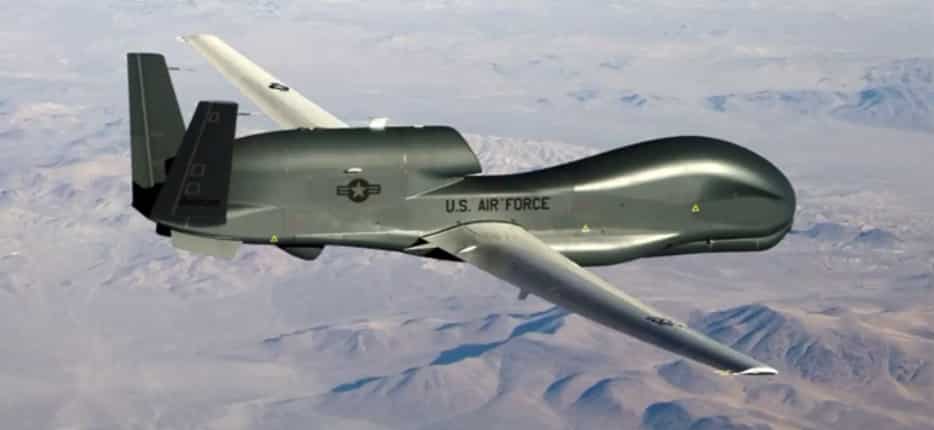
The Global Hawk is considered to be one of the US military's most sophisticated unmanned aircraft.
The drone is made by Northrop Grumman Corp and is used for intelligence gathering over water and coastal areas. It costs around $130 million, according to industry experts.
The RQ-4 Global Hawk is designed to fly at high altitudes of up to 60,000 feet (18 km), according to Northrop Grumman's website.
Commercial passenger aircraft typically fly at altitudes of between 31,000 and 38,000 feet or 9 to 11 km.
Global Hawks
In the early 2000s, both the US Navy and US Air Force began buying Global Hawks.
The Navy in a 2004 statement had said the Air Force bought four Global Hawk aircraft at roughly $360 million.
According to a 2013 news release by Northrop Grumman, the company has since delivered a total of 37 Global Hawks to the US Air Force. The drone can fly for up to 32 hours and has a range of up to 12,300 nautical miles, or 22,780 km.
With a length of 44 feet (13 meters), a wingspan of 116 feet (35 meters), and a gross weight of 25,600 pounds (12 tonnes), the Global Hawk is comparable in size to Lockheed Martin Corp's U-2 reconnaissance aircraft or a small business jet.
The Navy in recent years has been buying MQ-4C Triton drones which has a 130-foot wingspan, slightly larger than the Global Hawk.
The US Navy in March had requested two MQ-4 Tritons and budgeted $473 million for its use.
)
)
)
)
)