China's new warfare mindset: Fujian & drone carriers


China's modern force
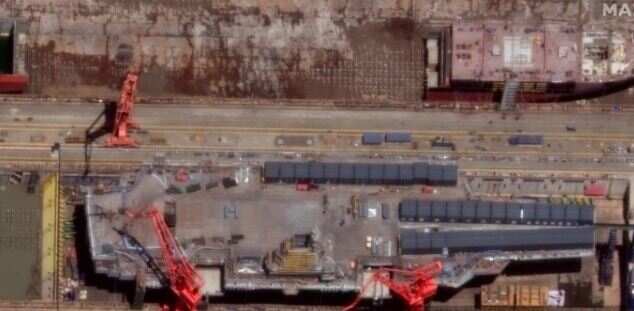
China last week launched its biggest and most modern aircraft carrier, marking a major military advance for the Asian superpower.
The announcement comes at a time of heightened tensions between China and the United States over Beijing's sabrerattling towards Taiwan, which it views as a breakaway province to be seized by force if necessary.
China's carrier development programme is part of a massive overhaul of the People's Liberation Army under President Xi Jinping, who has vowed to build a "fully modern" force to rival the US military by 2027.
The new carrier, named Fujian, is the "first catapult aircraft carrier wholly designed and built by China", said state broadcaster CCTV.
It will take years before the Fujian becomes operational, however. Authorities have not said when it will enter service. The Liaoning was commissioned in 2012, and the Shandong entered service in 2019.
The Shandong was the first aircraft carrier entirely built by China.

Fujian uses conventional propulsion
The United States has by far the most aircraft carriers in service at 11 ships, followed by China and Britain at two each, according to defence magazine Janes.
Unlike the US Navy's nuclear-powered supercarriers, the Fujian uses conventional propulsion. Nuclear vessels have significant advantages over conventional ships as they can operate for long periods without the need to dock and refuel.
The launch of the carrier comes at a time of ramped-up geopolitical tensions as Washington looks to shore up military alliances in the Asia-Pacific region.
Last year, the United States secured a historic deal with Britain to share nuclear submarine technology with Australia and has since made multiple arms sales to self-ruled Taiwan, provoking angry responses from Beijing.
China's Solomon gamble
China brokered an unprecedented security agreement with the Solomon Islands earlier this year which blindsided Washington and its allies, stoking fears of a Chinese military base in the Pacific.
In recent years, Beijing has deployed naval assets as a show of power in the strait that separates Taiwan from the Chinese mainland.
It has also used fighter jets to repel freedom of navigation patrols by the United States and its allies.
China's newly unveiled drone carrier
Chinese defence minister Wei Fenghe last week warned his US counterpart that Beijing would "not hesitate to start a war, no matter the cost" if Taiwan declared independence.
State media reported that the PLA's newest aircraft carrier is named after China's Fujian province -- which lies across from Taiwan.
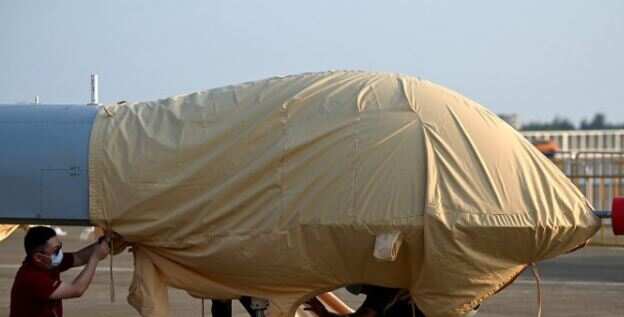
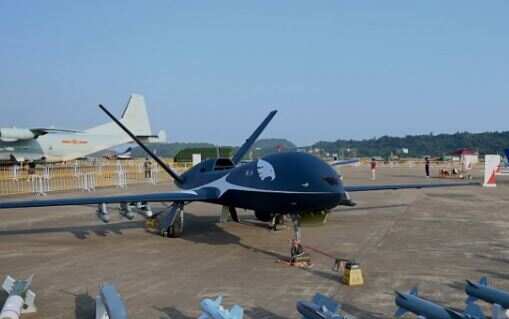
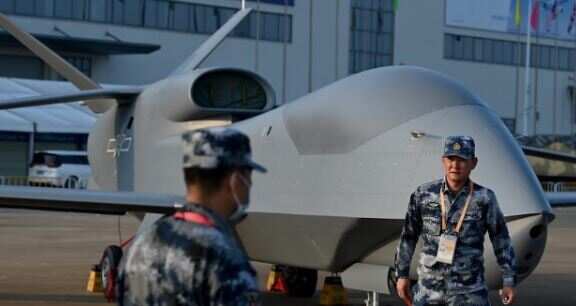
China has continued to ramp up its navy as it continues to eye a greater role in international waters, China's newly unveiled drone carrier is a clear sign Beijing is rushing to deploy an autonomous swarm of unmanned devices in its push for military supremacy in the Pacific Ocean.
State media last month showed the launching of the Zhu Hai Yun -- "Zhu Hai Cloud" -- capable of transporting an unspecified number of flying drones as well as surface and submarine craft, and operating autonomously thanks to artificial intelligence.
China eyes Pacific with drone squardons
The 292-foot ship would be operational by year-end with a top speed of 18 knots, vastly increasing China's surveillance potential of the vast Pacific area it considers its zone of influence.
Armies worldwide see drone squadrons as key players in combat, able to overwhelm defence systems by sheer numbers and without putting soldiers' lives at risk, such as with more expensive jets or tanks.
Even if the vessel's actual capabilities remain to be seen, Beijing is broadcasting its intent to cement territorial claims in the region, as seen with the security partnership agreed last month with the Solomon Islands northeast of Australia.
China's anti-access and area denial in Pacific
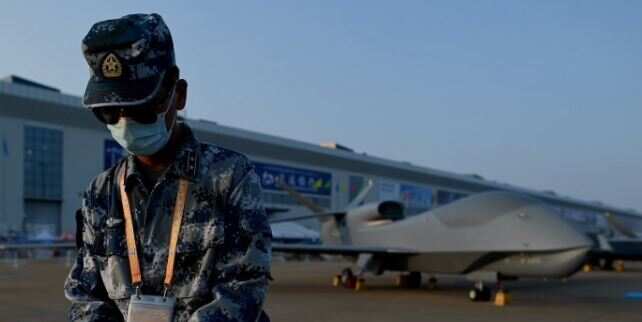
Building fleets of autonomous and relatively inexpensive drones would greatly augment China's ability to enforce so-called anti-access and area denial (A2-AD) in the Pacific, with the aim of weakening decades of US influence.
Unlike traditional aircraft carriers or destroyers carrying hundreds of troops, the drone carrier could itself navigate for longer periods while sending out devices that create a surveillance "net," potentially able to fire missiles as well.
The Zhu Hai Yun could also improve China's mapping of the seafloor, providing a covert advantage for its submarines.
China's drone swarm experiment
Beijing has made no secret of its desire to wrest control of Taiwan, and military experts say it is closely watching the West's response to the Russian invasion of Ukraine to gauge how and when it might make its move.
Last month, Chinese researchers published a drone swarm experiment allegedly showing 10 devices autonomously navigating a dense patch of bamboo forest, without crashing into the trees or each other.

Profound shift in modern warfare
Noting this profound shift in modern warfare, a RAND Corporation study from 2020 found that while unmanned vehicles need significant improvements in onboard processing, "the overall computing capability required will be modest by modern standards -- certainly less than that of a contemporary smartphone."
"A squadron of approximately 900 personnel, properly equipped and trained, could launch and recover 300 L-CAATs every six hours, for a total of 1,200 sorties per day," it said, referring to low-cost attributable aircraft technology -- meaning devices so cheap an army can afford to lose them.
"We do have indications that China is making rapid capabilities development," Lushenko said of Beijing's new drone carrier.
"What we lack is empirical data to suggest that China's one-party state can actually employ the ship in an integrated fashion in conflict."
)
)
)
)
)